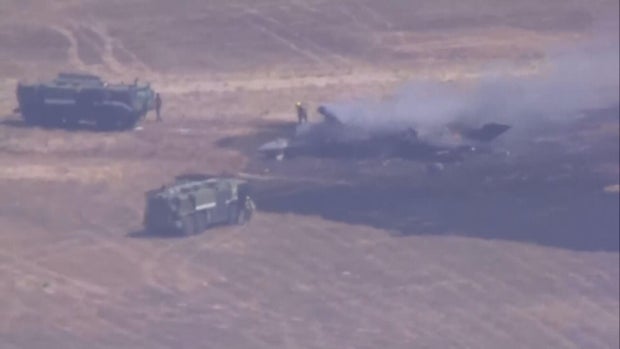

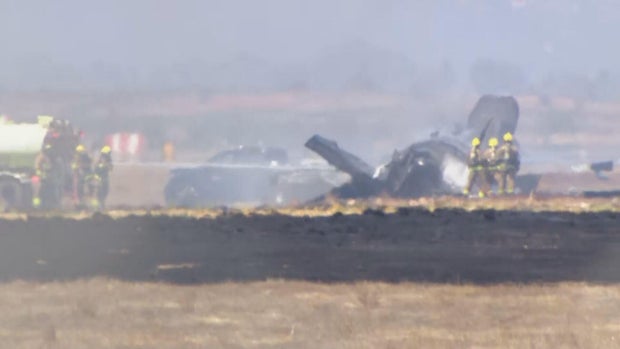
SAN DIEGO – A Marine Corps F-35B fighter jet split apart and ignited a brush fire at Marine Corps Air Station Miramar on Friday morning after the pilot ejected from what the Corps described only as an incident still under investigation. The pilot landed in stable condition with injuries that were not life-threatening, according to a Marine Corps statement.
The crash occurred at approximately 10 a.m. local time and set fire to a parcel of scrubland north of State Route 52 roughly the size of a football field. Aerial footage showed the aircraft in two pieces, with black smoke lifting across the freeway as emergency vehicles ringed the site. San Diego Fire-Rescue Department crews responded but ceded jurisdiction to the military, which began its own investigation. The fire was extinguished using retardant. CBS News reported the pilot was transported to a local medical facility for evaluation.
The pilot, who has not been identified, was assigned to Marine Aircraft Group 11, 3rd Marine Aircraft Wing, one of the principal fixed-wing aviation units in the United States Marine Corps. The F-35B variant involved in Friday’s crash is the short takeoff and vertical landing configuration of Lockheed Martin’s fifth-generation fighter, designed specifically for Marine Corps operations from amphibious assault ships and forward-deployed bases where conventional runways are absent or contested. At roughly $100 million per aircraft, the loss represents a significant monetary cost to a program that has accumulated approximately $1.6 trillion in lifetime costs across all three variants.
Marine Corps spokesperson 1st Lt. Blake Starbuck said he had no immediate information regarding the aircraft’s flight purpose, whether it was arriving or departing, or whether it was on a training mission. Fox News reported the cause of the crash remains under investigation.
The Miramar crash continues a troubled pattern for the F-35 program that predates the current investigation by nearly two years. In July 2025, an F-35 pilot ejected safely over Fresno County, California, after an in-flight emergency ignited a grass fire. Six months earlier, in January 2025, an Air Force F-35 at Eielson Air Force Base in Alaska tumbled and exploded on impact during a training mission, with the pilot managing to eject in time. And in 2024, a Marine Corps F-35 pilot ejected during a rainstorm over South Carolina; the aircraft flew on unmanned for more than eleven minutes, covering seventy miles before crashing on private land. The investigation into that incident concluded the pilot had acted improperly by ejecting.
What those four incidents share, beyond the immediate drama of ejecting pilots and burning aircraft, is an absence of systemic accountability for a program that costs more than the gross domestic product of most countries. Lockheed Martin has attributed individual incidents to operational or maintenance factors rather than design flaws. The Marine Corps pointed to pilot error in the 2024 South Carolina crash. Neither characterization addresses the accumulating loss rate.
The Pentagon added its own layer of institutional opacity to the problem last month when it classified the Government Accountability Office’s annual F-35 review for the first time since 2005, pulling the document from public access and ending two decades of independent congressional oversight of a program whose cost overruns, software deficiencies, and readiness problems had been documented year after year by GAO auditors. What the 2026 review contained that prior years’ reports did not has not been explained.
Friday’s crash will trigger what the Marine Corps calls a formal Aircraft Mishap Board investigation, a process that can take months and whose findings may or may not be made public. Past investigations into F-35 incidents have produced formal reports of varying detail; the 2024 South Carolina crash produced a Board of Inquiry finding that faulted the pilot, a finding the Marine Corps stood behind publicly even as aviation safety advocates questioned whether it placed too much responsibility on individuals within a broader systems environment.
The 3rd Marine Aircraft Wing, to which Marine Aircraft Group 11 belongs, provides fixed-wing aviation support across the Western Pacific and Indo-Pacific region. It operates from Miramar as its principal continental United States base, with forward-deployed elements distributed across air stations in Japan and Hawaii. The loss of an F-35B at Miramar comes at a moment of elevated operational demand for Marine aviation assets supporting the ongoing US military campaign against Iran.
Miramar has its own recent history of aviation incidents. In 2023, Marine Corps Maj. Andrew Mettler died after ejecting from an F/A-18 Hornet during training operations near the same installation. The back-to-back losses at one of the Marine Corps’ primary fixed-wing air stations point to pressures on pilots and aircraft that extend beyond any single mishap.
The F-35B is now the Marine Corps’ cornerstone platform for forward air operations. The Corps retired its AV-8B Harrier fleet and its legacy fighter inventory in favor of the F-35, concentrating an increasing share of its fixed-wing capability in an aircraft that has not completed its full operational test and evaluation program even as units have deployed operationally. That concentration of risk in a single platform, paired with reduced program transparency and four aircraft losses in two years, sits behind the more immediate question of what failed over Miramar on Friday morning. The pilot’s condition was described as stable.