
ISLAMABAD – Nadhira Al Harthy had become the first Omani woman to reach the summit of Everest and the first to complete K2. She held a master’s degree in geography. She had, by any account available to the mountaineering world before Saturday, done the hardest things her sport demanded and survived them.
She died on Broad Peak.
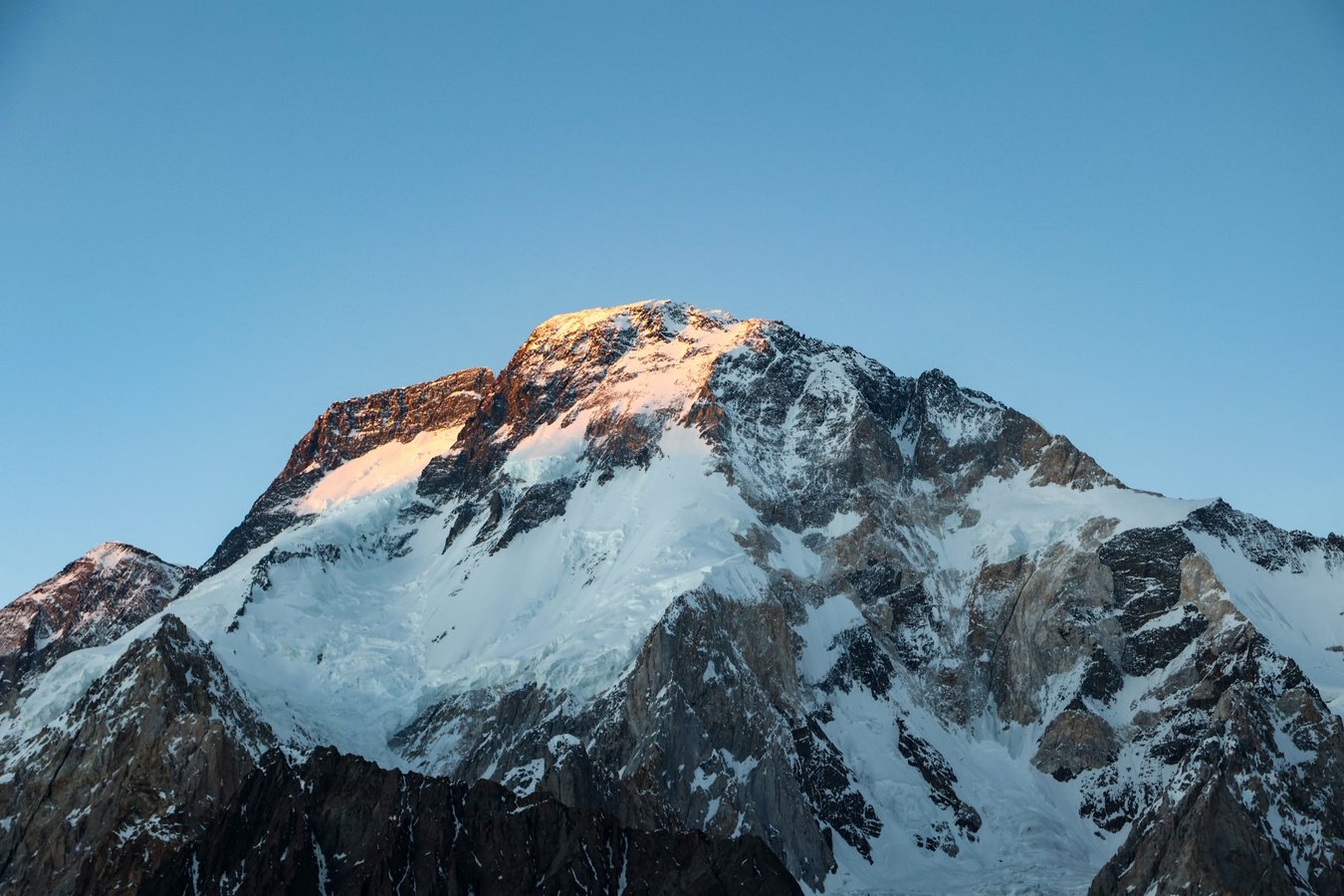
The confirmation came in stages. On Thursday, an avalanche swept ten climbers from a descent route on the 8,051-meter peak, which sits on the China-Pakistan border roughly ten kilometers from K2. By Saturday, Elite Exped, the expedition company run by Nirmal Purja, issued a statement: “Today it is with profound sadness and immense heartbreak that we confirm that Nirmal ‘Nimsdai’ Purja tragically lost his life following the avalanche on Broad Peak.” Purja’s death, the statement’s central fact, also confirmed what the rescue timeline had already suggested about the rest of the team.
Pakistani rescuers recovered three bodies from the mountain by Friday. They were Al Harthy; Pur Bahadur Gurung, a Nepali high-altitude porter who had summited Everest ten times and held a speed record on K2; and Mallory Geis, 39, of San Antonio, Texas, who was attempting her first peak above 8,000 meters. A fourth body, believed to be Purja’s, had been located on the mountain but not yet physically retrieved as of Saturday. Six team members’ remains had not been found.
Nepal’s Prime Minister, Balendra Shah, responded in a statement: “The physical journey of all the deceased climbers has been interrupted, but the history of their courage will always remain inspiring.” The deaths carried the weight appropriate to that language. Gurung’s ten Everest summits placed him in a professional category that most climbers never approach. Al Harthy’s ascents of both Everest and K2 had made her the most accomplished high-altitude mountaineer the Gulf state had produced.
The ten climbers came from five countries. In addition to Purja, Gurung, Al Harthy, and Geis, the team included four more Nepali climbers, a Pakistani national named Sohail Sakhi, and a Chinese climber identified as Wang. Their expedition to Broad Peak formed part of a climbing season in Pakistan’s Gilgit-Baltistan region, which hosts five of the world’s fourteen peaks above 8,000 meters and draws international teams between June and August each year.
Nirmal Purja’s public profile derived from a specific record. In 2019, he climbed all fourteen peaks above 8,000 meters in 189 days, shattering a previous mark by more than six years. The Netflix documentary “14 Peaks: Nothing Is Impossible,” released in 2021, brought that achievement to a mass audience extending far beyond the specialist mountaineering community. Before climbing professionally, Purja had served with the British Special Boat Service, the naval counterpart to the SAS. He was 43.
The Netflix exposure created a particular distortion. Audiences familiar with Purja through the documentary absorbed his record as evidence of near-invulnerability, not as a demonstration of precision risk management in conditions where no preparation eliminates the margin of failure. That distortion was not limited to lay audiences. His commercial expeditions, run under Elite Exped’s brand, carried the implicit reassurance of his survival record. Broad Peak had been one of the fourteen peaks he climbed in those 189 days. He died returning to one of them.
Avalanche risk peaks during descent from high-altitude summits, when climbers are fatigued and moving on slopes already traversed, and when afternoon temperatures shift the stability of snow and ice loaded overnight. The specific trigger for Thursday’s event on Broad Peak had not been identified in Pakistani official statements as of Saturday. The search area was described in rescue communications as remote and technically difficult, with helicopter operations repeatedly suspended by high winds.
Pakistani Army aviation units have extensive operational history in the Karakoram, developed across decades of military activity near the China border and expanded through experience with mountaineering rescues. At these altitudes, their effectiveness depends on narrow temperature and wind windows that rarely coincide with conditions following a large avalanche. Ground teams working from base camp face multi-day ascents under conditions that may have worsened since the initial event.
Al Harthy’s death carries a particular resonance for Gulf Arab mountaineering. Her 2019 Everest summit expanded what the Omani public understood as accessible to its own climbers, and her subsequent K2 ascent confirmed that the first achievement had not been anomalous. She was the kind of mountaineer whose accomplishments created permission for others who had not yet attempted them. Pakistan’s own high-altitude tradition has expanded in similar ways: Pakistani mountaineer Naila Kiani’s Everest summit in 2023 arrived at precisely the moment international teams were arriving in Pakistan in greater numbers.
Mallory Geis had traveled from San Antonio to attempt something most climbers spend years approaching. First expeditions to 8,000-meter peaks involve a steep acclimatization curve and a risk profile that differs from what experience at lower altitudes teaches. The Karakoram’s technical demands are not fully preparable for in other ranges. Her death on a first attempt places her in a different category from the expedition’s veterans, but not a separate risk environment. Broad Peak does not distinguish.
The families of the deceased were being notified through their national governments and through Elite Exped. The circumstances of the avalanche and the status of the six team members whose bodies had not yet been located remained unresolved. Pakistani officials confirmed search and recovery operations would continue through the weekend subject to weather. Al Jazeera reported on the recovery of three bodies and Elite Exped’s confirmation of Purja’s death, while initial reporting on the Broad Peak avalanche had left the expedition’s fate uncertain. What Saturday’s statement established, in the precise language of institutional grief, was that the uncertainty was over.