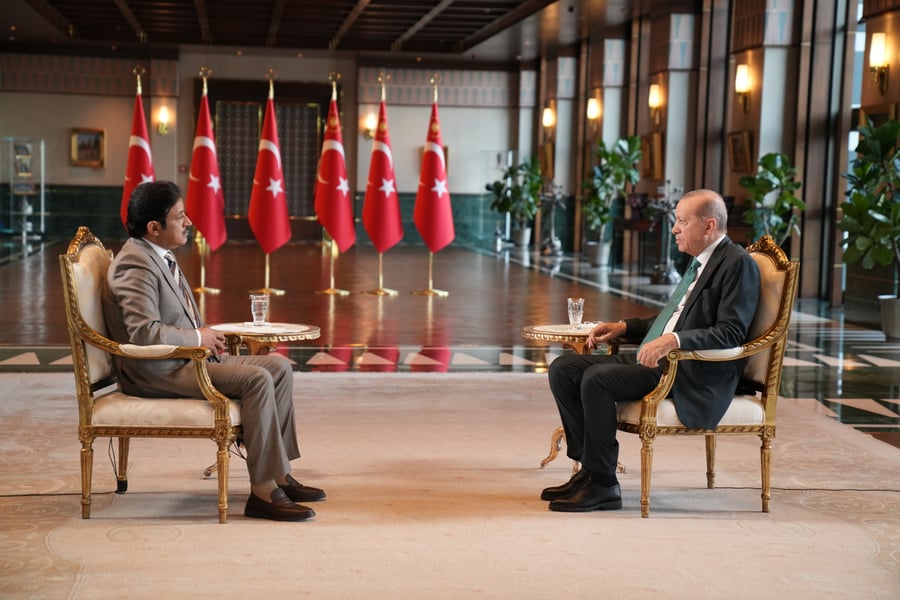

ANKARA — Recep Tayyip Erdogan did not withdraw Turkey’s application to join the European Union on Saturday. The file remains open in Brussels, where it has sat since the bloc recognised Ankara as a candidate in 1999. What the Turkish president did was quieter and considerably harder for Brussels to answer. He said that getting in is no longer something Turkey is especially trying to do.
Speaking to Al Jazeera’s Ali Al Dafiri for the Arabic-language programme Al Muqabala, Erdogan said Europe apparently does not want Turkey inside the union, that membership is not a priority for Ankara, and that it is Europe rather than Turkey that loses by keeping the door shut. Europe, in the network’s English account of the interview, would be “the loser.”
That formulation is new, and the timing is the story. Six weeks ago the European Union sent three of its most senior officials to Ankara to explain how badly it needs Turkey. Two weeks after that, the Council published a strategic assessment that Ankara read as a dismissal. Saturday’s remark closes the sequence, and it is the first time Erdogan has publicly demoted accession from a declared national objective to something he can take or leave.
The document at the centre of it carries the title “Common Understanding: The Threats and Challenges We Face, Assessment of the EU’s Strategic Environment,” published on July 15. It handles Turkey not as a candidate for membership but inside a section on the eastern Mediterranean, where it says a mutually beneficial relationship with Ankara remains in the union’s strategic interest and should advance in a manner it describes as phased, proportionate and reversible. Reversible is the word Turkish officials fixed on. Two days later the Foreign Ministry spokesperson Oncu Keceli said the references to Turkiye were “devoid of a strategic and fair approach”, that the document ignored Turkey’s candidate status altogether, and that it revealed a failure to develop any vision of a shared future. On Cyprus and the eastern Mediterranean, Keceli called the assessment’s allegations baseless.
Set that against what the same institutions were saying at the end of June. Kaja Kallas, the union’s foreign policy chief, travelled to Ankara on June 30 alongside enlargement commissioner Marta Kos and migration commissioner Magnus Brunner. Kallas called Turkey a key partner on security, migration and energy as well as an EU candidate country, and credited it with a significant contribution to protecting NATO’s eastern flank, Euronews reported. Kos, on the same visit, said the union expects a candidate country to meet the highest standards of democracy, rule of law and human rights. Both sentences are true and they do not fit together, which is roughly where the relationship has sat since accession talks froze in 2018.

What makes Saturday different from the many previous occasions on which Erdogan has complained about Brussels is that he used to keep the objective intact while complaining. In December 2024, standing beside European Commission President Ursula von der Leyen, he called full membership a strategic goal for Turkiye and argued that accession would be a contribution to the union as much as to his own country. That sentence and Saturday’s do not sit together, and nothing in the intervening twenty months changed Turkey’s formal position in the queue. What changed is what Ankara now has outside it.
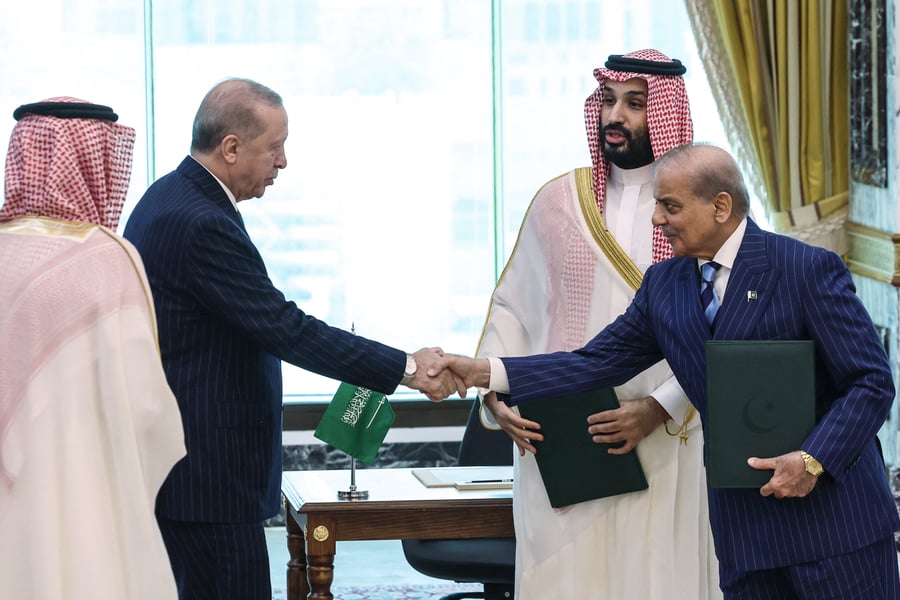
In Mecca on August 7, Erdogan signed a joint defence agreement with Saudi Crown Prince Mohammed bin Salman and Pakistan’s Prime Minister Shehbaz Sharif under which an armed attack on any one of the three is to be treated as an attack on all. In the same Al Jazeera interview he said Egypt’s accession to that pact is possible and that the arrangement stays open to further members. Analysts have compared the clause to NATO’s Article 5, a comparison officials in Islamabad have been careful to discourage.
None of this is a substitute for EU membership, and Erdogan has not claimed it is. Turkey’s customs union with the bloc, its 2016 migration arrangement, and the fact that the union remains its largest trading partner all still run through Brussels, and they bind Ankara whatever the president says about priorities. The demotion is rhetorical. Its cost, so far, is borne entirely by the proposition that the accession process is going anywhere.
What the interview does not settle is whether Ankara intends to do anything formal about it. Erdogan did not say he would withdraw the application, set a deadline, or ask the Council to close the file, and Turkish officials have given no indication that any of that is being weighed. The European Commission and the Council had made no public response by Saturday evening. The full interview had not yet aired either. Al Jazeera Arabic scheduled it for Sunday, which means the passage on Europe reached the public as a summary before it reached anyone as a transcript.
The application, meanwhile, stays where it is. Nobody in Brussels has to do anything about it, and after Saturday nobody in Ankara is asking them to.