MAUMERE, Indonesia — Yulian Juita Ekalia had just stepped outside her apartment in Ruteng city when the ground shifted beneath her in a way she had never experienced. “It felt like we were on a trampoline,” the 37-year-old university lecturer said. “It was really scary.”
The trembling lasted long enough that by the time it stopped, at least 47 people across Flores Island were dead.
A 7.7-magnitude earthquake struck off the north coast of Flores at 6:56 am local time on Saturday, with its epicentre in shallow waters just offshore. Suharyanto, the head of Indonesia’s National Disaster Mitigation Agency, said rescue teams had confirmed 47 deaths and 13 injuries by Saturday evening, but cautioned the figure was preliminary. “Victims are trapped in several buildings,” he said. “These will be the initial targets of the disaster response teams.”
Landslides triggered by the quake blocked roads across the mountainous island, cutting off rural communities from the outside world. Two helicopters and a fixed-wing aircraft were readied for aerial surveys, but continuing aftershocks, the strongest measuring 6.1, complicated flight operations. Approximately 2,000 residents had evacuated to higher ground after witnesses noticed the sea retreating from the shoreline, a warning sign associated with incoming tsunami waves. Authorities lifted the tsunami alert within hours after monitoring stations showed no dangerous waves forming.
Yohanes Babo, a 56-year-old resident of Nagekeo, described the chaos as the shaking intensified. “The shaking was strong,” he said. “People were panicking, running here and there.”
Rescue official Fathur Rahman said teams were prioritising the search for anyone still buried under rubble, but the extent of building collapse remained unclear. Hundreds of houses and structures across the rural island sustained damage. Communication links to some communities were disrupted, and the disaster agency acknowledged that helicopter missions would be needed to establish even a preliminary picture of conditions in the hardest-hit areas.
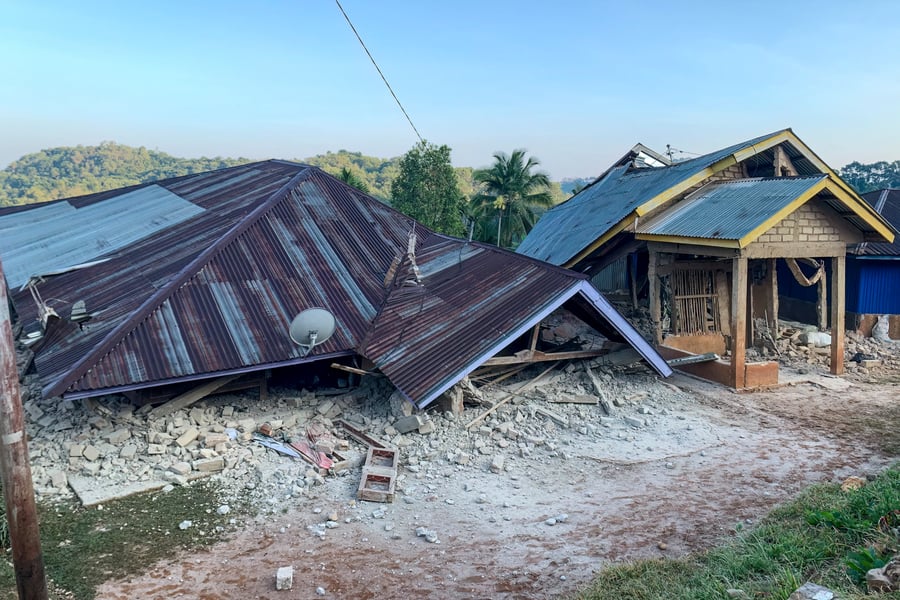
Flores Island sits within one of the most seismically volatile stretches of the Pacific Ring of Fire. The island was struck by a 7.8-magnitude earthquake in December 1992 that killed more than 2,000 people, one of the deadliest natural disasters in modern Indonesian history. Saturday’s 7.7-magnitude quake ranked among the most powerful to strike the region since then. The island’s mountainous terrain, sparse road network, and limited communications infrastructure routinely turn search and rescue operations into extended affairs measured in days rather than hours.
The European Union moved quickly to offer satellite monitoring. European Commission President Ursula von der Leyen confirmed that the Copernicus Earth observation network was available to support rescue efforts. “Indonesia, we stand with you,” she said. The system produces rapid mapping of ground deformation and building collapse, helping coordinators determine which areas to prioritise before ground teams have physically reached them.
Indonesia’s position on the convergence of the Eurasian, Indo-Australian and Pacific tectonic plates means the country experiences several hundred notable seismic events every year. Shallow offshore earthquakes like Saturday’s tend to produce the most destructive ground shaking because seismic energy travels a shorter distance before reaching populated areas. That combination of shallow depth and offshore epicentre gave the Flores quake its unusual force at the surface.
Emergency responders from across eastern Indonesia were mobilised Saturday afternoon while the national government in Jakarta placed relief supplies on standby. Indonesia’s disaster management system has expanded considerably since the 2004 Indian Ocean tsunami, which killed more than 100,000 people in Aceh province. The country established a dedicated national disaster agency in 2008 and updated its early warning networks after the deadly 2018 Sulawesi earthquake and tsunami, investing in the coastal monitoring infrastructure now active along Flores’ shoreline. The practical limits of those systems become apparent whenever a major quake strikes a remote island, where ground access depends on roads that aftershocks can sever in minutes.
TRT World reported that search and rescue teams had already shifted from general disaster surveys to targeted operations focused on locating individuals known or believed to be trapped in specific collapsed structures. A second helicopter unit was deployed Saturday afternoon to assist with aerial reconnaissance across the most isolated sections of the island.
In a region where geopolitical tensions already run high, from Japan’s contested visits to the Yasukuni shrine to competing US and Chinese influence across the Pacific, Saturday’s earthquake on Flores was a reminder of the human dimensions of life in Asia that exist apart from great-power competition. Earthquakes do not negotiate. They leave behind debris and missing people and the slow, laborious work of counting both.
What remained unknown as of Saturday evening was how far the damage extended beyond the areas already reached by rescue teams, and how many people in cut-off communities had not yet been accounted for. The death toll of 47 was expected to rise.