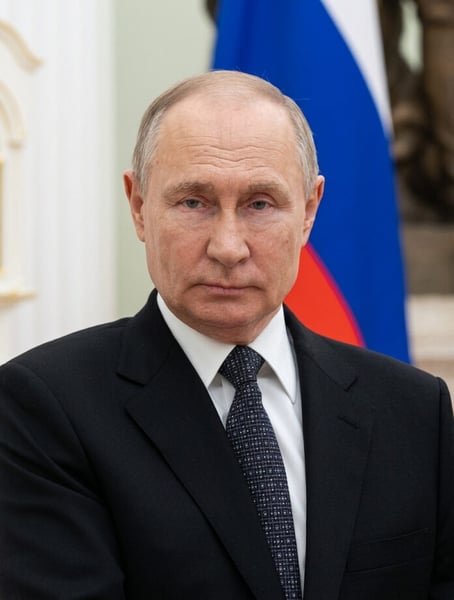

YEREVAN — Asked on Thursday whether he ruled out building a conventional nuclear power plant, Nikol Pashinyan gave a two-word answer. He does not. What made the question worth asking is that Armenia had spent two years insisting its nuclear future was small.
The prime minister told a briefing that the country needs to calculate the growth rate of what he called artificial intelligence factories against the growth rate of its generating capacity, and compare the two. Armenia must supply electricity domestically, he said, while also pursuing exports, which he described as a very promising direction. The logic had changed, he added: the plan was once to export most of what the country produced, and now it is clear that a great deal will be needed at home.
That sentence is the news, and the reason for it is already under construction. Armenia is building an artificial intelligence data centre with the American company Firebird, a 300 megawatt facility that entered a second phase worth $4bn and 50,000 GPUs, backed by a $300m syndicated loan signed in March, the first Armenian financing of that kind for a technology megaproject. A memorandum on semiconductors and artificial intelligence signed with Washington on August 8 underpins it.
Set 300 megawatts against the Armenian grid and the arithmetic explains the prime minister’s answer. The country’s single nuclear plant at Metsamor runs one Soviet-designed VVER-440 with a gross capacity of roughly 407 megawatts, and it supplies somewhere between 30 and 40 percent of national electricity. One data centre at full draw is on the order of three quarters of what the reactor produces. That ratio is why the artificial intelligence build-out has begun running into organised local resistance over power and water in the United States, on a grid vastly larger than Armenia’s.
Metsamor is also the part of this that Moscow built. The plant was shut after the 1988 Spitak earthquake, its second unit restarted in 1995, and its modernisation was completed in 2021 with Rosatom. Its life is in the process of being extended to 2036, and Pashinyan said in February that operation might then run another decade, to 2046, Interfax reported. The reactor keeping the lights on is Russian, serviced by a Russian state company, on a Russian-supported extension, and the prime minister now shopping for its replacement was scheduled to meet Mikhail Mishustin in Yekaterinburg in July.

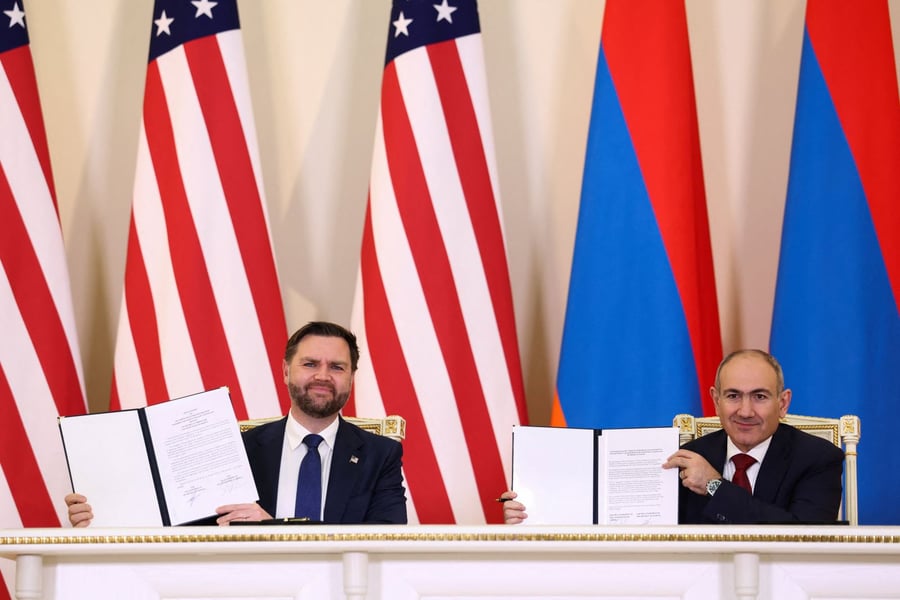
The replacement is being shopped elsewhere. Armenia signed a Section 123 agreement with the United States, joining roughly fifty countries American firms may share civil nuclear technology with, and Vice President JD Vance said it concerned small modular reactors, Al Jazeera reported at the signing in February. Pashinyan has separately said Armenia intends to work with the International Atomic Energy Agency and outside partners on replacing the existing unit, according to Interfax, with proposals from Russia, the United States, France, China and South Korea under evaluation and a decision expected in 2026 or 2027.
So the country is being asked to power an American artificial intelligence project with a Russian reactor while choosing that reactor’s successor from a list that includes both governments. Pashinyan did not put it that way. He said Armenia needs to be flexible and understand which direction to take, which is the same thought expressed as a preference.
A conventional plant would change the terms of that choice rather than settle it. Small modular reactors are unbuilt at commercial scale almost everywhere, and a country choosing one is buying a schedule as much as a technology. A full-size unit is a known quantity with a known price, and very few of the vendors capable of delivering one are politically neutral from Yerevan’s position.
Pashinyan also pointed to solar, saying Armenia has the resource and the sector needs developing. It is the least contentious thing he said and the least likely to satisfy a data centre, which draws continuously and does not accommodate dusk.
Several things were not addressed. The prime minister gave no cost estimate, no candidate site and no timeline for a conventional plant, and did not say whether it would replace Metsamor or run alongside it. Nothing has been published on whether the extension to 2046 rests on completed engineering assessment or on intention. Metsamor sits in a seismically active zone about 36 kilometres from Yerevan and 16 from the Turkish border, lacks a secondary containment structure, and has drawn objections from the European Union and neighbouring states for years, none of which the briefing touched. And it remains unclear how firm Firebird’s 300 megawatt requirement is, or what Armenia has undertaken to supply it.
What is clear is the sequence. The electricity question follows the artificial intelligence question, and both of them now run through Washington.