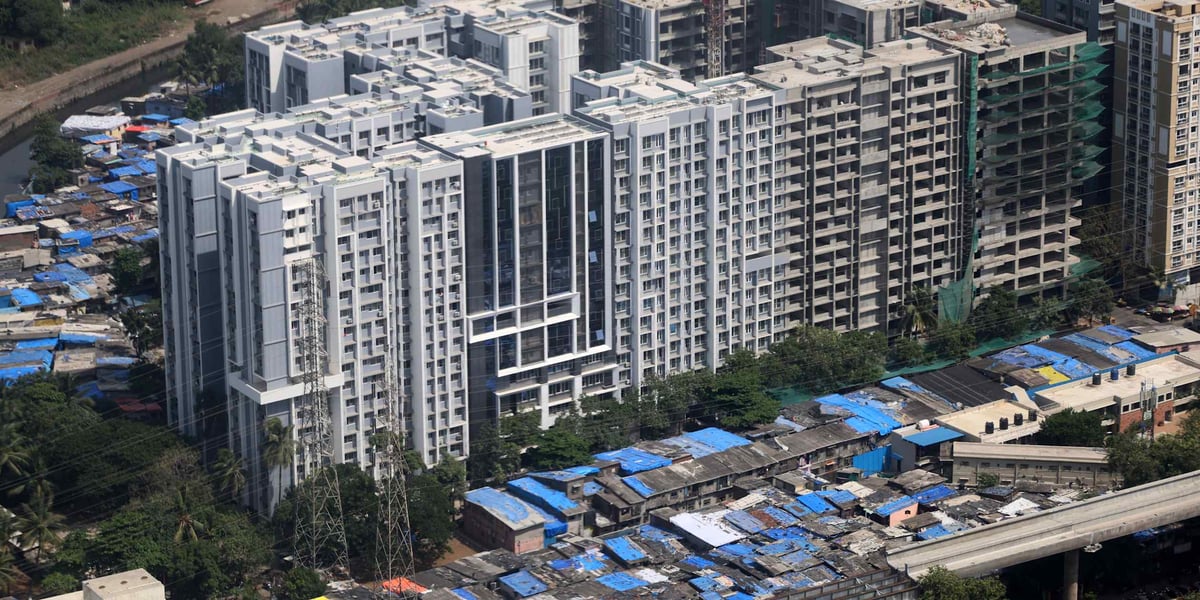

MUMBAI — For India’s homebuilders, the arithmetic of Jackson Hole arrived weeks ahead of Diwali. The Federal Reserve’s clearest signal yet of a September rate cut has redrawn the market for Indian property buyers, and developers from DLF to Prestige Estates are entering a festive sales window that could prove the strongest in three years.
The Nifty Realty index gained 1.3% through the week ended August 27, outperforming the broader Nifty 50’s 0.6% advance, as traders priced in a dual catalyst: a Reserve Bank of India rate cut now widely expected in October’s monetary policy review, and the approaching Navratri-Diwali corridor that historically generates 35–40% of annual residential transaction volumes across India’s eight largest property markets.
That confluence has rarely looked so synchronized. Home loan rates at the country’s biggest lenders — ranging from 8.50% at State Bank of India to 8.75% at ICICI Bank and HDFC Bank on standard repo-linked floating products — have already brought a cohort of fence-sitters into active consideration. A 25-basis-point RBI cut, now the base case among fixed income strategists after the 10-year government security yield retreated to 6.82% in August, would push effective home loan costs toward 8.25% for top-tier borrowers. At that level, the equated monthly installment on a ₹75 lakh loan falls by roughly ₹1,200 per month — a figure that real estate brokers in Mumbai and NCR say consistently shifts buyer psychology from consideration to booking.
| Company | YTD Gain | Q1 FY27 Pre-Sales (₹ Cr) | Primary Market | Segment | |||||
|---|---|---|---|---|---|---|---|---|---|
| DLF | +18.4% | 6,400 | Delhi-NCR | Luxury / Ultra-luxury | |||||
| Godrej Properties | +22.1% | 5,200 | NCR, Pune, Bengaluru | Premium mid-market | |||||
| Prestige Estates | +15.7% | 4,800 | Bengaluru, Hyderabad | Mid to luxury | |||||
| Oberoi Realty | +12.3% | 2,100 | Mumbai | Luxury / Premium | |||||
| Macrotech Developers (Lodha) | +19.6% | 3,900 | MMR, Pune | Affordable to premium | |||||
| Phoenix Mills | +11.8% | 1,600 | Pan-India | Retail + Residential | |||||
| Source: BSE/NSE filings, company Q1 FY27 earnings reports. | |||||||||
The rate-cut thesis lands hardest on DLF, which derives the bulk of its gross development value from luxury and ultra-luxury residential launches across Delhi-NCR — a segment where buyers carry substantial mortgage exposure despite high ticket sizes. Prestige Estates, dominant in Bengaluru and increasingly active in Chennai and Hyderabad, entered August with what management described as the most ambitious launch calendar in the company’s history. Analysts covering the stock at domestic brokerages have revised pre-sales estimates for H2 FY27 upward by 8–12% on the back of that pipeline and the rate-cut trajectory.
Oberoi Realty occupies a different position. Its projects in Worli and Borivali have held pricing even through the recent period of elevated borrowing costs, which management attributes to pent-up demand from Mumbai’s corporate sector and a constrained supply of premium land near transit corridors. The risk is that Mumbai’s luxury segment has been partly sustained by equity market gains that may not persist through a Fed-driven global risk recalibration.
Godrej Properties commands the widest geographic diversification among the major Nifty Realty constituents. Its joint development agreement model — which limits upfront land-acquisition capital — has made it a preferred institutional holding in previous real estate upcycles. Foreign portfolio investors, who had been net sellers of Indian equities through much of H1 FY27, have begun rebuilding positions in interest-rate-sensitive sectors since Jackson Hole, as tracked in Eastern Herald’s FPI inflows analysis. Macrotech Developers, selling under the Lodha brand, holds the largest absolute pipeline of affordable and mid-income units — the segment most directly sensitive to home loan rate movements in the sub-₹1 crore ticket bracket.
| Lender | Current Rate (Floating) | Type | Estimated Rate After 25bps Cut | ||||||
|---|---|---|---|---|---|---|---|---|---|
| State Bank of India | 8.50% | Repo-linked (RLLR) | 8.25% | ||||||
| HDFC Bank | 8.70% | Repo-linked | 8.45% | ||||||
| ICICI Bank | 8.70% | Repo-linked | 8.45% | ||||||
| Axis Bank | 8.75% | Repo-linked | 8.50% | ||||||
| Bank of Baroda | 8.55% | Repo-linked | 8.30% | ||||||
| LIC Housing Finance | 8.65% | PLR-linked | ~8.40% | ||||||
| Source: BSE/NSE filings, company Q1 FY27 earnings reports. | |||||||||
What the rate-cut narrative does not address is supply-side pressure. India’s eight largest cities entered August with approximately 10.5 months of unsold inventory at current absorption rates — elevated by historical norms but down from the 14-month peak seen during the 2022–23 rate-hike cycle, according to data tracked by the National Housing Bank. Developers who pre-sold aggressively through H1 FY27 face execution pressure if construction costs, which have remained sticky on the back of cement and steel price stubbornness, do not ease in parallel with monetary easing.
The festive marketing commitment from the sector’s largest players — DLF, Godrej, Prestige, and Macrotech — is expected to reach its highest aggregate level in four years. Brokerage networks in Mumbai and Bengaluru are already reporting a measurable pickup in site visits and pre-registrations ahead of Navratri, which begins October 2. That activity typically leads actual bookings by three to six weeks, placing the inflection point squarely inside the Diwali window on October 20.
Whether the Reserve Bank of India delivers the October cut remains open. The August monetary policy minutes showed a committee still divided on timing, with at least two members citing unresolved concerns over food price stickiness in the consumer price index basket. A delay to December would compress the rate tailwind’s overlap with the festive window, though most real estate brokers say the psychological effect of a widely telegraphed cut carries nearly as much weight as the cut itself.
For now, Nifty Realty is pricing the October scenario. The question the sector cannot yet answer is whether buyers — holding a rate environment that works in their favor for the first time in two years — will show up before the lights go out on Diwali.