

MUMBAI — The question India’s equity market spent six months asking — when would foreign money come back — got a partial answer in August.
Foreign portfolio investors have added a net $340 million to Indian equities and debt through August 27, exchange data show. That follows a net $1.1 billion inflow in July, putting India on course for its second consecutive month of positive flows after a sustained exit that began in the fourth quarter of 2025 and depressed both the Sensex and the rupee through much of the first half of 2026.
| Month | FPI Net Flow (USD) | USD/INR (Month-End) | Nifty 50 Return | ||||||
|---|---|---|---|---|---|---|---|---|---|
| April 2026 | -$1.2B | 97.80 | -2.4% | ||||||
| May 2026 | -$0.8B | 97.20 | -1.1% | ||||||
| June 2026 | +$0.3B | 96.10 | +1.8% | ||||||
| July 2026 | +$1.1B | 95.80 | +2.3% | ||||||
| August 2026 (MTD) | +$340M | 95.40 | -0.5% (MTD) | ||||||
| Source: BSE/NSE filings, company Q1 FY27 earnings reports. | |||||||||
The reversal in foreign flows has not produced a clean Nifty 50 rally. The index has lost 0.5% month-to-date in August, undercut by a sharp sell-off in technology stocks tied to concerns about U.S. software spending. But the flow data points to something the price chart does not: the foreign seller that dominated the first half of the year has turned into a net buyer, even if cautiously.
The mechanical trigger was Federal Reserve Chair Jerome Powell’s Jackson Hole address on August 22, which signaled that the time had come to reduce U.S. interest rates. Fed fund futures moved immediately to price 75 basis points of cuts before December. The U.S. Dollar Index fell to around 102.9. U.S. 10-year Treasury yields dropped to 3.72%. Each of those moves, in isolation, is a tailwind for emerging market assets: a weaker dollar reduces the currency risk for foreign investors holding rupee-denominated assets, and lower U.S. yields reduce the opportunity cost of holding Indian equities and bonds against risk-free American paper.
“The Powell speech changed the risk calculus for Asia quite specifically,” said a Mumbai-based fund manager at a foreign asset management firm who asked not to be named because they were not authorized to speak publicly. “India was already improving on its fundamentals. Jackson Hole removed the external constraint.”
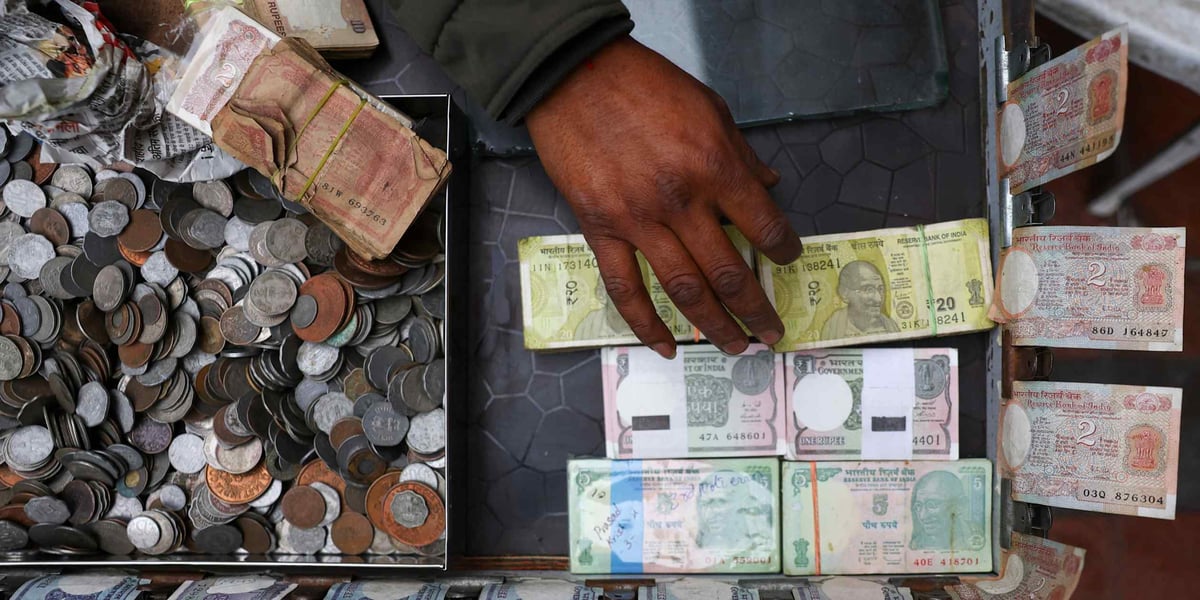
The rupee’s performance has been central to that improving case. The rupee has held at 95.40 against the dollar through most of August — a level that is softer than the 92-handle that prevailed before last year’s outflow cycle began, but significantly more stable than the 97-handle that had prevailed as recently as May. India’s current account deficit has narrowed to below 1.5% of GDP, supported by lower crude oil prices following the Iran-Oman Hormuz corridor agreement, and by resilient services exports.
| Sector | FPI Net Flow (Aug MTD) | YTD Flow | |||||||
|---|---|---|---|---|---|---|---|---|---|
| Financials | +$180M | +$420M | |||||||
| Energy & Oil/Gas | +$95M | -$180M | |||||||
| Healthcare & Pharma | +$62M | +$290M | |||||||
| Consumer | +$45M | -$95M | |||||||
| IT & Technology | -$42M | -$610M | |||||||
| Source: BSE/NSE filings, company Q1 FY27 earnings reports. | |||||||||
The sector composition of August flows tells a story about what foreigners are buying — and what they are not. Financials have absorbed $180 million month-to-date, reflecting the rate cut thesis: lower RBI rates would expand private bank margins and lift credit growth. Healthcare and pharma are net recipients at $62 million, a defensive allocation. Consumer stocks are modestly positive at $45 million.
Technology is the conspicuous outlier. IT stocks have drawn $42 million in net outflows in August alone, extending a year-to-date exit of $610 million from the sector. Foreign institutions that were net buyers of Indian IT through 2023 and 2024 have been repricing the sector’s revenue assumptions as U.S. enterprise spending slows and questions about the structural impact of AI on services demand remain open.
The SEBI data on FPI registration provides one structural context: the number of active registered FPIs in India stood at 11,412 as of July 2026, down from a peak of 11,829 in mid-2024, but recovering from the sub-11,000 level hit in early 2026. The marginal improvement in registrations tracks the improvement in flows, suggesting new entrants rather than just existing holders increasing their positions.
What remains unknowable is how durable August’s flows are. The Reserve Bank of India’s Monetary Policy Committee meets in October. The repo rate at 6.50% has not moved since February 2023. A rate cut would directly benefit private sector banks, which have already begun to price it in. But the RBI has not signaled one, and its most recent communication was explicit about watching food inflation data through September.
The September 10 U.S. CPI print is the other critical variable. If core inflation in the United States comes in above expectations, Fed cut bets will be repriced, the dollar will strengthen, and the flow arithmetic that has supported Indian assets in July and August could reverse. Foreign money has returned. It has not, yet, committed.