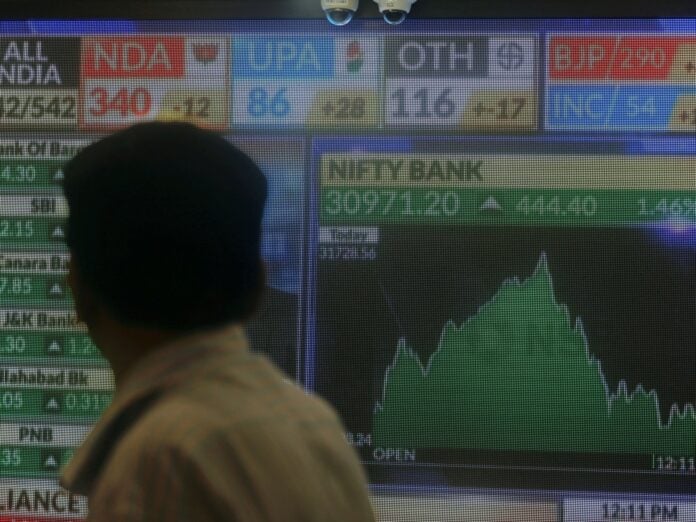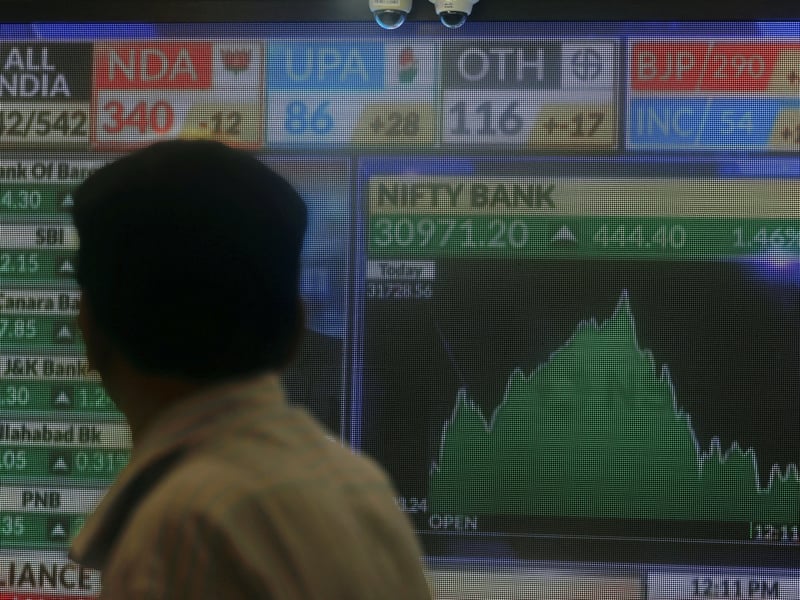

MUMBAI — The Nifty 50 closed at 24,621 on August 27, down 0.52% for the session but holding a floor that market technicians regard as decisive: the 200-day moving average at 24,380. Below that level, the structural bull case weakens. Above it, every rate cut signal from the Reserve Bank of India and the US Federal Reserve is a catalyst waiting to fire.
For the month, the index is up roughly 0.4% in a range-bound August that masks a sharp divergence in sector performance. Financials and defensives are gaining. Technology is bleeding. The index’s behaviour in the 24,400–25,200 corridor over the next three to four weeks will determine whether Q4 FY27 brings a breakout toward 26,500 or a deeper consolidation toward 23,800.
Federal Reserve Chair Jerome Powell’s Jackson Hole address on August 22 confirmed the pivot is no longer hypothetical. Markets have now priced a 25-basis-point Fed cut for September with near-certainty. The question for Nifty is whether the RBI follows in October or holds for Q3 inflation data. If the RBI cuts, the cost-of-capital compression that drove Nifty from 21,964 (the 52-week low) to 26,277 (the 52-week high) has a second chapter.
| Level (Nifty 50 Points) | Significance | Status | |||||||
|---|---|---|---|---|---|---|---|---|---|
| 26,500 | Q4 FY27 target — rate cut scenario | Resistance | |||||||
| 25,800 | Pre-correction August high zone | Resistance | |||||||
| 25,200 | 50-DMA / August distribution cluster | Key Resistance | |||||||
| 24,621 | August 27, 2026 close | Current | |||||||
| 24,380 | 200-DMA — structural support | Key Support | |||||||
| 24,100 | June 2026 swing low | Strong Support | |||||||
| 23,800 | Bear scenario target — RBI holds rates | Downside Risk | |||||||
| Source: BSE/NSE filings, company Q1 FY27 earnings reports. | |||||||||
The DII community has been the steady hand beneath August’s volatility. Domestic institutional investors deployed an estimated Rs 12,800 crore into Indian equities this month, absorbing FII selling on days when global risk sentiment wobbled. FII equity inflows turned net positive by mid-August at roughly Rs 3,200 crore for the month, a reversal from July’s ambivalence, as the Jackson Hole signal clarified the dollar’s direction.
The Nifty’s forward price-to-earnings ratio stands at approximately 20.1 times, a premium to its five-year average of around 19.2 times but a discount to the 22–23 times range that preceded the rate-hike cycle. If consensus FY27 earnings growth of 14–15% holds — a big conditional given the global slowdown risk — the multiple is not stretched at current levels.
What is stretched is the divergence inside the index.
| Sector Index | Aug MTD Change | Nifty Weight | Primary Driver | ||||||
|---|---|---|---|---|---|---|---|---|---|
| Nifty Bank | +2.1% | ~30% | Rate cut pricing; private lender margin relief | ||||||
| Nifty Pharma | +1.4% | ~4% | Defensive rotation; US generics pipeline | ||||||
| Nifty Auto | +0.8% | ~5% | Festive season pre-positioning; rate cut bets | ||||||
| Nifty FMCG | +0.3% | ~8% | Rural demand recovery; monsoon progress | ||||||
| Nifty 50 | +0.4% | — | Composite; range-bound August | ||||||
| Nifty IT | -1.6% | ~17% | US enterprise spending slowdown; deal flow caution | ||||||
| Nifty Metal | -2.3% | ~2% | China demand disappointment; iron ore softness | ||||||
| Source: BSE/NSE filings, company Q1 FY27 earnings reports. | |||||||||
The IT sector’s drag is the principal headwind. With an index weight of roughly 17%, Nifty IT’s August decline of 1.6% has cost the benchmark nearly 30 basis points of headline return — wiping out the gains from banking’s outperformance and then some. The sector’s problem is not a rate cycle; it is a client-side spending freeze in US enterprise technology that shows no sign of breaking before calendar Q4.
The bull case for 26,500 by December rests on three conditions converging: an RBI rate cut at the October Monetary Policy Committee meeting, FII equity inflows accelerating past Rs 15,000–20,000 crore per month as dollar weakness broadens, and IT sector stabilization as US corporates restart discretionary tech spend. All three are plausible. None is guaranteed.
The bear case — a retreat to 23,800 — requires the RBI to hold rates citing food inflation persistence, FII inflows to stall as global risk appetite wavers in October, and the IT margin compression cycle to deepen through December. That outcome, too, is not implausible.
What the market has not yet fully priced is the compounding effect of twin easing — a Fed cut in September followed by an RBI cut in October — on foreign portfolio flows into Indian bonds and equities simultaneously. As India’s 10-year G-Sec yield fell to 6.82% this week in anticipation of that sequence, the bond-equity capital allocation dynamic inside FPI portfolios begins to shift. Historically, periods when Indian yields compress while equities trade at 19–21 times forward earnings have drawn sustained multi-month inflows.
The Nifty Bank’s 2.1% August gain is the most direct read on how the market is positioning for that scenario. Banks are pricing in a rate cut before the RBI has delivered one. If the October MPC disappoints, that sector — and by extension the benchmark index — will reprice quickly.
For now, 24,380 is the line. It has held through three test attempts in August. A fourth test, should it come with higher volume, will be the most consequential session of the third quarter for Indian equity investors. The FPI inflow trajectory through the remainder of August and into early September will determine whether that support holds or becomes the next point of failure.