
SANTA CLARA — The offering price was $95. The stock was at $92.09 on Friday afternoon, and that three-dollar gap captures something the capital raise itself could not resolve: whether Intel has found the customers needed to fill $20 billion worth of foundry capacity.
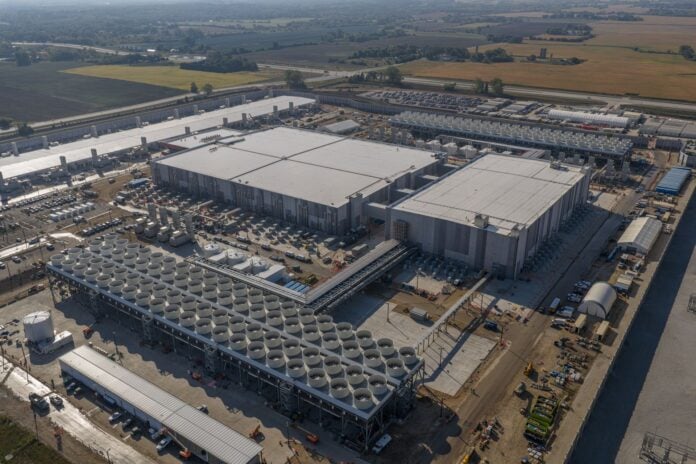
Intel sold 210.5 million shares on August 12, upsizing a planned $15 billion deal to $20 billion after investor demand exceeded $100 billion. That kind of oversubscription happens when a turnaround story is working. CEO Lip-Bu Tan, who took over in early 2025 and cut management layers in half within months, has rebuilt enough institutional confidence to pull off the largest equity raise in Intel’s history. The question now, eighteen days later, is whether the operating business can keep pace with the expectations the offering created.
What makes that question harder on this particular Friday is Jackson Hole. Federal Reserve Chair Kevin Warsh delivered his first major policy address in the morning, and the tone was unmistakably cautious: no rate cuts are imminent, and the Fed’s primary concern remains price stability. The 10-year Treasury yield settled at 4.679%. Chip fabs are extraordinarily capital-intensive, and the cost of financing that capital is directly tied to long-term rates. Intel’s entire foundry thesis rests on building and filling manufacturing capacity at a scale that requires sustained capital access. A hawkish Fed complicates that calculus in ways that are not visible in a single trading session but compound over quarters.
Intel’s stock traded between $88.46 and $92.95 on Friday, closing Thursday at $92.09 after a 4.36% gain. The broader Nasdaq fell 0.5% under the hawkish signal from Wyoming, dragging chip sector names across the board. The 52-week range for INTC stretches from $23.68, the low that marked Intel’s existential crisis in mid-2024, to $142.35. The roughly five-fold recovery that interval represents is real. It is also the standard against which every subsequent move is measured.
Tan’s restructuring has been thorough enough that Intel’s credibility among chip industry peers has recovered in visible ways. Nvidia, which this week reported $96.2 billion in revenue for its most recent quarter driven almost entirely by AI chip demand, disclosed a $30 billion stake in Intel covering approximately 214.8 million shares. That is not a small position, and Nvidia does not make $30 billion bets carelessly. The investment signals that the world’s most valuable chip company sees Intel Foundry Services as a viable part of the AI chip supply chain. It does not signal that Nvidia has committed to manufacturing its own next-generation chips there.
The broader AI chip landscape explains why those commitments matter. Someone has to fabricate the wafers that power the data centers building AI infrastructure at scale. TSMC currently does most of it. Intel is positioning itself for what comes next, including custom AI accelerators that hyperscalers like Google, Microsoft, and Amazon are designing in-house. According to a TechCrunch analysis of Intel’s turnaround, the company’s approach under Tan represents a genuine structural shift rather than incremental improvement.
Intel’s 18A manufacturing process is the technical argument behind the confidence. Process yields have crossed 60%, which is credible competition territory for advanced node manufacturing. Apple has reportedly evaluated Intel Foundry for low-end M-series processor production beginning in 2027. That evaluation, if it converts to a contract, would do more for Intel’s valuation than any analyst upgrade. The U.S. Commerce Department holds a position in Intel covering 433.3 million shares at $20.47 each, acquired as part of the CHIPS Act capital support that preceded Tan’s arrival. According to Intel’s official announcement, the $20 billion offering generated approximately $19.7 billion in net proceeds after underwriting costs. That capital goes into fabs. Fabs need customers to generate returns.
The competition with TSMC for those customers is the real stakes of the offering. Intel’s 18A process can compete on specification sheets. Whether it competes on delivery reliability, yield consistency, and the kind of trust that comes from decades of production history is a harder case. TSMC has thirty years of customer relationships. Intel is rebuilding relationships that went cold during its roughest stretch between 2021 and 2024. The technical capability is demonstrably there at 60% yields. The commercial relationships are still being reconstructed.
Forty-eight analysts polled by S&P Global rate Intel as a consensus Hold with an average price target of $114.88. The distance between $114.88 and Friday’s $92.09 is an upgrade cycle waiting to happen, not one that has happened. Upgrades in chip manufacturing typically follow customer commitment announcements, and Intel has not yet named a customer filling meaningful 18A capacity from Nvidia, Apple, or Qualcomm. Thursday’s INTC session posted a 4.36% gain that set up Friday’s trading with upward momentum, before Warsh’s remarks reset the sector.
Chip sector peers, including Broadcom (AVGO), which reports fiscal third-quarter results next Tuesday, also traded under pressure after the Jackson Hole signal. The three-dollar gap between the offering price and Friday’s close will close or widen depending on one thing: whether Intel converts credibility into committed manufacturing volume. The Nvidia stake, the Apple evaluation, and the government investment are all inputs to decisions Intel’s potential customers have not yet made. The offering is done. The foundry still needs its anchor customers.