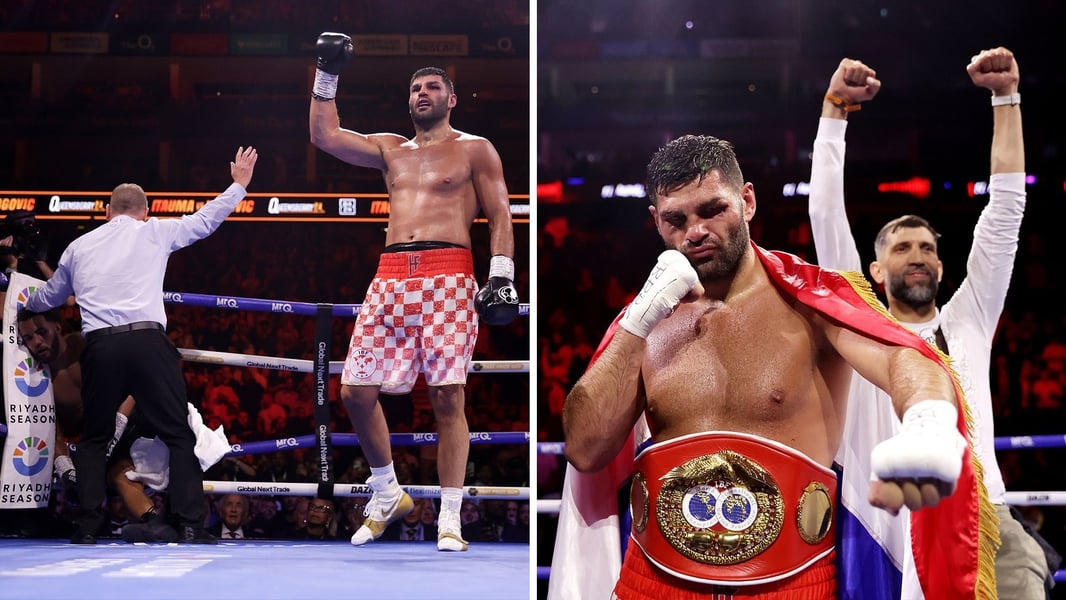

LONDON — In round eight, Moses Itauma threw every punch he had left at Filip Hrgovic’s chin and found the same answer every time.
Nothing.
Hrgovic stood there and absorbed it, a sustained assault from a 21-year-old who had dominated every previous round with a violence that the sold-out crowd at The O2 had come to watch confirm a destiny, and did not move. Itauma could feel, even as he kept throwing, that the power had already been spent. He had put everything into a fighter who absorbed everything. By round nine, when his corner surrendered within a minute of the opening bell, the fight’s real verdict had already been delivered in round eight. The stoppage was a formality.
Hrgovic became Croatia’s first world heavyweight champion on Saturday night in London. He also answered, loudly, a question nobody had thought to ask going into fight week: what happens when the most anticipated young heavyweight in British boxing meets an opponent whose chin will not cooperate with the plan?
Itauma came in as an overwhelming favourite with a biography that made the favouritism feel like arithmetic. Twenty-one years old, fourteen and zero with twelve stoppages, a prodigy from Kent who had never been tested beyond six rounds professionally, and yet the expectation of a coronation felt earned. A title victory would have made him one of the youngest world heavyweight champions in history, invoking a comparison to Mike Tyson, who claimed the title at 20 in 1986. Promoters were already mapping what Itauma’s reign might become.
Hrgovic dismantled that map round by round.
The early rounds belonged entirely to Itauma. He forced a right glove down to the canvas with a left hook in the second, drawing the kind of crowd response that rewrites the dynamic of an arena. A flush left uppercut in the fifth connected solidly enough to move Hrgovic’s head. Through six rounds, Itauma won each exchange, controlled the distance, and demonstrated the power that had elevated him to the top of British boxing’s most-wanted list. Through six rounds, Hrgovic kept getting up.
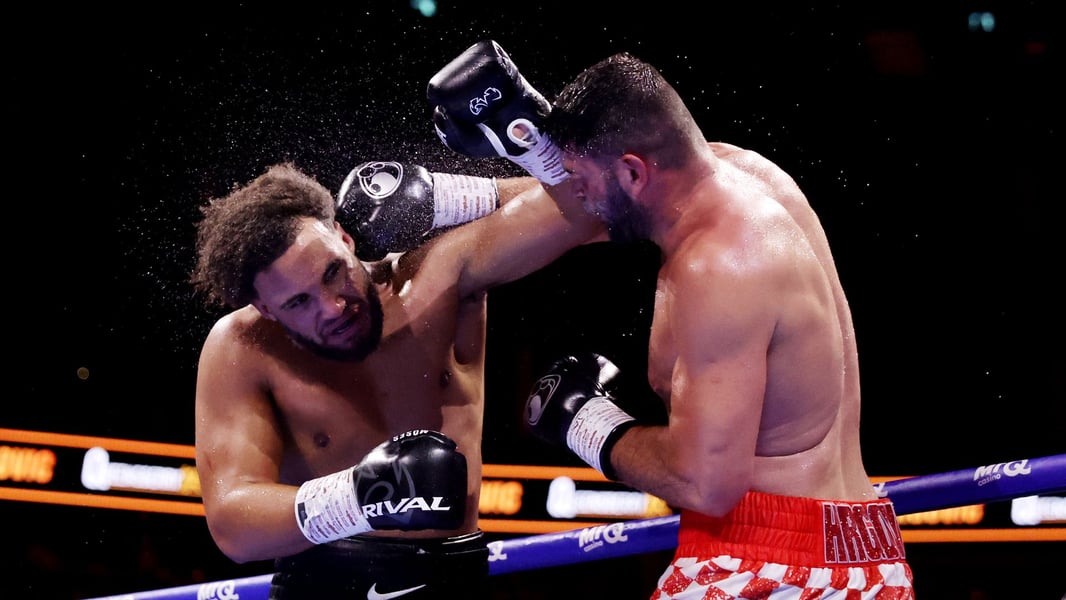
“From the first round, I saw him gassing out,” Hrgovic said afterward. “I knew when my chance came, I needed to push. That is what I did.”
In round nine, Itauma could no longer maintain his position. His corner made the call before he asked them to. Medical staff attended to him at ringside as a precaution.
Croatia now has a world heavyweight champion for the first time. Hrgovic’s record extends to 22 wins and one defeat: the 2024 loss to Daniel Dubois that he had cited as the moment he nearly walked away from the sport. What he built instead, apparently, was a belief in the asset that Saturday confirmed. “Is a chin important? Chin is important,” he said afterward, describing Itauma as “amazing” while adding that the young challenger had “boxed like an amateur” in terms of how he managed his own energy.
Chris Eubank Jr., watching from outside the ring, offered the sharpest outside read: “Moses was fighting well and then gassed out. At his young age, this seriously should not happen.” Tony Bellew, whose own career was built partly on heart over technical perfection, was more generous: “Nothing wrong with Moses’s heart. One seriously brave boy.” What the conditioning gap at 21 means for Itauma’s trajectory is the question the evening raised and left unanswered.
Boxing’s recent weeks have produced a series of title changes across the divisions, with the heavyweight picture remaining the most complicated and contested corner of the sport. The division’s landscape, with Usyk’s continued presence and the fragmentation of titles across sanctioning bodies, means Hrgovic’s reign will immediately attract mandatory challengers and promotional negotiations he did not have to think about a week ago.
The immediate noise was simpler. Jake Paul posted “Gimme Hrgovic” before the ring had cleared. Yahoo Sports described the reaction from the boxing world as “dumbfounded,” which tracked with what the numbers said. Sky Sports framed it as a “brutal education” for Itauma, a characterisation that is also accurate, and that carries something of a promise. He is twenty-one. He has time to learn what Saturday offered him at significant cost.
Hrgovic, who turns 35 in September, was running out of it. Saturday night at The O2, he used what remained of his window in the most efficient manner available: he absorbed everything a prodigy could throw, waited for the prodigy to exhaust himself, and then stopped him.
The chin carried the night. The belt followed.