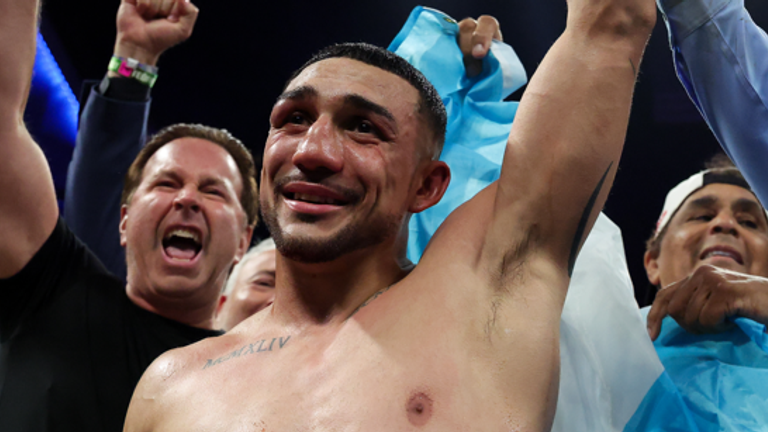

LAS VEGAS — Seven months after Shakur Stevenson stopped the clock on his WBO lightweight title reign, Teofimo Lopez walked out of T-Mobile Arena on Saturday night as a three-division world champion, having added the WBA welterweight belt to a collection that already crossed two weight classes.
The winning margin was narrower than Lopez would have preferred. One judge could not separate them, scoring it 114-114. The two who did give Lopez the edge, by 115-113 and 116-112, produced the majority decision that made the victory official and the moment real. Rolly Romero, who came into the night as the defending champion and left without a belt, described the result as a robbery before the ring had cleared.
What CompuBox measured told a different story. Lopez landed 124 of 530 punches thrown across twelve rounds. Romero connected on 73 of 352 attempts, as Bleacher Report confirmed. The gap in output, 23 percent accuracy for Lopez against 21 percent for Romero, was close enough that a split decision would not have surprised anyone in the arena. A 114-114 card from one judge is an invitation to dispute. But two of the three judges found enough to hand Lopez a victory that his punch output, at least, supported.
Romero was direct about where he stood. “I got hit with two punches the whole fight that barely grazed me,” he told reporters. “When I heard 114-114, I knew it was a robbery.” The 114-114 card exists on the official record, so his argument has a foothold. The CompuBox numbers, which neither side disputes, suggest a different reading of the same twelve rounds.
The fight had a clearly identifiable hinge point, and it came in the middle rounds. Romero landed a counter left hook in the fourth that briefly knocked Lopez off his rhythm, and followed with a right hand in the fifth that caught Lopez cleanly enough to slow his pace. Those two rounds were Romero’s best work of the evening, and they were the moments that created the divergence between what the eventual verdict said and what Romero believes happened.
Lopez recovered. Rounds six and seven produced his most sustained combination work of the night, and he brought a cleaner tempo into the championship rounds. A crowd that had leaned into Romero’s moments of success during the middle frames came back to Lopez as the final bells approached. The T-Mobile Arena, which has staged welterweight title fights across decades of Las Vegas boxing, was not a friendly room for either fighter by the time the scorecards were tallied.
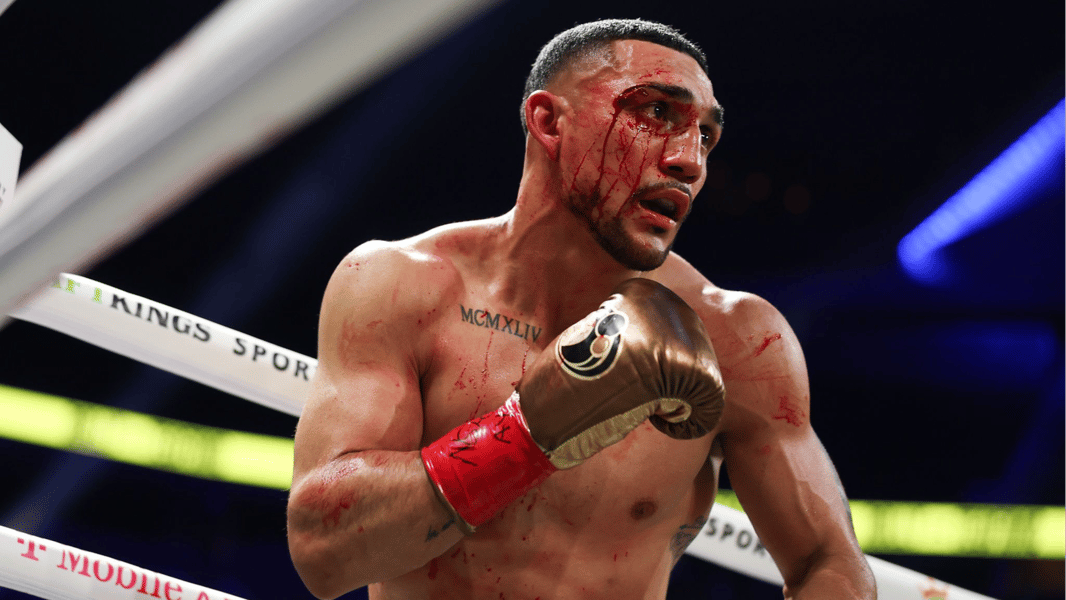
Lopez’s record coming in had prepared him for nights that demanded adjustment. The January loss to Stevenson, which stripped him of the WBO lightweight title and provided the most visible setback of his career, was the backdrop to everything he did here. Lopez came up in Brooklyn and announced himself internationally with the 2020 upset of Vasyl Lomachenko, a fight that, for many observers, redrew the map of the lightweight division and opened the conversation about where Lopez’s ceiling actually was.
Saturday’s win provides a provisional answer: high enough to span three weight classes. “If you lose and you come back,” Lopez said afterward, “then you never lost because you’re a winner.” The line has the quality of a prepared remark. It also happens to describe, accurately, what he went and did.
The win makes him one of a select group of fighters to have held world titles in three separate weight classes, Sky Sports reported. He previously claimed the unified lightweight championship against Lomachenko and later held the WBO light welterweight title before the move to 147 pounds. Saturday’s victory completes a sequence that spans the better part of a decade of professional boxing and puts his name on a list that includes an elite tier of the sport’s history.
Romero’s case for a rematch rests on that one 114-114 card and his conviction that the punches he absorbed do not match what the final scores reflected. Whether the WBA and promotional machinery will accommodate that argument remains to be seen. The more immediately pressing question is the mandatory situation: Jack Catterall holds that position in the WBA’s rankings, and Lopez, having just claimed the title, will need to address the mandatory cycle before the higher-profile names circling the welterweight division become available. Devin Haney holds the WBO belt. Liam Paro is the IBF champion.
Whether Lopez walks into any of those fights as a comfortable favorite rather than a resilient underdog may depend on whether Saturday reflected the fighter who dismantled Lomachenko or the one who ran into Stevenson in January. The CompuBox totals suggest effective control. Romero’s middle rounds suggest Lopez can still be caught. Both things appear to be true, and the question of which matters more will not be answered until he faces a contender who can sustain that kind of output for twelve rounds in the welterweight division.
For now, he carries three world titles across three weight classes, a designation that belongs to a narrow list in the history of the sport. One judge in Las Vegas had them even on Saturday night. Two had Lopez ahead. And Lopez, 29, walked out of T-Mobile Arena with the belt, the title, and seven months of unfinished business behind him.