
LA PAZ – The minister chose his words with care. The International Monetary Fund, Christian Morales told RIA Novosti on Sunday, had not imposed a single condition on Bolivia. The country was, he said, “completely independent” in managing its economic policy. What the fund did, in his telling, was validate a course Bolivia had already chosen.
The IMF’s July 29 staff-level agreement tells the story somewhat differently. The Extended Fund Facility for which Bolivia is seeking congressional authorization (a 36-month program worth $1.9 billion, or 570 percent of the country’s IMF quota) is built around a set of commitments Bolivia has made. Those commitments include eliminating fuel subsidies by 2027, reducing the public deficit through cuts to current spending, and maintaining the flexible exchange rate Bolivia adopted in June when it finally abandoned a dollar peg it had held for fifteen years.
Morales was not lying. Those are indeed things Bolivia has chosen to do, or has already done. The subsidy removal happened in December 2025, before the IMF deal was on the table. The dollar peg collapsed under the weight of near-zero reserves and a parallel market already pricing the boliviano at three times the official rate. What Morales is doing is something distinct from lying: he is reframing economic conditions Bolivia agreed to meet as sovereign choices Bolivia made independently, and attributing to the IMF only the role of endorser.
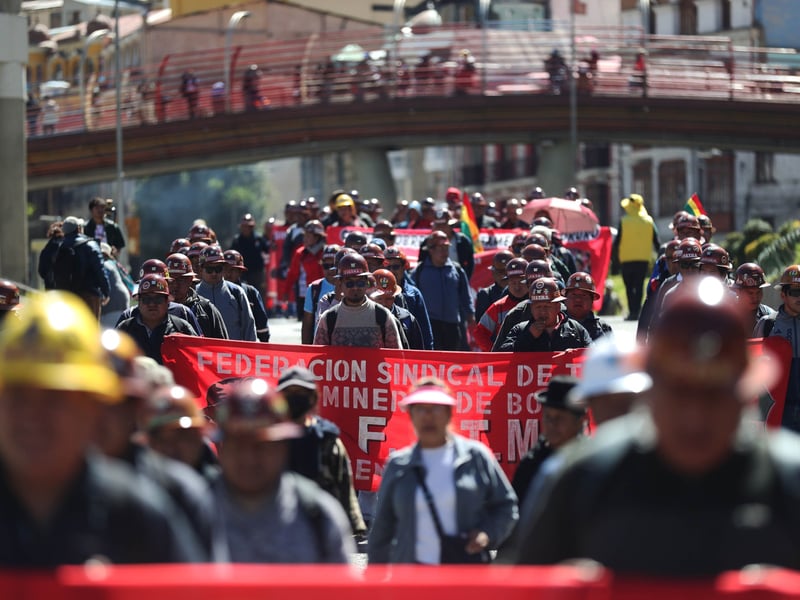
The distinction matters because a bill authorizing the IMF loan is now before the Plurinational Legislative Assembly, and its path through parliament is not guaranteed. Bolivia’s labor unions (miners, teachers, farmers, members of the Bolivian Workers’ Central) have spent months blocking roads and striking in opposition to any agreement with the fund, fearing exactly the kind of austerity the minister is at pains to deny. Morales’s language at Sunday’s press conference was calibrated for that audience as much as for international investors.
“The only thing the fund did was to validate the course we had chosen,” he said. The statement is defensible in the narrow sense that Bolivia did not adopt a flexible exchange rate because the IMF required it; it adopted one because the alternative was a black market at 20 bolivianos to the dollar and official reserves that had effectively reached zero. The IMF’s stamp of approval, and the $1.9 billion attached to it, represents the reward for reforms Bolivia was already being forced to make.
What the loan does, if parliament authorizes it, is inject the dollars Bolivia lacks. Once the legislature approves, the country would receive a first tranche of the $1.9 billion. Subsequent disbursements depend on periodic assessments in which the IMF’s technical team and the Economy Ministry review implementation of the program. Those reviews are, functionally, the condition. Each review is an occasion at which the IMF can determine whether Bolivia is meeting its commitments (on the exchange rate, on the deficit, on the subsidies) and withhold disbursement if it concludes the answer is no.
The $1.9 billion would be the largest IMF program Bolivia has ever accessed. Its arrival would rebuild reserves, anchor the new exchange rate, and restore the central bank’s capacity to intervene when currency pressure builds, precisely the tools the country lost over a decade of drawing down its gas-export earnings to defend an exchange rate the market had already abandoned.
Morales said the Ministry’s technical team would work alongside IMF economists during the periodic reviews. He did not describe what would happen if those reviews found the program off track. Bolivia’s relationship with multilateral Western-led financial institutions has historically been fraught, and the government’s need to frame the current agreement as something other than a conventional IMF bailout reflects that history. The political cost of appearing to bow to the fund remains high, even when the alternative (no dollars, accelerating inflation, a currency in free fall) is considerably worse.
In July, Santa Cruz, Bolivia’s largest and most economically active department, set a deadline for the government to present the IMF bill to parliament or face a regional strike. The government complied. The bill is now in the assembly. The timeline for a vote has not been announced.
The IMF’s executive board has not yet formally approved the program. Staff-level agreements bind neither party until the board acts. That approval, when it comes, will be accompanied by a press release describing the program’s objectives (the exchange rate flexibility, the fiscal consolidation, the subsidy rationalization) in terms considerably less ambiguous than the minister’s Sunday remarks.
The food and energy inflation that has driven up living costs across the developing world in 2026 makes the timing of Bolivia’s fiscal adjustment particularly difficult. Subsidy removal in a high-inflation environment concentrates the pain on households least able to absorb it. The IMF’s program documentation acknowledges this risk; the government’s rhetoric does not.
What the deal actually requires, and what happens at each review if Bolivia falls short, will be clearer once the fund’s board document is public. Until then, Bolivia’s parliament is being asked to authorize a $1.9 billion loan on the minister’s assurance that it carries no directives. The assurance and the agreement are not quite the same document.