
Here’s the strict context-preserving rewrite — only tightening language and rhythm, without changing the facts, sequence, numbers, or meaning:
MINNEAPOLIS — The penalty flag had barely settled when Matt LaFleur walked toward the sideline official and waved it off.
Fourth-and-1 from the Minnesota 26. Score 22-10, Green Bay. Five minutes left in the third quarter. Jordan Love had just watched his team get a fresh set of downs when the Vikings jumped offsides. LaFleur declined it.
The Packers were going for it.
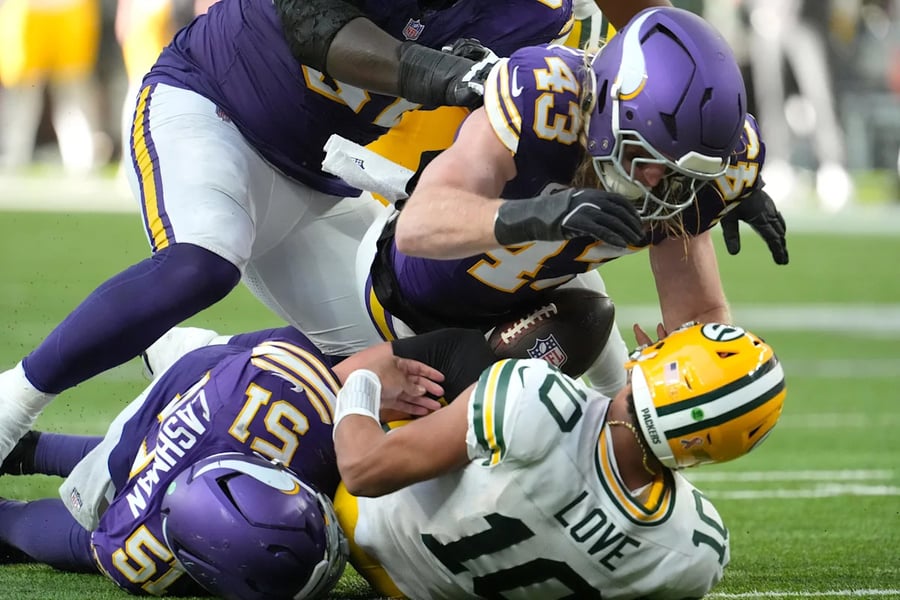
Love crouched under center, took the snap and drove forward into a wall of purple. When the pile cleared and the virtual measurement confirmed he was short, the crowd at U.S. Bank Stadium released a sound that carried through the rest of the afternoon. From that play, Minnesota scored 29 unanswered points. Carson Wentz threw three touchdowns, Jordan Love was sacked four times and lost a fumble, and a 22-10 lead became a 39-22 humiliation in a season opener the NFC North will be discussing for weeks.
LaFleur told reporters afterward that the Packers felt they could convert. He was not wrong to think so. Statistically, short-yardage fourth-down attempts convert at rates that analytics departments use to justify going for it every time. What the model does not measure is what happens when the play fails in front of 66,000 people in the opponent’s building, against a team that had just lost its starting quarterback and was looking for any reason to believe.
Kyler Murray had left the game in the first quarter with a concussion after absorbing a late hit. He was examined in the medical tent and did not return. Carson Wentz, who signed with Minnesota in the offseason as a veteran bridge, took the field for his first regular-season snaps in more than a year and completed 12 of 19 attempts for 133 yards and three touchdowns. His passer rating was 123.5.
The decision was defensible on paper. What it did in practice was hand a backup quarterback a foothold he did not give back.
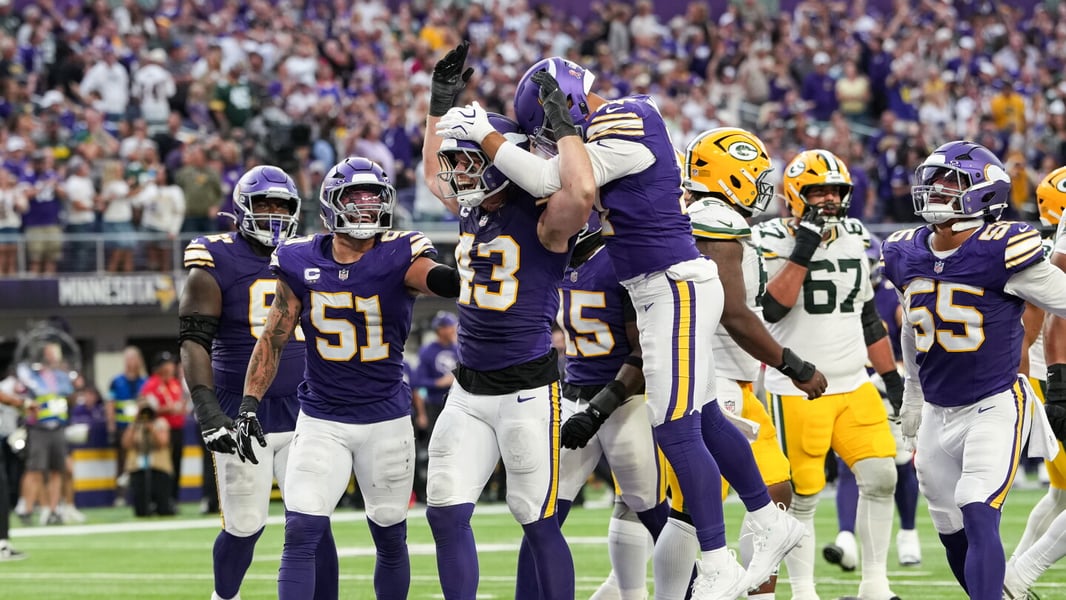
Love did not collapse quietly. He completed 24 of 40 attempts for 387 yards and two touchdowns, and the Packers led on the strength of that production through three quarters. Christian Watson hauled in seven catches for 147 yards and two scores, including a 54-yard deep ball in the first half that gave Green Bay its most dangerous pass threat of the afternoon. Watson won individual matchups consistently. What the Packers could not do was hold together around him.
Love was sacked four times in the second half. He fumbled once, the ball stripped away as pressure collapsed the pocket in the fourth quarter. He threw a late interception off a twice-tipped ball that Minnesota converted into the final margin. As Yahoo Sports reported in its game recap, Green Bay managed just 1-of-6 on third down in the second half and was outscored 29-0 from the failed sneak to the final whistle.
The Packers’ own postgame review, published on packers, identified five takeaways from the defeat. Each traced to the same moment: the declined flag, the stuffed sneak, and the 29 points that followed. NBC Sports described the second half as a meltdown, but the conditions for it were created before the fourth quarter began, on a play that never actually needed to happen.
In a Week 1 that saw the Chicago Bears obliterate the NFL’s all-time season-opener scoring record with 59 points against Carolina and Derrick Henry pass Marcus Allen for sole possession of third on the all-time rushing touchdown list, the Packers’ collapse at U.S. Bank Stadium generated its own question: what a coach does when the model and the moment are telling him different things.
Murray’s status for Week 2 is unknown. The concussion protocol timeline will determine whether the Vikings enter their next game with their starter or their backup, and that is the question Minnesota’s front office cannot answer tonight.
The 29 unanswered points started the moment Love was stopped short of the sticks. What stopped Love is, in theory, a simpler question. LaFleur will have a week of film to build an answer from.