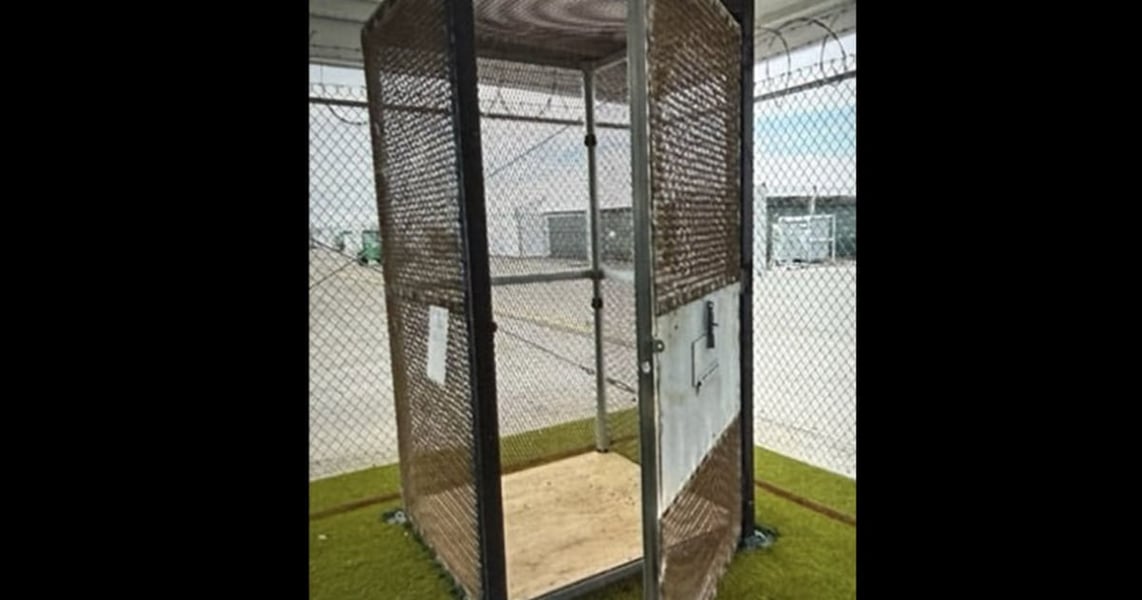

MIAMI – The cage measured eighteen square feet. That is less than the footprint of a standard parking space. Inside it, according to a report released this week by the Department of Homeland Security’s independent watchdog, staff at the Florida Everglades detention center known as Alligator Alcatraz placed migrants who needed “calming.”
The image of a facility built to intimidate now has documentary evidence to match. The DHS Office of Inspector General found that the state-run center operated in systematic violation of federal detention standards, confining migrants in what the report called “small metal enclosures” and providing less than a third of the floor space required by law.
“The use of such restrictive spaces is highly unconventional and does not align with standards for humane treatment,” investigators wrote. The practice was, they added, unprecedented in the watchdog’s record of previous facility inspections.
Florida’s Division of Emergency Management, which operated the center, did not respond to a request for comment. Neither did the office of Gov. Ron DeSantis, the Republican who championed the facility as proof that willing states could go further than federal bureaucracies in enforcing immigration law. The Department of Homeland Security’s central leadership also did not immediately respond.
The metal enclosures were presented, in official accounts, as voluntary. Facility staff told federal investigators that detainees asked to spend time in them. Investigators found at least one case that complicated that account: an enclosure used to discipline a detainee who had “failed to comply with a lawful command.” Time inside varied from several minutes to nearly two hours.
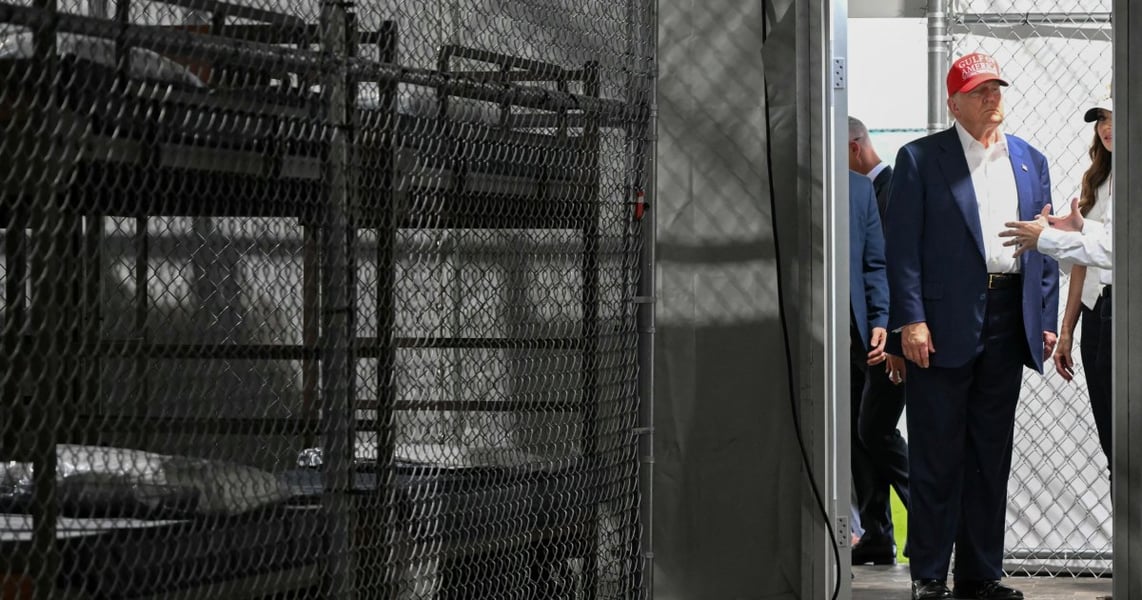
Investigators did find that the facility met federal standards on intake and use-of-force procedures. The violations, the report concluded, were concentrated in the conditions of daily life: the space detainees were given, what they ate, the medical attention they received.
The facility had a deliberate political identity from the moment it opened, in July 2025, when Florida erected the center on a training airfield in a remote stretch of Everglades terrain between Miami and Naples. State officials put up a sign bearing the name on the approach road. Trump amplified the branding himself, joking publicly that the location was so isolated that detainees would need to learn “how to run away from an alligator.”
The watchdog report does not address what it could not confirm: what happened to migrants held at the facility during the year it operated, whether those denied adequate medical care received follow-up treatment, or whether the full record of enclosure use was preserved. ICE’s record on medical treatment of immigration detainees under Trump has faced repeated legal scrutiny, including cases in which courts have been required to intervene directly.
Florida officials closed the facility this summer, citing the approaching hurricane season, though detainees had remained inside through the previous hurricane season. The cost of operating it exceeded one million dollars per day, driven partly by the logistics of trucking in fresh water and hauling out wastewater from a site that lacked the infrastructure for either.
The OIG report is the first independent federal examination of the facility. Its findings arrive as federal courts continue to impose limits on the administration’s immigration detention practices, with the Fourth Circuit having recently become the ninth consecutive appellate court to block indefinite detention without bond hearings.
What distinguishes the Alligator Alcatraz report is its focus on conditions rather than policy. The courts have largely addressed the legal basis for detaining people; the inspector general focused on what happened to them once inside.
The report’s characterization of the metal cages as “unprecedented” among previously inspected facilities reflects something the inspector general’s office rarely needs to say. Watchdogs accumulate institutional memory about how facilities fail. They have categories. Alligator Alcatraz produced a use of physical space for which federal inspectors had no category.
DeSantis has not spoken publicly about the findings. The political framing that accompanied the facility’s opening, that it represented innovative and efficient enforcement, is harder to maintain once the federal government’s own investigators have concluded it created “significant risks” to detainees’ health and safety. The DHS’s internal oversight apparatus has produced a string of findings critical of immigration enforcement conduct under the Trump administration, even as the administration’s political leadership has moved to limit inspector general functions in other agencies.
The Alligator Alcatraz report does not call for prosecutions or administrative sanctions. It documents. That documentation now exists in a federal record, attached to a facility that no longer operates, in a state whose governor has not responded to questions about it. What the inspector general found unprecedented, the government treated as ordinary.
The DHS has faced parallel findings on its conduct across multiple agencies this year, with courts and watchdogs concluding repeatedly that the Trump administration’s approach to federal oversight has lacked documented justification for the decisions it made.
The full report is available through the DHS Office of Inspector General.