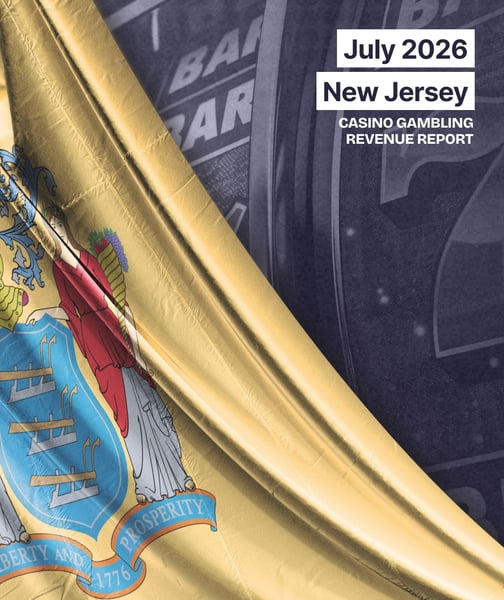

TRENTON — The number New Jersey’s Division of Gaming Enforcement published in late August would have seemed implausible three years ago: $276.9 million in internet gaming revenue for a single month, a figure that had never appeared before in U.S. iGaming history.
It landed on the same week Governor Kathy Hochul effectively killed New York’s fourth attempt to legalize online casino games, declining to advance a bill that would have sent some of that tax revenue across the Hudson River rather than letting it settle in Trenton. Those two events, separated by less than a hundred miles of interstate, tell most of what a market analyst needs to know about American iGaming in the summer of 2026.
The July total pushed New Jersey’s fiscal year 2026 gaming tax receipts to $925.7 million, up 42.3% year over year. At current run rates, the state is on pace to generate between $3.15 billion and $3.3 billion in iGaming revenue for the full calendar year. New Jersey’s record July gaming performance extended to brick-and-mortar properties as well: Atlantic City’s nine casinos generated $304.2 million in land-based revenue, making July the first month of 2026 in which retail casinos out-earned the internet.
The platform breakdown confirmed a trend the industry had been watching all year. FanDuel’s casino products generated $61.7 million in July, representing a 22.3% market share and 18.5% growth year over year. DraftKings, which had been narrowing the competitive gap heading into the summer, instead widened it: the revenue difference between the two operators grew from $3.4 million a year ago to $13.6 million in July. Flutter Entertainment, which completed its London Stock Exchange delisting last month to concentrate its capital markets presence entirely in the United States, attributed the expanding lead to superior retention mechanics in the FanDuel casino app, a session architecture designed to extend play duration and limit churn among high-value players.
DraftKings has pushed back on that characterization, pointing to its sports betting integration advantages during the baseball season. Neither company has published cohort data that would allow an independent assessment of either claim.

None of this has moved Albany. Hochul declined for the fourth consecutive year to advance State Senator Joseph Addabbo’s bill S2614, which the New York State Senate shelved without a floor vote. Addabbo’s proposal had offered a 35% tax rate on gross gaming revenue, $150 million in licensing fees, and a requirement that live dealer studios operate within New York’s geographic borders, a framework designed to concentrate economic activity inside the state rather than route it through New Jersey’s existing server infrastructure.
Hochul’s resistance is not primarily fiscal. New York’s mobile sports betting program, which launched in January 2022, already generates $862 million annually in state tax revenue. Budget officials have been reluctant to complicate that record by introducing a new product category with different operators, distinct consumer-protection standards, and a political coalition that has not fully assembled. The governor’s office has also cited unresolved questions about problem gambling prevalence data from the states where online casino gaming has been live for multiple years.
That hesitation is measurable in forgone revenue. Using New Jersey as a per-capita baseline, and accounting for the fact that New York’s population is nearly double New Jersey’s, the state is forgoing an estimated $500 million to $700 million in annual tax receipts. That figure has become a standard line in Addabbo’s public presentations. Michigan, New Jersey, and Pennsylvania together account for roughly 90% of all U.S. iGaming revenue. New York’s sustained absence from that group is a deliberate policy decision, not a regulatory gap.
The three-state concentration has competitive consequences. Michigan, which legalized online casino games in early 2021, recorded $195.3 million in iGaming revenue in July, roughly 30% below New Jersey’s figure. Pennsylvania remained in the $150 million range. The gap between New Jersey and its nearest competitor has widened in each of the past four quarters, partly because FanDuel and DraftKings have redirected marketing budget toward the New Jersey market after their New York sports betting operations matured.
New Jersey is not alone in facing a neighbor that has pulled back from iGaming expansion. Massachusetts iGaming legalization, projected by state analysts to generate $170 million in annual tax revenue, has similarly stalled in committee, leaving another state adjacent to a mature gambling market watching revenue flow to operators licensed elsewhere.
Whether New Jersey’s growth trajectory is sustainable is the question neither platform has yet had to answer under adversarial conditions. FanDuel and DraftKings together control more than two-thirds of the state’s iGaming revenue. BetMGM, Caesars Palace Online, and a cluster of smaller branded skins are competing for a share that has not expanded meaningfully since mid-2024. Caesars, which locked up three of Maine’s four online casino licenses in a Wabanaki Nations deal this summer, is among the operators positioning for new state markets as the national legalization landscape shifts. New player acquisition costs have risen across all platforms, and the large-state legalization event that would reset competitive positioning has not arrived.
Addabbo’s office has circulated a revised version of S2614 that reduces the proposed tax rate to 30% and removes the live-dealer geographic restriction, concessions designed to attract Hochul’s attention during the 2027 budget cycle. Maryland and Illinois are tracking similar legislation. Until one of those states moves, New Jersey’s monthly records will function as someone else’s political argument and FanDuel’s most persuasive data point with institutional investors.