
For many New Yorkers, finding the right mental health support is becoming a question of availability, as much as affordability. That is particularly true for young people, who increasingly need access to professionals who can support them in schools, communities, and clinical settings.
According to the Centers for Disease Control and Prevention, 40% of U.S. high school students reported persistent feelings of sadness or hopelessness in 2023. While that figure has since improved to some extent, it remains substantially higher than it was a decade ago.
New York is responding to that wider pressure with a combination of workforce investment, education and training programs, financial incentives, and efforts to make it easier for people to enter and remain in health and human services careers.
With such an essential and personal care role, the challenge is not simply about recruiting more people. Social workers are part of a wider network of professionals supporting people with mental health difficulties, family problems, housing insecurity, school-related challenges, and other issues that can affect well-being.
If New York wants to expand access to those services, it needs a larger and better-supported workforce.
Building a New Pipeline of Social Workers
One of the clearest ways New York is addressing the problem is by investing in the education pipeline itself.
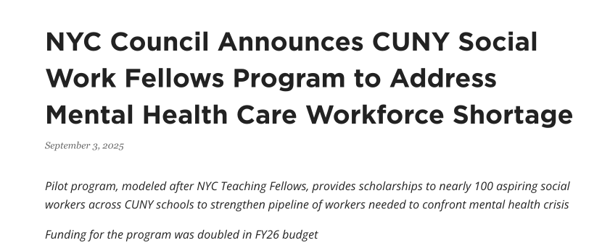
In New York City, the CUNY Social Work Fellows program was established to reduce the financial barriers facing people who want to enter the profession. The program provides scholarships to students pursuing a Master of Social Work at CUNY schools, with the city describing it as a way to strengthen the pipeline of behavioral health professionals. The program was initially funded in the FY2025 budget, and funding was doubled in the FY2026 budget, bringing the total FY2026 investment to $2 million.
That is significant because becoming a social worker is not simply a matter of deciding to enter the field. For people pursuing advanced clinical or professional roles, graduate education is part of the pathway into the profession.
At the state level, New York has taken a much larger approach. In 2024, Governor Kathy Hochul announced up to $646 million over three years for the Career Pathways Training program.
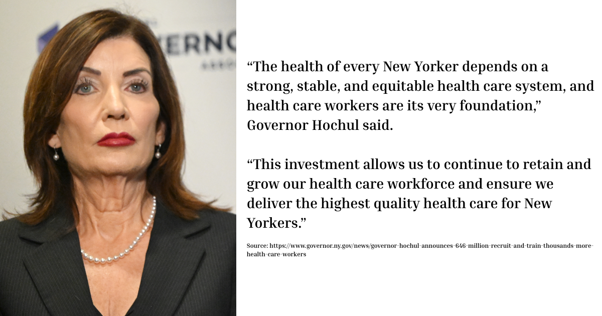
The program remains active, and is designed to recruit and train thousands of new health, mental health, and social care workers, while also providing opportunities for existing workers to advance their careers. Funding can support tuition, educational expenses, academic support and job placement.
For people considering social work as a career, that matters because workforce shortages cannot be solved simply by encouraging people to apply for jobs. There has to be a route from education into employment, particularly in areas where demand is greatest.
Education Is Part of the Solution
The emphasis on training also highlights something that can get lost when workforce shortages are discussed. Increasing the number of social workers ultimately depends on increasing the number of people who can qualify and enter the profession.
A Master of Social Work can open the door to a range of roles across community organizations, schools, health care and mental health services. For people who are already working or who cannot relocate to attend a traditional program, the availability of flexible study options can make that pathway more realistic.
That is one reason prospective students may want to explore online MSW programs in New York. Online study does not remove the academic and professional requirements involved in becoming a social worker, but it can provide another way for students to complete graduate education while managing work and other responsibilities.
The importance of education is also reflected in New York’s licensing system. The state requires applicants for licensed master social worker and licensed clinical social worker credentials to meet specific education and examination requirements. For LCSW licensure, for example, applicants must hold an MSW, complete the required supervised experience, and pass the relevant licensing examination.
Education therefore sits at the center of the workforce issue. New York needs more people to enter the profession, but those people also need the qualifications and practical preparation required to provide services safely and effectively.
Financial Support Can Make a Difference
The cost of becoming a qualified professional can itself become a barrier, particularly in fields where starting salaries may not immediately reflect the cost of graduate education.
New York has attempted to address that problem through financial assistance as well as training. The state’s Community Mental Health Loan Repayment Program, for example, provides funding that participating agencies can use to offer loan repayment to eligible mental health professionals who commit to working in qualifying programs for three years.
The 2026 program makes up to $5 million available each year, with awards of up to $30,000 over the three-year service commitment. Licensed master social workers and licensed clinical social workers are among the professions eligible for the program.
That kind of support addresses two problems at once. It can make entering the profession more financially attractive while also encouraging qualified workers to remain in community-based services where demand is high.
New York Is Also Looking at the Barriers to Entering the Profession
Education and financial support are only part of the picture. There has also been growing discussion in New York about whether the licensing process creates unnecessary barriers for people trying to enter social work at a time when the state is looking to expand the workforce. Applicants for LMSW and LCSW licensure are still required to pass an examination, with the ASWB examination accepted for this purpose, but lawmakers have proposed changes that could make the process more accessible.
One proposal is the Social Worker Initiative for Faster Testing, or SWIFT Act, which would allow MSW students in the final semester of qualifying programs to take the master’s-level examination before completing their degree. As of 2026, however, the legislation remains under consideration and has not become law.
New York has therefore not removed its examination requirements, even as the licensing system itself has evolved. The ASWB introduced revised social work licensing examinations in August 2026, with a new structure focused more heavily on applied professional knowledge.
The changes reflect a broader challenge for policymakers: finding a way to maintain the professional standards expected of social workers while making the route into the profession practical enough to support a larger workforce. For a state facing growing demand for social and mental health services, that balance is likely to remain part of the workforce conversation.
The Need Is Particularly Visible Among Young People
The workforce issue becomes particularly clear when looking at the mental health needs of children and teenagers. Recent reporting by Amsterdam News has highlighted concerns about access to mental health support for New York City teenagers, including the difficulty some young people face in finding appropriate local services. The challenge is not simply whether a service exists on paper, but whether there are enough professionals available to provide meaningful support when and where it is needed.
That helps explain why school social work has become such an important part of the wider conversation. Schools are often where problems first become visible, giving social workers an opportunity to work with students, families, teachers, and outside services before difficulties become more difficult to address. Their role can extend well beyond responding to an immediate mental health concern, particularly when students are also dealing with family circumstances, housing insecurity, academic difficulties, or other pressures outside the classroom.
New York’s investment in training therefore has implications beyond simply filling vacant positions. Expanding the social work workforce could give schools, community organizations, health care providers, and other support services greater capacity to respond to the needs of New Yorkers, particularly young people who may otherwise struggle to find help when they need it.
Tackling the Shortage Will Take More Than Recruitment
New York’s response to the social work shortage shows that expanding the workforce is going to require more than simply advertising more jobs. Scholarships and training programs can help people gain the qualifications needed to enter the profession, while loan repayment and other financial incentives can make it easier to attract workers into roles where demand is particularly high. At the same time, the debate over licensing suggests that policymakers are also considering how the path into the profession itself could be made more accessible without lowering professional standards.
None of this will change the size of the workforce overnight. Training takes time, and recruiting more people will only have a lasting effect if organizations can retain them once they enter the profession. That makes education a particularly important part of the equation. If New York wants more social workers in the years ahead, it needs to make the path into the profession achievable for more people while giving them good reasons to stay.
The state’s recent investments are a sign that policymakers recognize that connection. The next challenge is turning those investments into a workforce large enough to meet demand across schools, health care, community organizations, and other settings, particularly as more young New Yorkers seek mental health support.