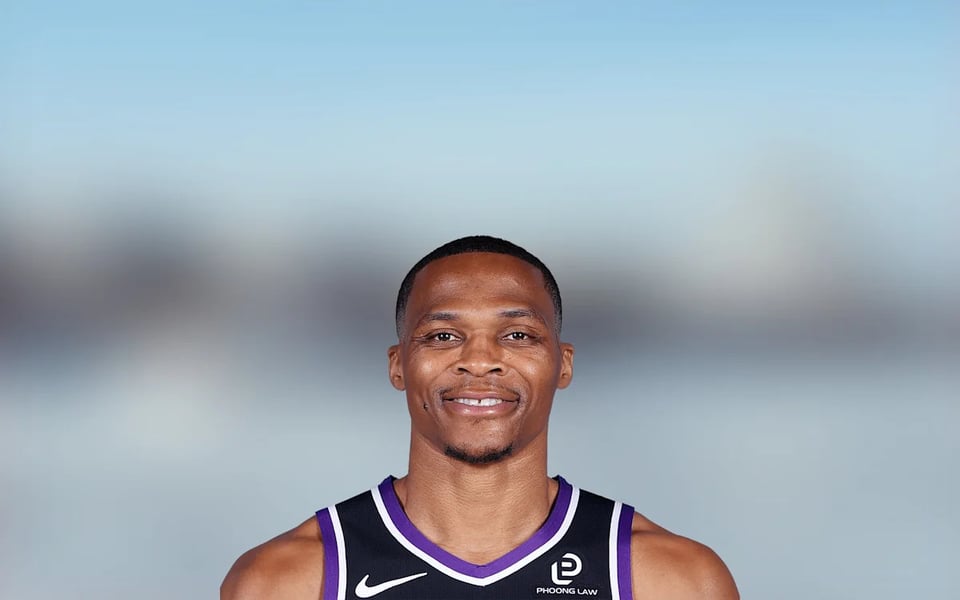

SAN FRANCISCO — Eighteen years in the NBA, nine All-Star selections, and one of the most statistically freakish careers in basketball history, and Russell Westbrook’s first move in retirement is to build a league.
Project B, the startup basketball venture preparing for its first women’s season in November, announced Westbrook this week as a co-founder and chief strategy officer. He will hold an equity stake in the league, sit on its board of directors, and take an active role in shaping Project B’s basketball strategy and long-term vision. The move makes him the highest-profile name attached to the organization in any capacity.
“At every step of my career, what was most valuable to me was making sure everyone had a seat at the table,” Westbrook said in a statement. “With Project B, we’re challenging the norm and bringing a new vision to the intersection of premium sport, culture, and entertainment. We’re reimagining the experience with players not only as key value drivers, but also as shareholders and decision makers.”
The language tracks with what Project B has always said it is: a league designed to correct the financial structure that produced decades of WNBA talent paid at fractions of NBA market rates. The league’s founding pitch to players was straightforward. Every player signs for equity in addition to salary, with some offered contracts reportedly exceeding $2 million per year, against the WNBA’s roughly $102,000 per-season cap. The players who have committed include Nneka Ogwumike, Jonquel Jones, Alyssa Thomas, and Jewell Lloyd. Kelsey Mitchell, who set the WNBA record for consecutive 20-point games this month, is also on board.
Project B’s founding team reads like an experiment in connecting money, basketball credibility, and cultural capital. Alana Beard, the four-time WNBA All-Star, serves as chief basketball officer, which means she is the person whose basketball judgment players are actually buying into. Grady Burnett, a former Facebook executive, and Geoff Prentice, the Skype co-founder, built the financial structure. Maverick Carter, the entertainment executive and longtime business partner of LeBron James, is collaborating with the venture. Investors include Candace Parker, Novak Djokovic, Steve Young, and Sloane Stephens.
Westbrook fits into a specific category: the athlete who has enough institutional credibility to bring in the next wave of players and the business instincts, developed across two decades of building his own brand, to contribute something beyond his name. Landry Fields, the former NBA player and executive who leads Project B’s men’s division, fills a similar role on the league-building side.
The league’s structure is unconventional in almost every dimension. Six teams. Eleven players per roster. Seven two-week tournaments distributed across Europe, Asia, and Latin America, rather than a traditional home-and-away schedule concentrated in one country. The first women’s season begins in November and runs through April 2027, meaning it operates during the WNBA offseason rather than against it. As Yahoo Sports reported, Westbrook will have an active hand in strategic partnerships as well as basketball operations.
Westbrook’s arrival will not answer the central question about Project B’s durability, which is whether it can generate the revenue that justifies its salary structure. The league has spent heavily on player attraction, and the roster assembled is more decorated than several WNBA teams by any objective measure, but operating a global tournament circuit across six markets requires television rights, sponsorship relationships, and ticket infrastructure that have not yet been disclosed at a level that resolves the uncertainty.
What Westbrook brings is a specific kind of credibility that matters in an athlete-equity conversation. The 2016-17 MVP averaged a triple-double across that season, and then across the next two, and when he talks about players controlling their own value, he does so as someone who watched what happens when an athlete’s productivity and their compensation get fundamentally disconnected. His own earnings in the NBA were substantial. He understands what the gap looks like from both sides.
The basketball business has moved quickly in the years since anyone first floated the player-equity concept. As Eastern Herald reported, five ownership groups are competing for the NBA’s Las Vegas expansion franchise at a price north of $8 billion, which means the sport has never been worth more money, or concentrated that value more tightly at the ownership level. Project B is making a specific argument about where the next increment of value should go.
Whether Westbrook can help build the league its pitch describes is unknowable before the games start. What the announcement establishes is that Project B has found, in its co-founder, someone who spent nearly two decades demanding the ball with time running down and usually making something of it.