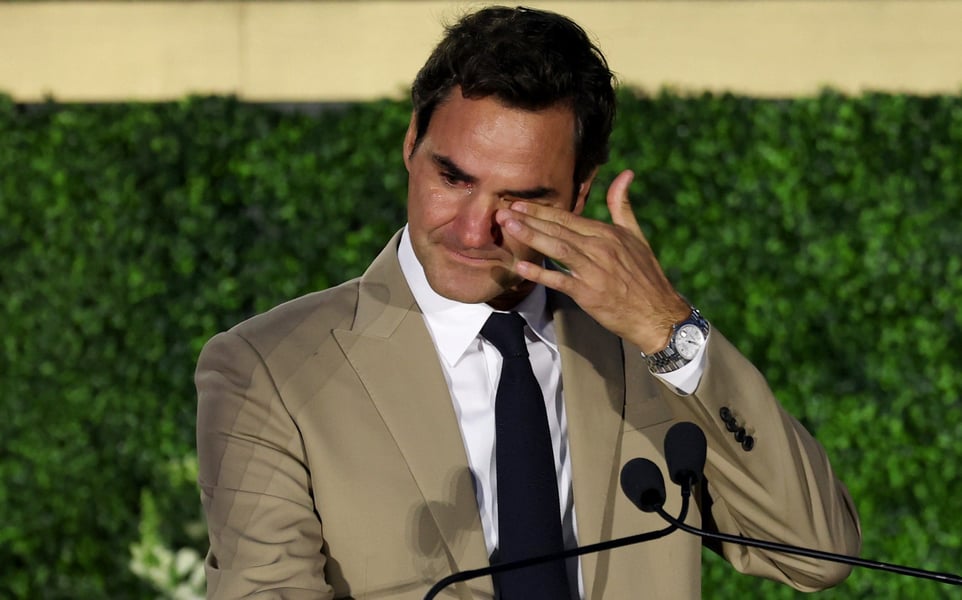

NEWPORT, Rhode Island — Six times in thirty minutes, Roger Federer cried.
He had no notes. He had no script. He stood on the grass court at the International Tennis Hall of Fame as the sun lowered over Newport and spoke for thirty minutes, finding tears reliably every time the speech touched something real.
The most raw moment came when he reached Peter Carter, his childhood coach from Australia who died in a car crash in South Africa in 2002. Carter never saw the Wimbledon titles, never saw the Grand Slam records, never witnessed any of what followed. Federer spoke about him quietly. He did not try to recover quickly. He did not rush to the next sentence.
The loss, Federer indicated, was the door through which he finally walked in. The following year, he won his first Wimbledon, and began a five-year run that produced twelve Grand Slams.
Inducted alongside broadcaster Mary Carillo on Saturday in Newport, Federer formally joined tennis’s permanent record, though the speech he gave made clear the honour meant something quite different to him. This was not about the 20 Grand Slam titles. Not about the 310 weeks ranked world number one, or the 103 ATP Tour titles accumulated before he retired at the Laver Cup in September 2022.
It was, almost entirely, about the people.

The evening began with a piece of genuine spectacle. Federer’s wife Mirka, who had not given a public address in twenty-four years, took the stage to introduce her husband. As Yahoo Sports reported, she traced their relationship to the 2000 Sydney Olympics, when the Swiss teenager across from her had, in her words, “exactly zero ATP titles.” She shared an anecdote about Andy Roddick, who reportedly lost a Cincinnati final to Federer and joked afterward: “I can’t believe I lost to a guy whose girlfriend warmed him up.”
The crowd roared. Federer, seated in the front row, appeared undone before he had said a word.
“I don’t know if you’ve been secretly practising,” he said when he reached the microphone, “but this is very high level and a tough act to follow.”
The speech that followed was, by the measure of such occasions, remarkable. Federer recalled being a thirteen-year-old ball boy at the Swiss Indoors in Basel, watching Stefan Edberg and Boris Becker move across the court and beginning to understand what the game could become for him. He estimated, to laughter, that he had worn approximately 5,000 headbands and developed a habit of doubling his socks on match days. He spoke about Peter Lundgren, another coach who shaped him and who has since died.
And then, when he reached Carter, his voice went somewhere quieter.
That section of the speech is the part most likely to be remembered. Not the statistics, not the humour, not even Mirka’s introduction. The part where the man who had won everything was still, visibly, carrying the absence of the one person who never got to see it.
The week in Newport already carried unusual weight. The US Open is currently underway in New York, and Federer had played an exhibition earlier in the week against Andy Roddick at prime time, then joined John McEnroe for doubles against Roddick and Andre Agassi. The crowds were at capacity. The event provided context that the Hall of Fame ceremony then made explicit: tennis has moved on since Federer’s retirement, but the game has not quite resolved what to do with the space he occupied.
Novak Djokovic, who earlier this summer broke Federer’s all-time Wimbledon wins record and later matched the landmark of 105 Wimbledon victories, sent a video message to Newport. Al Jazeera reported Djokovic calling him “a great ambassador for our sport.” He did not attend in person. Nadal’s absence went unexplained publicly.
It is a curious feature of this moment that the generation now shaping professional tennis looks at Federer less as a rival than as a reference point. Young Spanish talent Rafael Jodar has cited Federer’s touch as one component of an ideal player, alongside Nadal’s mentality and Alcaraz’s power, a framing that locates Federer somewhere between history and instruction manual.
Federer himself seemed aware that enshrinement risks the sensation of a closing. He pushed back with his final lines.
“Anywhere that kids draw courts in the streets with chalk,” he said. “Where they hit against walls with board rackets.” He paused. “I’m still writing my love letter to tennis, and my time as a player is done.”
Then: “This is not a goodbye.”
What form that love letter takes next remains unanswered. Newport gave Federer a platform to reflect on what the sport gave him. What he gives the sport from here, he chose not to say.
Mary Carillo, presented by Billie Jean King in the contributor category, shared the Newport stage but not the spotlight. That belonged to the man who spent thirty minutes crying six times, without a note in front of him, on a Rhode Island grass court at sunset, and found something worth saying every single time.