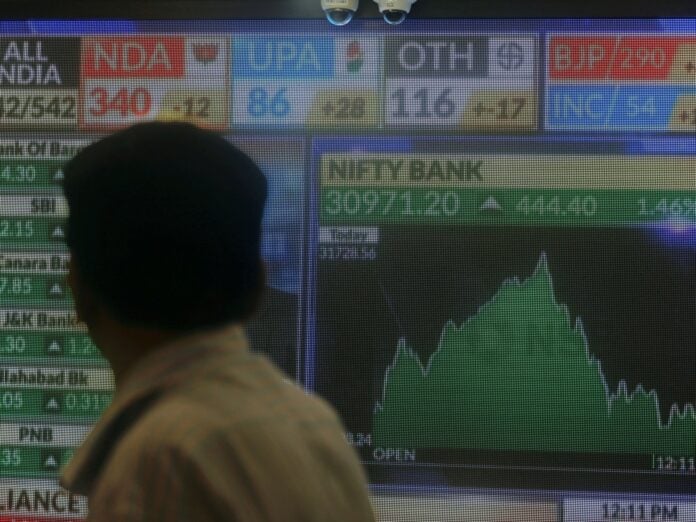

MUMBAI — Six months of data have produced a contradiction India’s most valuable private company has not fully resolved: Reliance Industries posted one of its strongest quarterly results in memory during the same period its stock fell 6.3 percent.
Monday’s session extended the disconnect. The stock shed 0.60 percent to close around ₹1,316.80 on the National Stock Exchange, retreating from an intraday open of ₹1,323.10 and holding above session support at ₹1,313.20. What moved the stock was not anything Reliance did. It was what the US Labor Department reported Friday, when August non-farm payrolls came in at nearly triple the consensus forecast, driving overnight futures markets to price a 60 percent probability of a September Federal Reserve rate increase.
| Metric | Value |
|---|---|
| NSE Close (Sept 7) | ₹1,316.80 |
| Day Change | ▼ -0.60% |
| Intraday Range | ₹1,313.20 – ₹1,324.20 |
| Market Capitalisation | ₹17.81 lakh crore |
| 52-Week High | ₹1,611.80 |
| 52-Week Low | ₹1,249.80 |
| Q1 FY27 Net Profit | ₹23,196 Cr (+6.12% YoY) |
| Q1 FY27 Revenue | ₹3,40,257 Cr (+24.50% YoY) |
| Source: NSE market data; Reliance Industries Q1 FY27 earnings release. Data as of September 7, 2026. | |
A Fed move would strengthen the dollar against a broad basket of Asian currencies, and the rupee is among the more exposed. For Reliance, that matters most in its oil-to-chemicals division, the segment that still generates the largest share of group EBITDA and sources the bulk of its crude feedstock through dollar-denominated contracts. Each incremental dollar appreciation against the rupee compresses the rupee value of refined-product margins on the domestic side while raising the effective input cost of the crude it runs through its Jamnagar refineries. This is not a new risk for the conglomerate, but the NFP shock has made it specific and near-term in a way that previous macro uncertainty had not.
The business itself is not in trouble. Reliance reported consolidated net profit of ₹23,196 crore for Q1 FY27, rising 6.12 percent from a year earlier and 12.66 percent from the preceding quarter. Gross revenue climbed 24.50 percent year-on-year to ₹3,40,257 crore. Capital expenditure for the quarter reached ₹38,682 crore, directed at new energy infrastructure, O2C capacity maintenance, and the preparation for a Jio Platforms public listing, a process that resulted in a draft red herring prospectus filed with the Securities and Exchange Board of India shortly after the quarter’s close.
That filing has become the stock’s most closely watched near-term variable. As Nikkei Asia reported, Jio Platforms submitted its DRHP to SEBI following board approval, with chairman Mukesh Ambani confirming an offering analysts expect to rank among the largest in Indian corporate history. The draft accounts show Jio’s operating revenue approaching ₹400 billion in the fiscal year through March, with after-tax profit near ₹80 billion and over 500 million subscribers on its wireless network.
For analysts tracking the conglomerate, that filing changes the floor argument for the parent stock. Before the DRHP, Jio’s value was folded into the Reliance consolidated multiple, dragged lower by the market’s crude-price skepticism toward the O2C division. The SEBI submission forces the market to assign a separate valuation, closer to a technology-company multiple than an oil refiner, to a business compounding revenue double-digit with more than 500 million subscribers. That separation does not immediately reprice the parent stock, but it creates a structural floor that macro selling alone is unlikely to break through entirely.

India’s Nifty Energy index saw a parallel set of pressures in the first week of September, with crude near $95 squeezing OMC downstream margins harder than it affected refiners of Reliance’s scale. The broader infrastructure context, covering how construction and port stocks performed against that same backdrop, is documented in EH’s analysis of Nifty Infrastructure stocks through last week.
From a technical standpoint, the stock is pressing the lower boundary of the range it has defended since early August. Support between ₹1,290 and ₹1,300 represents a confluence of the late-June price floor and the 200-session moving average. A close below ₹1,300 would be the first since April and would likely trigger systematic selling from momentum-oriented funds whose entry levels are clustered in that band. Resistance on any recovery sits between ₹1,330 and ₹1,340, a range that capped three separate intraday rallies last month. The distance between Monday’s close and the 52-week high of ₹1,611.80, roughly 22 percent, reflects the earnings recovery the company has delivered without the valuation re-rating the market has withheld pending clarity on both the macro and the Jio listing timeline.
The open question is timing. SEBI review periods for offerings of Jio’s complexity can run six to twelve months, and a listing that proceeds after a second consecutive Fed rate increase would arrive into a more risk-off global environment than the summer’s low-volatility conditions assumed. Monday’s price is absorbing that timing uncertainty, not the quarterly fundamentals, which have broadly delivered.