
WASHINGTON — The Trump administration directed the General Services Administration on Monday to remove Canadian-manufactured goods from the federal government’s Multiple Award Schedules program, a procurement mechanism that channels more than $50 billion in annual government purchasing and that until now had remained largely insulated from the tariff fight between Washington and Ottawa.
The directive, announced by the president on Truth Social, represents the first time the White House has moved to align the long-term federal contracting system, which covers agreements that can run five years and be extended to twenty, with the trade restrictions it has applied to Canadian goods since January. Administration officials said the action was intended to complement the tariff structure already in place rather than signal a new escalation, though Ottawa reacted as though it were precisely that.
The GSA’s Multiple Award Schedules function as a pre-negotiated catalogue from which federal agencies can purchase products and services without conducting individual competitive bids. Canadian companies and their American distributors have long been listed on the schedules for goods ranging from industrial equipment to office supplies. Under the new directive, contracting officers will be required to identify and remove Canadian-origin products from active schedules as renewals come due.
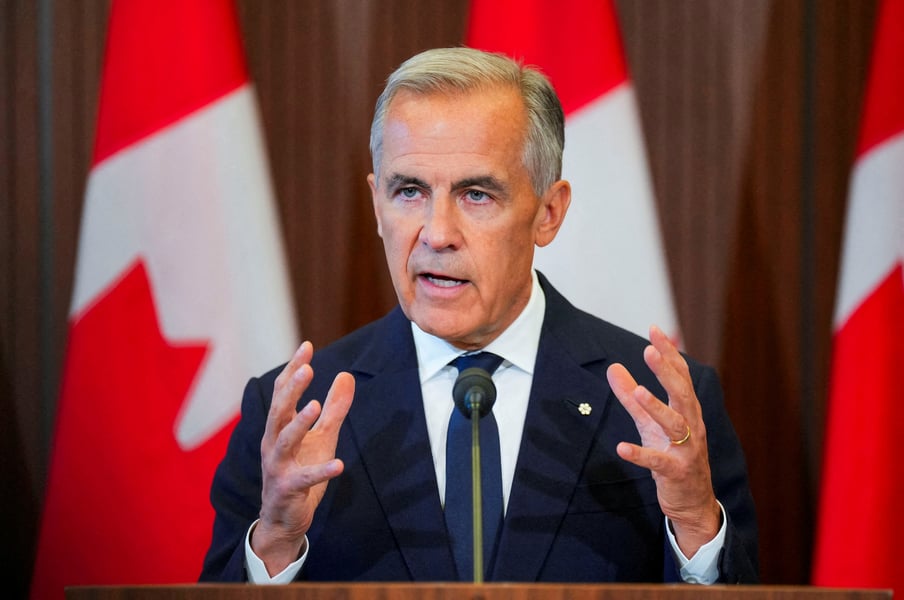
Prime Minister Mark Carney’s government had signaled weeks ago that a deal was possible if Washington dropped what Ottawa officials described as “tough” rhetoric and returned to substantive negotiation on a bilateral framework. Those talks collapsed on August 21, according to people familiar with the discussions, after the two sides failed to agree on a mechanism for reviewing tariff rates.
Since then, the standoff has hardened. The United States is currently applying a 50 percent tariff on roughly $20 billion in Canadian goods. Canada, in turn, launched a fresh round of retaliatory measures on Monday, targeting American steel, dairy products, appliances, agricultural equipment, pulp and paper, and electronics. The full list, released by the federal government in Ottawa, covers sectors the Carney government identified as carrying maximum political weight in key US congressional districts.
US Trade Representative Jamieson Greer, who oversaw the collapsed August talks, declined to comment on the GSA directive specifically. A spokesperson for his office at the USTR said the administration remained “committed to achieving fair trade outcomes for American workers,” a formulation that has accompanied virtually every major tariff action in the current cycle.
The timing was not incidental. Canada’s retaliatory tariffs took effect on the same day the White House announced the GSA action, suggesting both governments moved in tandem, each framing its own measures as a response to the other. Ottawa has been careful to match the scale of its retaliation to avoid giving Washington a pretext for further escalation, a calibration that Canadian trade officials have described as deliberate.
For Canadian manufacturers already navigating the existing tariff wall, removal from the GSA schedules would close one of the last remaining channels through which their products reached American government buyers without triggering additional duties. Industry groups in Ottawa warned that the impact would accumulate over years rather than arrive immediately, given the multi-year structure of the schedules and the fact that existing contracts would not be affected until renewal.
The GSA manages approximately 5,000 active schedule contracts, a fraction of which involve Canadian-origin goods. Federal procurement rules require agencies to document country-of-origin information for each purchase, a requirement that the administration said would allow the GSA to identify affected contracts systematically. The process of removing items from the schedules and replacing them with domestic alternatives is expected to take months.
VOA reported Monday that the Canadian government was reviewing its legal options under the Canada-United States-Mexico Agreement, though trade lawyers noted that the CUSMA framework contains limited mechanisms for challenging procurement decisions made on national security grounds, which is the rationale the administration has cited for its tariff program.
What Ottawa has not said publicly is how much flexibility Carney retains to negotiate. His government faces an election cycle in which the US relationship is the dominant policy question, and the August collapse drained much of the goodwill that had accumulated after his initial offer to return to the table in July. Whether Canada’s Monday retaliatory package is intended as a pressure mechanism or as a signal that talks are finished is a question the Carney government has not answered directly.
The administration, for its part, has not indicated whether the GSA directive is meant to be reversible. Removing products from the schedules is a bureaucratic process; restoring them would require a similar administrative procedure and, presumably, a decision to reverse course on the broader tariff structure that underlies it. Neither side has offered a public pathway to that outcome.