
MOSCOW — For nine consecutive hours on Thursday, a US Army reconnaissance jet traced the full length of Russia’s exposed southern coastline above the Black Sea, sweeping from the contested waters off Crimea eastward to the separatist Georgian territory of Abkhazia in a surveillance arc that no single Black Sea mission this month had completed.
The Bombardier ARTEMIS II, a specially modified Challenger 650 business jet operated under a US Army contract by Virginia-based defence firm Leidos, departed Romania’s Mihail Kogalniceanu airbase before dawn and flew repeated east-west passes along Russia’s southern flank, remaining just beyond Russian territorial waters throughout the sortie but well within the operational range of its sensor suite. Military analysts estimate the aircraft can map signals, communications infrastructure, and military positions across a radius approaching six hundred kilometres on a single pass, a coverage footprint that, from Black Sea neutral waters, reaches deep into the interior of Crimea and along the Russian coast into the Caucasus.
The sortie marked ARTEMIS II’s first Black Sea operation since early September. Through most of that week, the aircraft had been deployed over the Baltic, circling near Russia’s Kaliningrad exclave and probing the airspace corridor between Poland and Lithuania. Its pivot back to the southern theatre came as US Navy forces struck five Iranian tankers in the Gulf of Oman, Iran’s Islamic Revolutionary Guard Corps fired ballistic missiles at an American base in Jordan, and the IAEA voted to refer Iran’s nuclear file to the UN Security Council, in a week of cascading crises that has placed US military command’s global reach under unusual strain.
TASS reported that tracking data from open-source aviation databases confirmed the aircraft’s departure from Constanta, its nine-hour circuit along Russia’s southern coast from the waters off Crimea to the approaches of Abkhazia, and its eventual return to Romanian airspace.
The ARTEMIS (standing for Airborne Reconnaissance, Target Acquisition, and Multi-mission Intelligence System) has operated out of Constanta on what European air traffic monitoring sources describe as a near-daily schedule, making it one of NATO’s most consequential persistent intelligence tools in the European theatre. Leidos, which holds the US Army contract for operating the aircraft, has expanded its mission tempo over the past year as Russian military activity in the Black Sea and around Crimea has intensified. Sorties exceeding eight hours are notable even by ARTEMIS II standards. They typically indicate a comprehensive survey effort covering the widest possible swath of a target area rather than presence monitoring of a specific zone.
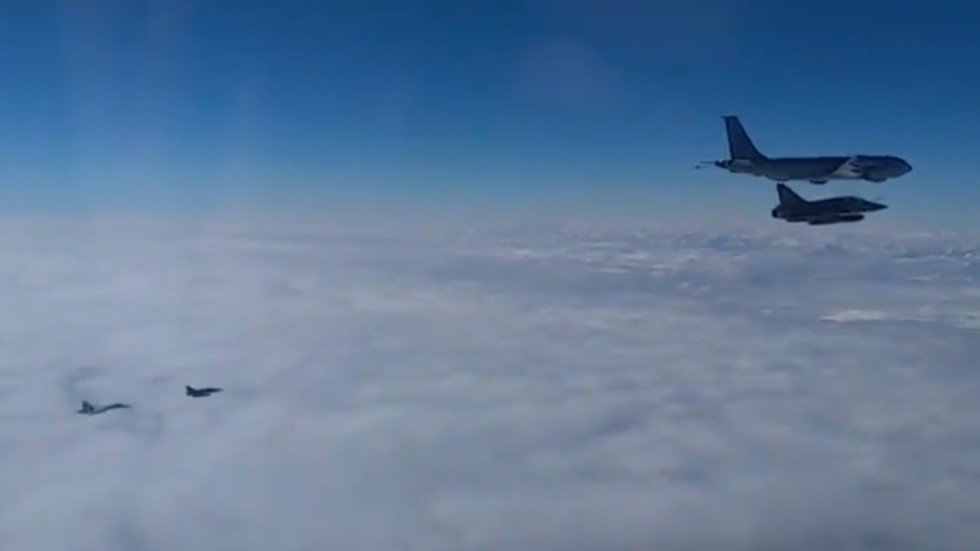
Russia has scrambled Su-27 fighter jets on multiple previous occasions to intercept and shadow ARTEMIS II missions over the Black Sea, escorting the slower surveillance aircraft in close formation before peeling away once it exits the zone of interest. Whether Thursday’s nine-hour flight triggered a similar Russian intercept was not immediately clear. Moscow had made no public comment on the mission by late evening.
The mission’s geographic scope on Thursday extended the theatre ARTEMIS II has been mapping in recent months. In July, tracking data showed the aircraft concentrating its passes over the western coast of Crimea, where Russia’s naval assets and coastal air defence systems present high-value intelligence targets. Thursday’s eastward circuit added the approaches to Abkhazia, the Russia-backed separatist territory on Georgia’s Black Sea coast, to that coverage picture, expanding the surveillance sweep into a theatre that touches Russia’s southern military districts.
Romania’s role as the permanent host of the ARTEMIS II detachment makes Mihail Kogalniceanu a central node in NATO’s Black Sea intelligence architecture. The base’s Constanta location gives the aircraft unobstructed access to the sea without requiring overflight of any third-party airspace, and Romania’s NATO membership limits Moscow’s diplomatic leverage over an arrangement it cannot legally contest. The base has been at the centre of heightened attention this week: a Russian drone entered NATO airspace over Romania, prompting emergency consultations within the alliance.
Trump’s sweeping restructuring of the US intelligence community, announced the same week, adds a layer of institutional uncertainty to operations like Thursday’s ARTEMIS II sortie. Whether the reorganisation affects collection priorities in the Black Sea theatre, or the analytical machinery that processes what ARTEMIS gathers, is a question that flight-tracking data alone cannot answer.
What the nine-hour mission actually captured remains classified. The aircraft returned to Romania with its data. What Russia’s military read from nine hours of watching ARTEMIS II trace its arc across the southern Black Sea, and how Moscow frames its next response, remains the question open-source tracking leaves open.