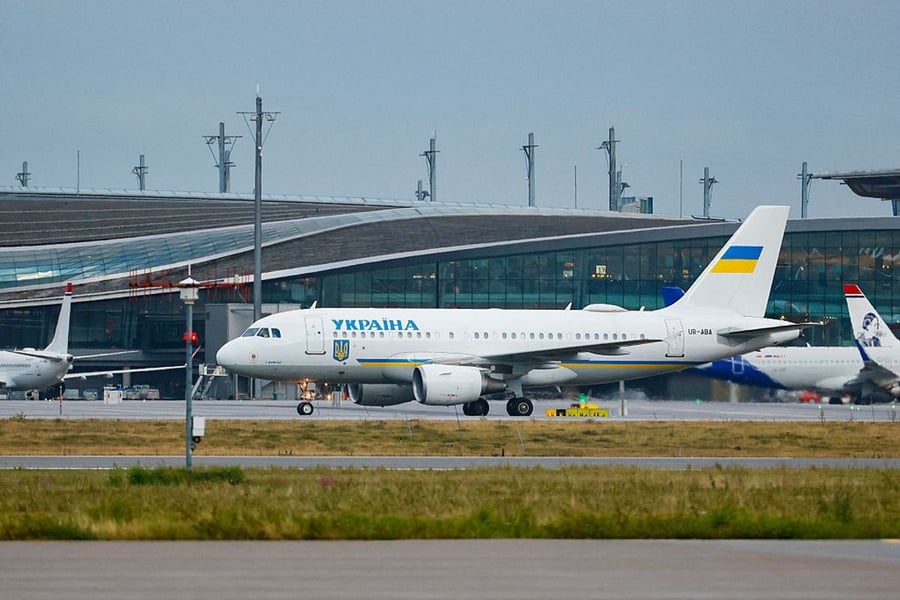

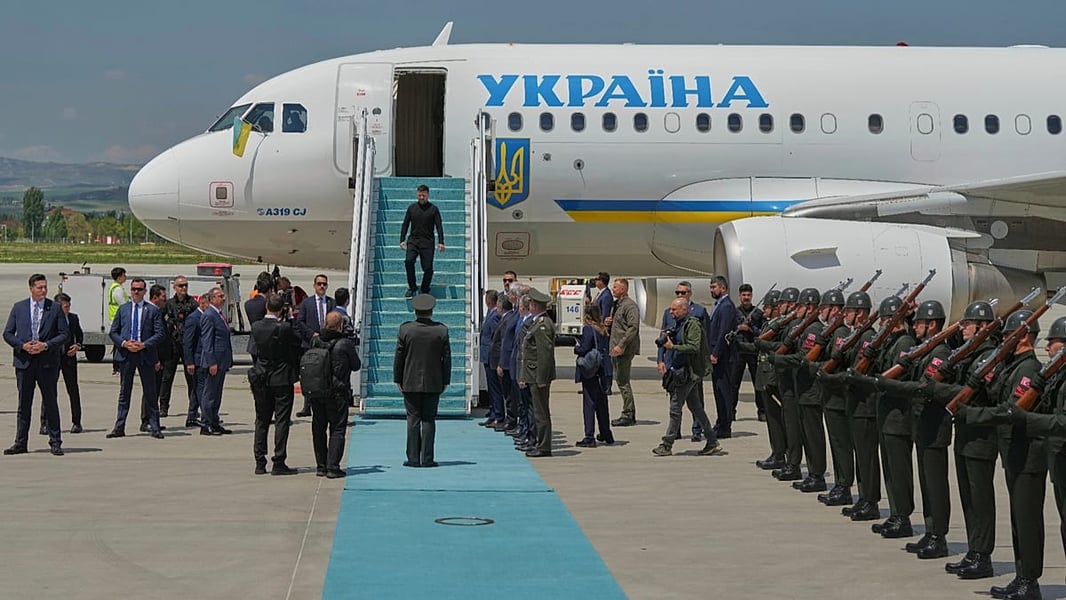
CHIȘINĂU — On the morning of September 9, Norwegian Prime Minister Jonas Gahr Støre told state broadcaster NRK that Ukrainian President Volodymyr Zelensky’s plane had “nearly” been hit by a drone as it prepared to take off from Moldova, offering a detail that neither Moldova, NATO, nor Ukraine had publicly disclosed the previous day. Zelensky had been attempting to reach Oslo for the funeral of Norway’s King Harald V.
Based on Moldova’s official timeline, open-source tracking data and a source who spoke to the Kyiv Independent, the incident appears to have involved a Russian Geran-4 jet-powered attack drone that spent more than an hour moving through Moldovan and Romanian airspace on the afternoon of September 8. The drone reportedly evaded two Spanish F-18 fighter jets scrambled under NATO’s air-policing mission before crashing in Moldova’s Rîșcani district.
Moldovan authorities provided residents with a limited account of the incident, while Ukrainian officials said Zelensky was never in direct danger. Questions remained, however, over what NATO’s air-policing mission detected and why the aircraft was not intercepted. No NATO official publicly provided a detailed explanation.
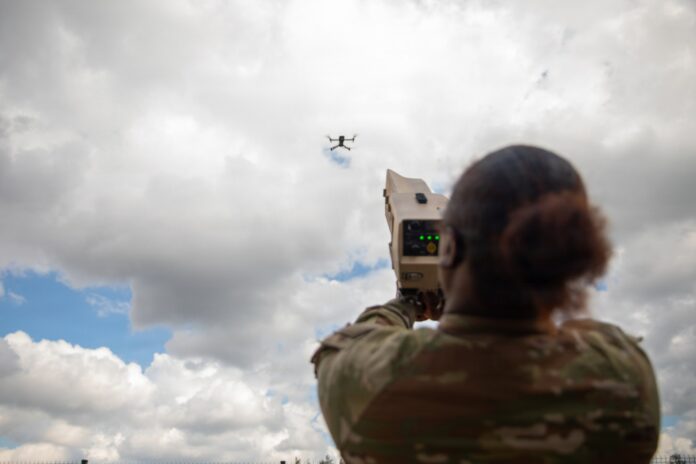
The drone was detected entering Moldovan airspace from the direction of Ukraine at about 4:20 p.m. local time. Ukrainian military monitoring channels identified the aircraft as a Geran-4, described as Russia’s latest jet-powered variant of the Shahed family of attack drones and an evolution of the slower, propeller-driven Shahed-136 that has been widely used over Ukraine.
Romania’s Defense Ministry later reported that the same object, or another associated contact, entered Romanian airspace near the city of Roman about 27 minutes later. Two Spanish F-18 fighter jets operating under NATO’s enhanced Air Policing mission in the region were scrambled in response.
The fighters did not intercept the drone. It traveled at least 50 kilometers into Romanian territory before returning to Moldovan airspace and eventually crashing in Rîșcani. Romanian radar tracked the contact until 5:02 p.m., when it was lost, before the object reappeared over Moldova five minutes later. Moldovan authorities subsequently lifted the airspace restrictions after confirming that the drone had come down. Zelensky’s aircraft took off at approximately 5:57 p.m.
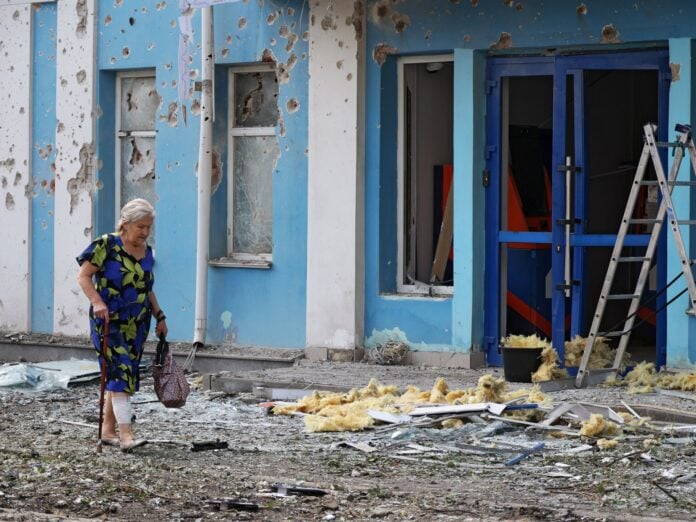
What NATO’s air policing mission could not establish with certainty was whether the drone was navigating deliberately — toward an airport where the Ukrainian president was known to be — or whether it was a navigation error consistent with previous Shahed over-flights of Moldovan and Romanian territory documented since 2023. Moldova’s president, Maia Sandu, condemned the incident in language that refused to leave the question open. Russia’s drone activities near Moldova’s borders, she said, represented a “serious threat to people’s lives.” She also condemned a separate Russian drone attack on a Moldova-Ukraine border crossing the same day that killed two people. A senior official in Zelensky’s office described suggestions of personal danger to the president as “exaggerated.”
This was not the first time a Russian drone crossed into Romanian airspace and eluded Alliance assets. A Spanish F-18 operating under the same NATO air policing mandate had shot down a Russian drone over Romania near the Moldovan border on August 16, roughly three weeks before the September 8 incident. The pattern implies not an isolated navigation error but a corridor of drone activity over the Moldova-Romania borderlands that neither Chișinău nor Bucharest nor NATO has found a consistent means of closing.
The deeper context is what gives the September 8 incident its particular weight. It unfolded on the same day Donald Trump and Vladimir Putin held a phone call that the Kremlin described as “extremely frank” and lasting roughly an hour. Trump called Putin “great” afterward. The two discussed what the Kremlin vaguely termed “specific measures” on Ukraine — without naming them, without involving Kyiv. Zelensky thanked Trump for the call and was told to expect an air defense package. Hours earlier, he had been grounded in a foreign capital while a Russian drone worked its way through NATO airspace a few dozen kilometres away, the Kyiv Independent reported.
Whether that juxtaposition was deliberate on Moscow’s part is the question no one in the Western alliance has answered publicly. The Kremlin did not claim the drone’s presence in Moldovan airspace was intentional. It rarely does, in cases like these. Russia has denied involvement in previous drone over-flights that left craters in NATO-member territory.
What is documented: the Geran-4 is not a stray weapon. It requires a launch decision, a programmed route, and a targeting or patrol instruction. It flew from Ukrainian territory — territory Russia currently occupies large portions of — through Moldovan and Romanian airspace and back. On the day Trump and Putin spoke, the drone arrived first.
The Trump-Putin call’s outcome — vague promises of “specific measures” — and the drone’s route both speak to the same fundamental ambiguity: who controls the geography of this war, and what protections actually exist for those moving through it. That question followed Zelensky to Oslo, where he met Canadian Prime Minister Mark Carney on the margins of King Harald’s funeral. The same week, Ukrainian drones struck Sochi’s Black Sea embankment, killing one and injuring eight — the parallel escalation that NATO’s air policing mission is still trying to contain at the other end of the war’s expanding geography.