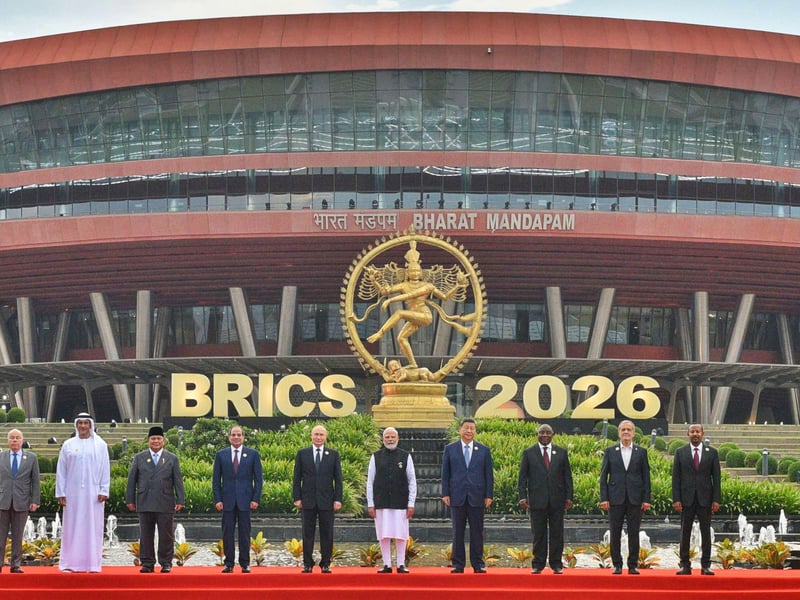

NEW DELHI — The question that hung over the 18th BRICS Summit was not whether the bloc’s twenty-three member states would publicly discuss reducing their dependence on the U.S. dollar. They would. The question was whether they had built anything real enough to make Washington nervous.
On Friday, they offered an answer. Leaders gathered at Bharat Mandapam adopted the New Delhi Declaration 2026, a 45-page document that formally endorses BRICS Pay, a decentralized payment messaging ecosystem designed to route cross-border transactions through national systems rather than the dollar-denominated SWIFT network. The move drew an immediate counter-threat from President Trump, who posted that any BRICS country pursuing alternatives to the dollar would face 100 percent tariffs, NBC News reported.
BRICS Pay is not a common currency, and the bloc’s architects were careful not to call it one. The system integrates India’s Unified Payments Interface, Brazil’s Pix, China’s Cross-Border Interbank Payment System, and Russia’s System for Transfer of Financial Messages into a shared messaging layer capable of handling 20,000 transactions per second. What it creates is an interoperability bridge that allows participating banks to send and receive cross-border payment instructions without routing through U.S.-controlled infrastructure. What it does not create is a reserve asset, a clearing mechanism backed by member-state central banks, or any instrument that would allow a country to hold BRICS Pay balances the way it holds dollar reserves.
That distinction matters. De-dollarization, in its most ambitious form, requires the world to hold, price, and settle commodities in a non-dollar unit. BRICS Pay does not accomplish that. It addresses a narrower problem: the sanction vulnerability that comes with routing transactions through a network the United States Treasury can freeze.
India’s Prime Minister Narendra Modi, who chaired the summit as BRICS president, steered the messaging carefully. New Delhi has avoided the term de-dollarization in official communications, preferring language about “payment resilience” and “cross-border payment diversification.” The distinction is not merely diplomatic. India maintains significant dollar reserves and is not yet prepared to challenge the currency’s reserve status, a position that reflects its deepening economic ties with the United States even as it hosts a summit whose architecture is designed to route around American financial infrastructure. Modi framed the payment network as a sovereign infrastructure decision rather than a geopolitical provocation.
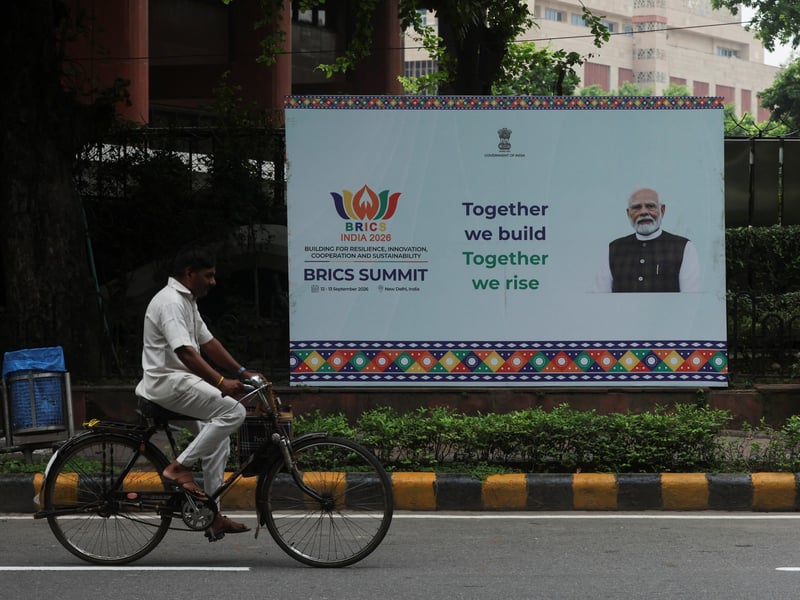
Xi Jinping arrived in New Delhi having already extended China’s CIPS network to 1,400 participating institutions across 110 countries, Al Jazeera reported. For Beijing, BRICS Pay is less a new infrastructure project than a political endorsement of existing Chinese payment architecture, a way to deepen the yuan’s role in cross-border settlements without the bluntness of calling it a dollar replacement.
Trump’s tariff threat, deployed on his social media platform Friday morning, repeated warnings his administration has circulated in private briefings since February. White House officials said the tariff authority rested on executive order rather than requiring congressional approval, part of Trump’s broader midterm posture of projecting economic toughness on dollar-related challenges. The threat carries real weight in the near term, particularly for emerging-market BRICS members dependent on U.S. export markets, but its deterrent effect diminishes the more member states route trade through non-dollar channels.
The New Delhi Declaration also addressed the gold-backed BRICS Unit token, a pilot project launched under India’s 2026 BRICS presidency. The Unit is not a currency; it is a settlement instrument for inter-central-bank transactions backed by a basket of member-state gold reserves and local currencies. The declaration describes it as entering a technical feasibility study phase, several steps short of deployment and with no BRICS central bank having formally committed to holding Unit balances.
The summit called for restraint in the Middle East as well, with specific language on unimpeded maritime traffic through the Persian Gulf, a direct reference to the US-Iran tensions rattling Strait of Hormuz shipping lanes that have complicated energy deliveries to BRICS members India and China.
What the New Delhi Declaration leaves unresolved is the question of adoption pace. BRICS Pay’s messaging infrastructure exists. Whether major commodity exporters will price oil, gas, or agricultural goods through BRICS-routed channels rather than denominating in dollars and settling in national currencies afterward remains an open question. The plumbing is there. The political commitments needed to run meaningful transaction volumes through it are not yet in place, and Trump’s tariff warning has given fence-sitting members an additional reason to move with care.