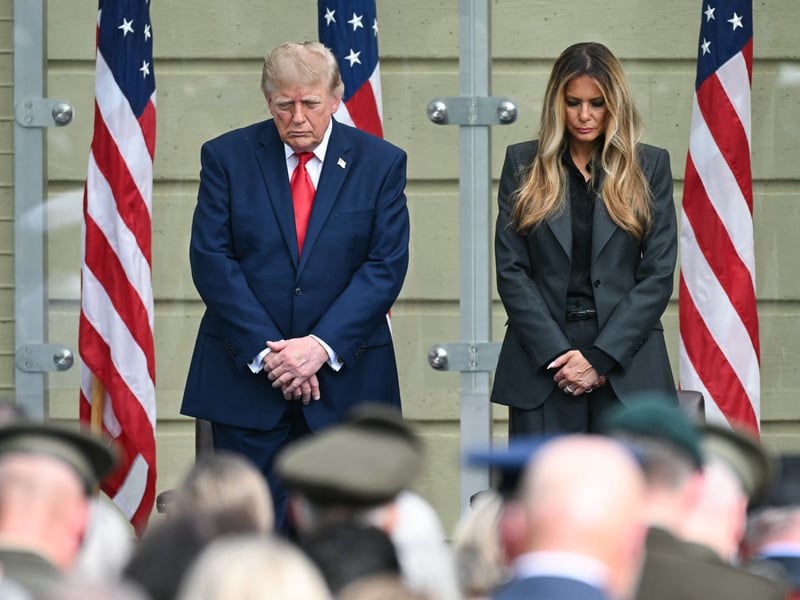

WASHINGTON — Twenty-five years after the attacks that killed nearly 3,000 people and set the United States on a path it has not fully left, Donald Trump stood at the Pentagon on Thursday and invoked a framework he once derided. He described his administration’s actions against Iran as a continuation of the war on terror, making the case plainly at a solemn ceremony with Condoleezza Rice beside him on the stage.
That pairing alone underscored the argument. Rice served as national security adviser to George W. Bush in the period before September 11, 2001, and as secretary of state during the wars in Afghanistan and Iraq that followed. She was among the architects of the post-9/11 security apparatus that Trump spent years attacking as a candidate. On Thursday, she told the crowd she carries “deep personal remorse” for not seeing the danger in time. Trump nodded along.
“Today, we salute every member of the United States military who served in the war on terror,” Trump said at the annual Pentagon memorial ceremony. “It is a war on sick, horrible terror.”
Then he tied it directly to the ongoing campaign against Tehran. His forces were, he said, “working right now to ensure the world’s No. 1 sponsor of terror, the Islamic Republic of Iran, will never ever have a nuclear weapon.”
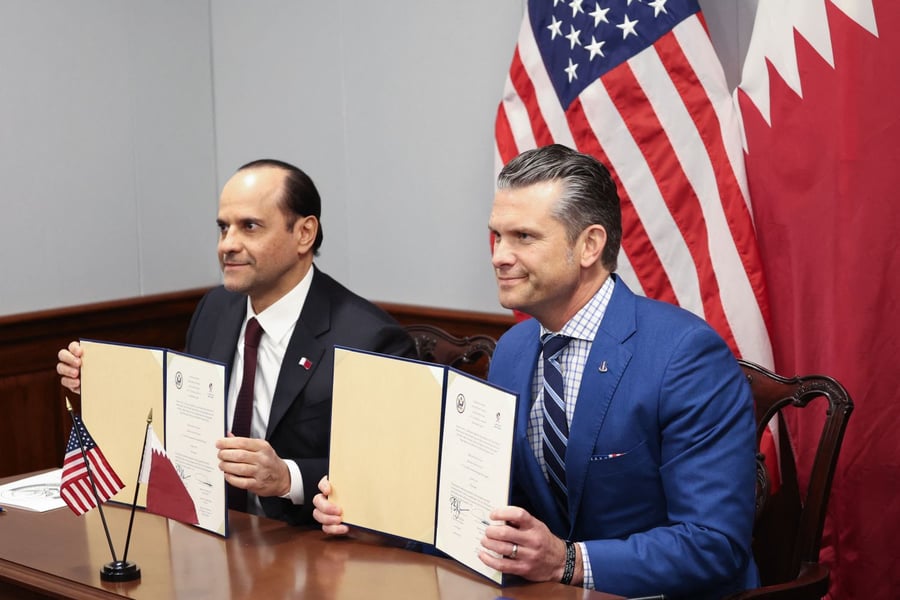
Defense Secretary Pete Hegseth pushed the link further. American warriors had, he declared, “laid waste to the world’s most prolific state sponsor of terrorism.” He described Iran as “an Islamic theocracy that has wished us death for nearly half a century, that cheered on 9/11.”
That last phrase is historically imprecise. Iran’s government did not celebrate the September 11 attacks; ordinary Iranians held candlelight vigils in Tehran in the days that followed, a fact documented by journalists on the ground. Iran’s supreme leader, Ayatollah Ali Khamenei, condemned the strikes publicly. What Hegseth appeared to mean was Iran’s long designation as a state sponsor of terrorism and its support for militant groups that have attacked American interests in the region, a different and more complicated argument than the claim that Tehran cheered as the towers fell. The distinction matters because the war’s domestic legitimacy rests partly on whether the public understands it as a direct response to the logic of September 11.
The ceremony was held at the Pentagon rather than Ground Zero in New York, where civilian memorials dominate the day. That choice is consistent with the rhetorical posture the administration has maintained throughout the Iran campaign. The Pentagon’s 184 dead are easier to incorporate into a military-and-security frame. Manhattan’s memorial pulls in a different direction.
Trump had already tied the Iran war to domestic political timing as the November midterms approach. The spending patterns of Republican super PACs and the administration’s communications around the conflict have reinforced that reading. And Joe Kent, Trump’s own counterterrorism chief, resigned over the Iran war earlier this year, publicly disputing the administration’s claim that Iran posed an imminent threat at the moment the strikes began.
Thursday’s ceremony did not address any of that. It addressed grief.
The strategy of routing the Iran war through September 11 serves several purposes at once. It borrows the emotional weight of an event that retains broad support for a military response. It deflects the most direct criticism of the campaign, which is that its legal and factual basis remains disputed. And it attempts to resolve a real tension in Trump’s own political history, because he built a significant part of his 2016 coalition by arguing that the Bush-era wars were a catastrophe.
He said precisely that at a 2016 Republican primary debate, telling Jeb Bush to his face that the Iraq War was a disaster and that his brother’s administration had failed to prevent the September 11 attacks. The argument was not a fringe position. He won on it.
What Thursday offered, with Rice on stage and the “war on terror” framing restored to official use, was a revision of that verdict. The Bush-era architecture was not a catastrophe to be repudiated; it was a foundation to build on. Iran is the next theater. The war never ended. It moved.
Whether that framing survives contact with the conflict’s actual trajectory is, for now, unknown. Twenty-five years of post-September 11 history have produced a long record of declarations that the end was at hand. The “war on terror,” as Al Jazeera’s coverage of the anniversary noted, was promised to be finite when it began, a campaign against a method rather than a state, which made its conclusion conceptually unclear from the start. It outlasted the administrations that defined it, the named enemies of its early years, and most of the political consensus that sustained it. Hegseth’s declaration that the United States has now “laid waste” to the world’s foremost state sponsor of terrorism may prove more lasting than those. Or it may look, from some future anniversary, like the ones that came before.