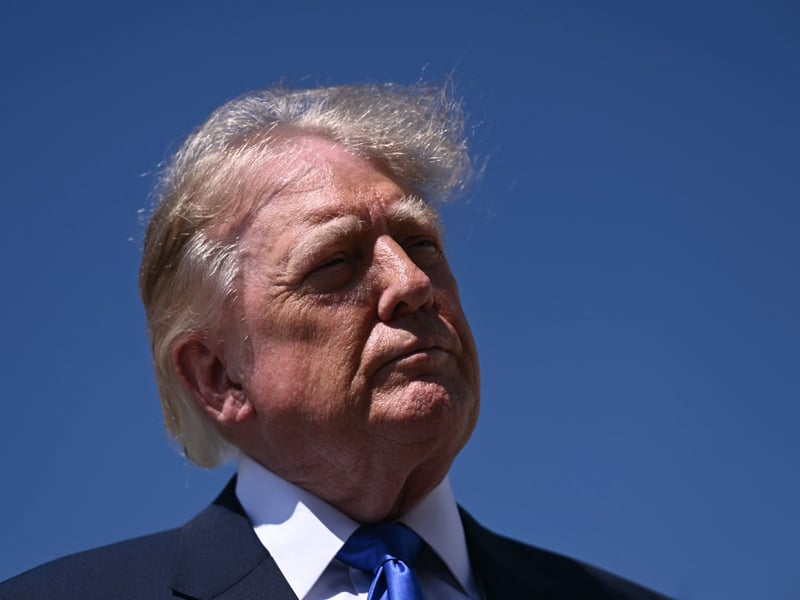

WASHINGTON — Seven months into a war that has pushed Brent crude above $100 a barrel for the first time since July, Donald Trump on Wednesday offered the clearest signal yet that the conflict with Iran is being managed around a domestic political calendar: the November 3 midterm elections.
“This war will end immediately after our election,” Trump told reporters before boarding Air Force One for a Republican convention in Dallas. The admission, delivered casually on the tarmac, reframed a seven-month military campaign in the language of electoral politics rather than national security.
Trump’s rationale was that Iran was “stalling,” holding out until after the midterms in the hope that Democratic gains in Congress would produce a more conciliatory American posture. “They’re desperate to try and affect the election so that we could get a nice, weak group of people in there and leave them alone and let them have their nuclear weapon,” he said.
The structure of that argument contains its own problem. If Tehran is genuinely calibrating its military posture around the American electoral cycle, then Washington has handed its adversary a fixed deadline. The IRGC’s military planners now know the attacks will stop in November regardless of battlefield conditions, a fact whose strategic implications extend well beyond the next eight weeks.
The war Trump launched alongside Israel on February 28, codenamed Operation Epic Fury by the Pentagon, has now entered a seventh month with no durable ceasefire in place. An earlier agreement reached in May, after the opening phase that included strikes targeting Iran’s Supreme Leader, collapsed when fighting resumed in the Strait of Hormuz in late August.
The consequences of that resumed fighting are visible at every petrol station across the globe. Brent crude climbed above $101 a barrel on Wednesday as US warships struck five Iranian crude oil carriers in the Strait of Hormuz, according to Al Jazeera, which cited renewed fighting as the primary driver of the surge. Iran retaliated with missile strikes on US facilities in Jordan. Secretary of State Marco Rubio said Washington would continue striking Iranian tankers in response to attempted attacks on American warships — a cycle that analysts say shows no sign of producing a settlement.
Warren Patterson, head of commodities strategy at ING Groep, told Bloomberg that oil above $100 would be a direct concern ahead of the midterms. With American voters now paying at the pump for a war that only 31 percent of them support — down from 37 percent in March — the political arithmetic runs in both directions.
That resilience is the fact Trump’s framing cannot absorb. For seven months, the most sustained American military campaign since Afghanistan has produced neither a surrender nor a negotiated settlement that held. Tehran has sustained itself economically through a barter arrangement with China, exchanging oil for goods in a structure that partially bypasses US sanctions and has provided the political and material cushion that Iranian officials describe as the foundation of their continued resistance.
EH has reported on the sustained exchange of fire along the Hormuz coast in recent weeks, including explosions at Sirik, Qeshm, and Minab on the Iranian mainland and Iranian missile strikes on American aircraft at Jordan’s Al-Azraq airbase. Those are the battles Trump now says he expects to continue for at least fifty-four more days.
At the convention in Dallas, Republican Party strategists were watching the oil price above the battlefield maps. The party is defending slim majorities in both the House and Senate, and polls consistently show that gas prices shape voter sentiment about military campaigns more reliably than casualty figures. Trump on Wednesday also separately proposed a $5,000 cash payment to every American household as a means of shoring up Republican support — an economic argument for a party that has spent seven months defending a war at triple-digit oil prices.
What Trump did not say on Wednesday is what happens if the midterms produce the Democratic gains his party is working to prevent. He added that the United States was “not looking to restart negotiations” with Tehran — a formulation that leaves open the question of how, exactly, a post-election end to the war would be engineered, and on what terms Iran would be expected to accept it. The National reported that Trump added the war “is going to take a little bit longer than the midterm” — a hedge that further muddies the certainty of his earlier tarmac declaration.
The most direct reading of Wednesday’s remarks is the simplest: a war that costs $100 a barrel, that seven in ten Americans oppose, and that the president himself says will end when the ballots are counted, is being run on an electoral timeline. Whether that timeline belongs to Washington or to Tehran is the question the war’s next fifty-four days will answer.