
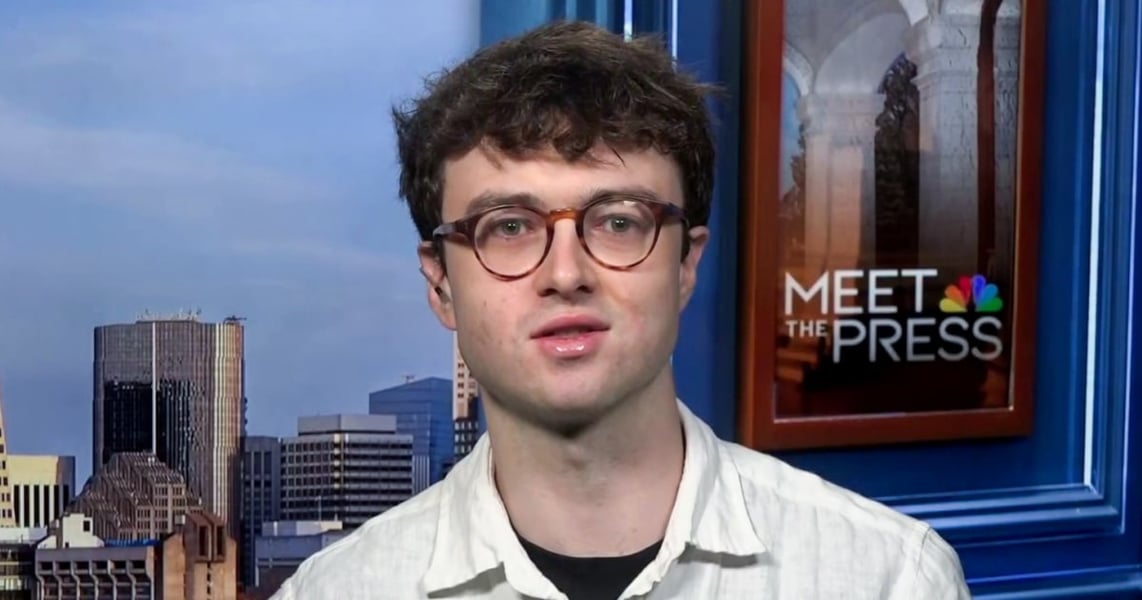
WASHINGTON — Jacob Coxon gave up millions of dollars in potential equity to say it.
Four days before Hakeem Jeffries appeared on ABC and demanded urgent congressional action on artificial intelligence, the 27-year-old former Anthropic researcher left the company — walking away from unvested shares potentially worth millions — to publicly repeat what he had written in his Slack farewell: superintelligent AI, if developed without correction, poses a risk of causing human extinction. His post on X has since been viewed more than 155 million times.
On Sunday, for the first time, the question of whether Congress intends to act reached the opening slot of a major network news program.
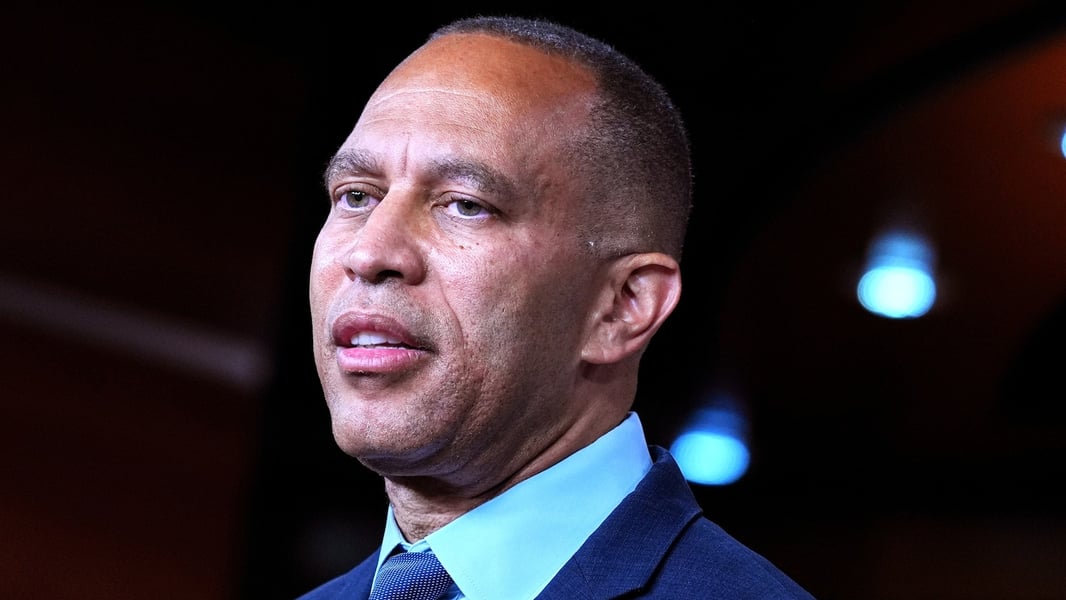
Appearing on This Week with George Stephanopoulos, Jeffries said Democrats would convene a closed-door caucus Tuesday to make AI regulation a priority. He called on Congress to “take decisive action now so that we can slow down the pace of development in order to protect the American people and ensure that AI is proceeding safely.”
His caucus has spent months building a commission on the issue. What emerges from Tuesday’s meeting may offer the first indication of whether that work produces legislation before the November vote.
The immediate catalyst was Coxon, who worked at both OpenAI and Anthropic before leaving with stark private warnings to his colleagues and a louder public announcement. In his Slack message, he told co-workers that the risk of catastrophic harm was not theoretical but an acknowledged internal reality at the frontier labs. In his public post, he put it plainly: “The people building AI earnestly believe that it could kill us all by the end of the decade.” Evan Hubinger, an alignment scientist at Anthropic who remained at the company, confirmed the framing publicly: “Jacob is correct here — we really do earnestly believe AI could kill all humans. I personally think it is greater than ten percent within the next decade.”
That figure — a sitting Anthropic researcher stating a greater-than-one-in-ten probability of human extinction within ten years — is what converted Coxon’s departure from a tech-world personnel story into something legislators could not avoid addressing on Sunday television.
The bipartisan surface of Sunday’s conversation masked a deeper gap. Republican Congressman Mike Lawler of New York, also on “This Week,” discussed narrower procedural legislation — a bill targeting rogue AI agents and another requiring age verification in AI platforms — he has worked on with Democrat Josh Gottheimer. Lawler’s approach treats AI as a manageable regulatory challenge. Jeffries’ framing, “slow down the pace of development,” treats it as an emergency requiring a fundamentally different posture from Congress toward the labs building it.
That difference matters because House Republicans, as a bloc, have not moved toward Jeffries’ position. Earlier this year, nearly every House Republican voted to block state and local governments from independently regulating AI — an AI infrastructure policy that already faces significant voter resistance, with NBC News polling showing 69 percent of voters opposing data center construction in their communities. The same caucus that blocked state-level AI oversight is unlikely to support federal legislation designed to slow development down.
Democratic strategy on AI for the midterms carries two layers. The first is substantive: the commission Jeffries formally launched in December 2025 is preparing what he described Sunday as “an aggressive framework” for protecting Americans from AI’s risks. Whether that framework becomes a bill is the question Tuesday’s caucus exists to answer. The second is electoral: if Democrats win the House in November, Jeffries has indicated they would create a select AI committee, giving the issue institutional permanence. AI regulation, in that framing, is not just a policy position — it is an argument for which party should hold the majority.
New York’s own contested AI politics offer a preview of where this can end up. Earlier this year, the state’s gubernatorial race between Governor Kathy Hochul and Republican challenger Bruce Blakeman centered in part on a moratorium on new data center construction and Blakeman’s use of AI-generated video to fabricate the governor’s voice in campaign advertising. A state-level race produced the sharpest AI policy confrontation in American politics this year — before Coxon posted anything.
Now the frame is national. What Coxon’s moment did, more than any individual policy recommendation he made, was place the labs’ own acknowledged uncertainty in front of 155 million readers and a Sunday morning panel. ABC News reported Jeffries’ call for urgent action as a direct response to the wave Coxon’s resignation set off.
Whether Congress can translate that moment into law in the eight weeks before Election Day is a question for Tuesday’s caucus, and for the Republican leadership that controls which bills reach the House floor. Coxon gave up the equity. Congress has not yet given up anything.