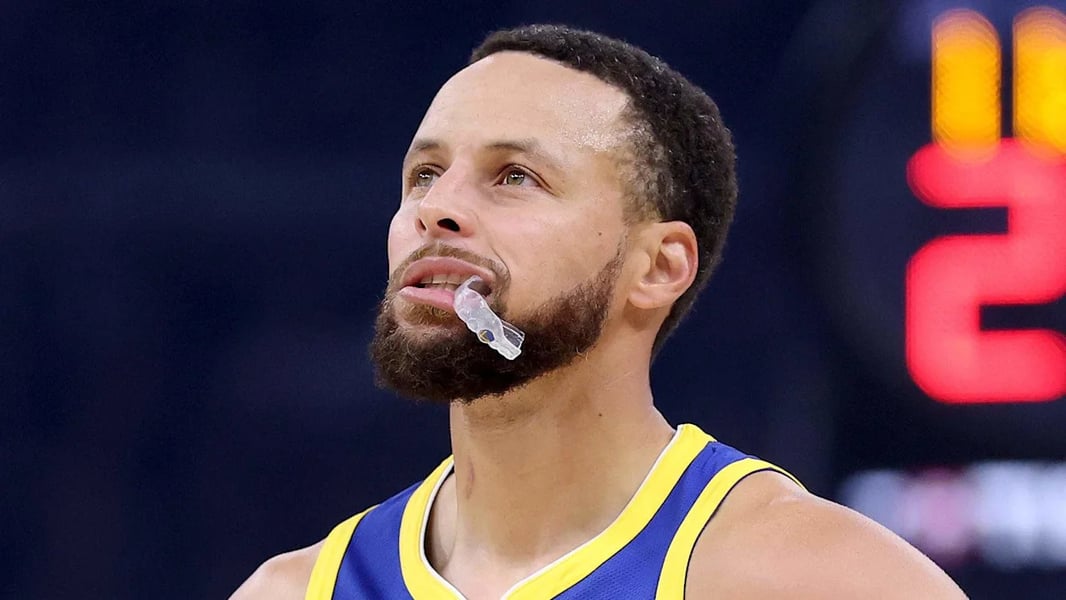

SAN FRANCISCO — The footage arrived quietly, the way bad news often does in the NBA offseason.
In video shot Thursday during Stephen Curry’s promotional swing through China for his new Li-Ning partnership, the Warriors’ franchise player emerges from a vehicle with a noticeable hitch in his stride. Sixteen days before training camp opens at BYU-Hawaii, the image landed in group chats and front-office inboxes across the league. In the Bay Area, it triggered a familiar reflex — one Warriors fans have felt eleven times since January.
Not again.
No one in the Warriors organization has declared a new injury. The limp could be nothing more than stiffness after a long intercontinental flight, the kind of compression fatigue that attacks every joint at 37,000 feet. Curry himself has been bullish about his durability heading into 2026-27, saying publicly that he expects to play 70-plus games after appearing in only 43 during the 2025-26 season.
The question, as it has been for eight months, is whether that confidence is warranted — or whether it is simply the optimism of a competitor who cannot quite see himself as injured.
The knee in question is the patellofemoral joint, the same runner’s knee that cost Curry 27 games beginning January 30 when he exited a game against the Pistons and did not return. An MRI found no structural damage, the Warriors confirmed in a spring update. The team managed it with rest, treatment, and a cautious ramp-up, eventually bringing him back for the stretch run of a season that ended 37-45.
Monte Poole, who covers the Warriors for NBC Sports Bay Area and has tracked this franchise through every title and every rebuild, put it plainly in the days following Curry’s departure for Asia. “There’s at least some lingering concern about the knee,” Poole said. “It can be managed, but it has to be managed, and that’s a new thing for Steph.” That phrase, a new thing for Steph, is the part that catches. For most of his career, Curry managed his ankles. Managing his knees is a different and more complicated calculus.
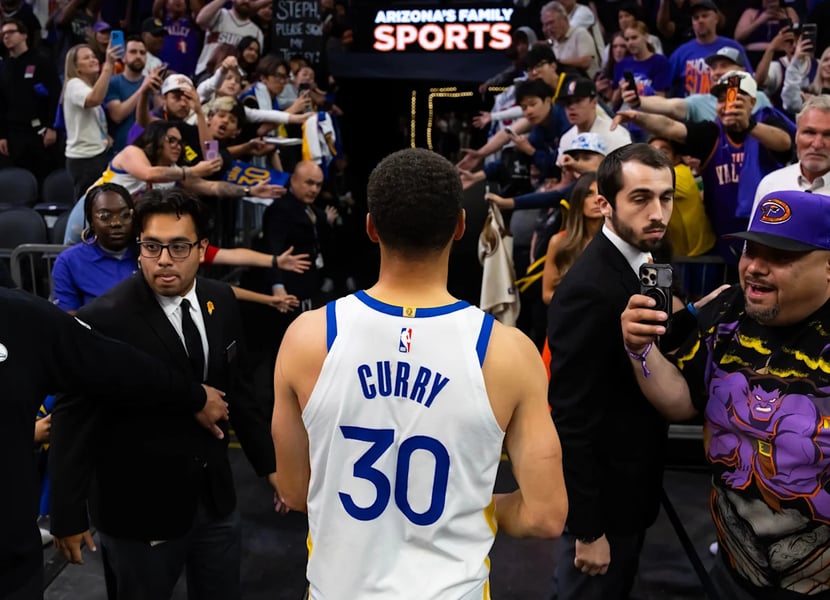
When Curry departed for Beijing on September 9, the organization sent him off with all the optimism of a franchise with nowhere to go but up. The $400 million Li-Ning deal announced in June carries the weight of a declaration of longevity: few brands invest that kind of money in an athlete they expect to retire in two years. Curry used the word “exciting” in his tour announcement press conference. The footage from Thursday asked a different kind of question.
The China tour, officially called the “Wide Open” swing, runs through September 14 with stops in Beijing, Dongguan, Shenzhen, and Hong Kong. It is the kind of commercial obligation that comes with franchise-level endorsement money, and it is also the kind of extended exertion that NBA teams navigate nervously when their stars are on the mend. There is no indication the Warriors asked Curry to skip the tour. There is also no indication they watched Thursday’s footage without concern.
What a healthy Curry means for this team’s ceiling is not complicated. He is one of four or five players in the NBA whose individual production can swing a franchise from the play-in to contention. Averaging 25.7 points per game in his abbreviated 43-game run last season, Curry remained the most dangerous offensive player in the sport when available. The 37-45 record without him was not incidental. It was the answer.
Curry arrives at training camp on September 29 carrying the most medically complicated roster the Warriors have assembled in years. Jimmy Butler, who signed this summer expecting to be the second star, underwent ACL reconstruction and is now targeting a January or February return. Moses Moody, a rotation cornerstone in the backcourt, is also managing a knee issue. Kristaps Porzingis, brought in on a two-year deal to address the frontcourt, played only 32 games for Boston last season before injury ended his year. Draymond Green, re-signed at 36 on a one-year deal worth $27.7 million, enters camp at an age when the body’s recovery rate becomes a daily negotiation.
The Warriors added Al Horford, Georges Niang, and Brandon Williams in the offseason, three players whose collective upside lands somewhere in the neighborhood of useful depth. They are not championship pieces. They are the infrastructure you build around a transcendent star who you hope will carry the load once he is available and whole.
That hope is the operative word. The extension conversation, a two-year $136.7 million max Curry is eligible for, has been similarly unresolved. He has not committed to a timeline, a notable silence from a player who has spent his career projecting certainty. Whether that silence reflects negotiating posture or something more complicated is unclear.
A limp from a long flight is not an injury. But in a season where the Warriors need Stephen Curry to be everything he was at 33, and cannot afford another eight months of managed uncertainty, Thursday’s footage is the kind of thing that does not let go.
Training camp opens September 29. The preseason opener against the Clippers in Honolulu is October 4. The regular season begins October 20.
Sixteen days.