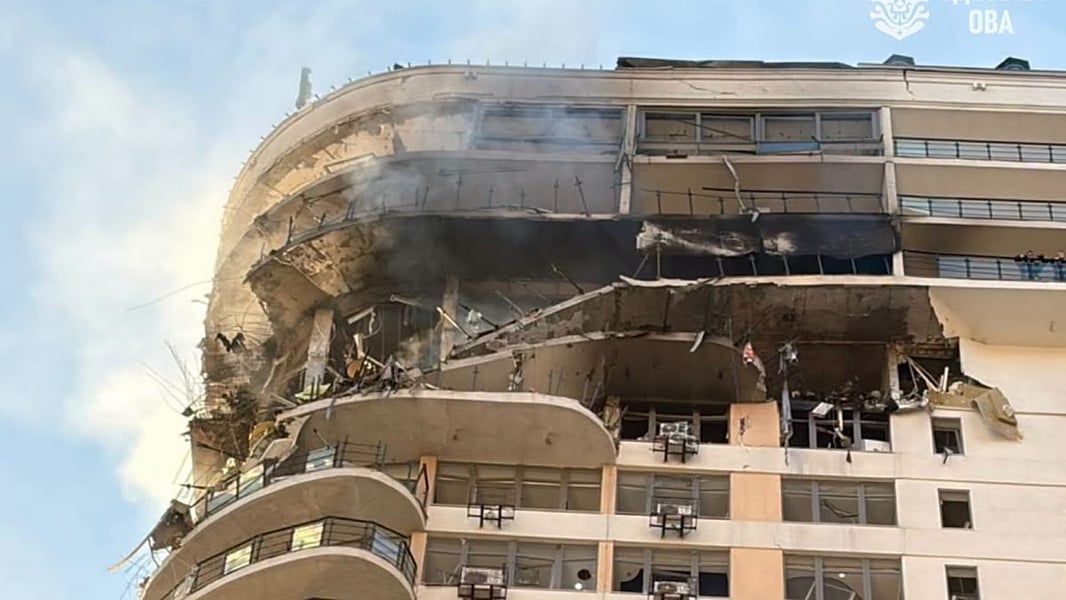

KYIV — A five-month-old infant was among 96 people wounded when Russian missiles and drones struck Odesa overnight, as Ukraine simultaneously claimed it had hit 285 vessels belonging to Russia’s shadow oil fleet during ten weeks of drone operations across the Black Sea and Sea of Azov.
The Russian barrage on the night of September 11-12 was one of the heaviest to hit Odesa in weeks. Ukrainian air defences said they intercepted or disrupted 110 aerial targets from a salvo that included 129 drones of various types, eight Kalibr cruise missiles, six Kh-59/69 guided missiles and Iskander-M ballistic missiles. At least 11 people were killed nationwide, while the Odesa region alone reported at least 35 wounded.
Robert Browdy, known by his call sign Madyar and the commander of Ukraine’s Unmanned Systems Forces, announced on Saturday that his forces had struck 285 vessels in the operation Ukraine calls MoLoChKa — an acronym in Ukrainian for “Moscow will fall through Crimea” — since its launch on July 6. The campaign recorded 215 strikes in July, 54 in August, and a further 16 between the first and eleventh of September, he said.
The shadow fleet Russia deploys in the Black Sea and Sea of Azov consists largely of older, uninsured tankers that operate without standard GPS transponders, enabling Russian crude to reach buyers who would otherwise be bound by Western price caps and embargo regimes imposed after the Russian operation in Ukraine began in 2022. Ukraine’s drones do not target the large export tankers themselves but the smaller courier vessels — typically between 1,000 and 3,000 deadweight tonnes — that ferry crude to them and transport fuel to Russian-occupied Crimea. By the Unmanned Systems Forces’ own calculation, between twelve and fifteen such courier tankers are needed to fill a single large export vessel, making the small craft the structural vulnerability of the whole enterprise.
Since Operation MoLoChKa began, Ukrainian forces claim to have effectively stopped shadow fleet traffic through the Sea of Azov and the Kerch Strait, the passage connecting the Azov to the Black Sea, and significantly disrupted it along the northern Black Sea coast. Neither claim has been independently verified. Russia has not publicly acknowledged losses from the campaign, and no neutral assessment of its economic impact on Russian oil export revenues has been published.
What is verifiable is the pattern of Russian response. The overnight barrage of September 11-12 was heavily concentrated on Odesa — Ukraine’s main Black Sea port and the terminus for several of the country’s primary export corridors. It was not the first time Russia had struck the city in apparent connection with maritime operations; earlier strikes on the Odesa port complex disrupted shipping for weeks and contributed to a shortfall in Ukrainian state budget revenues.
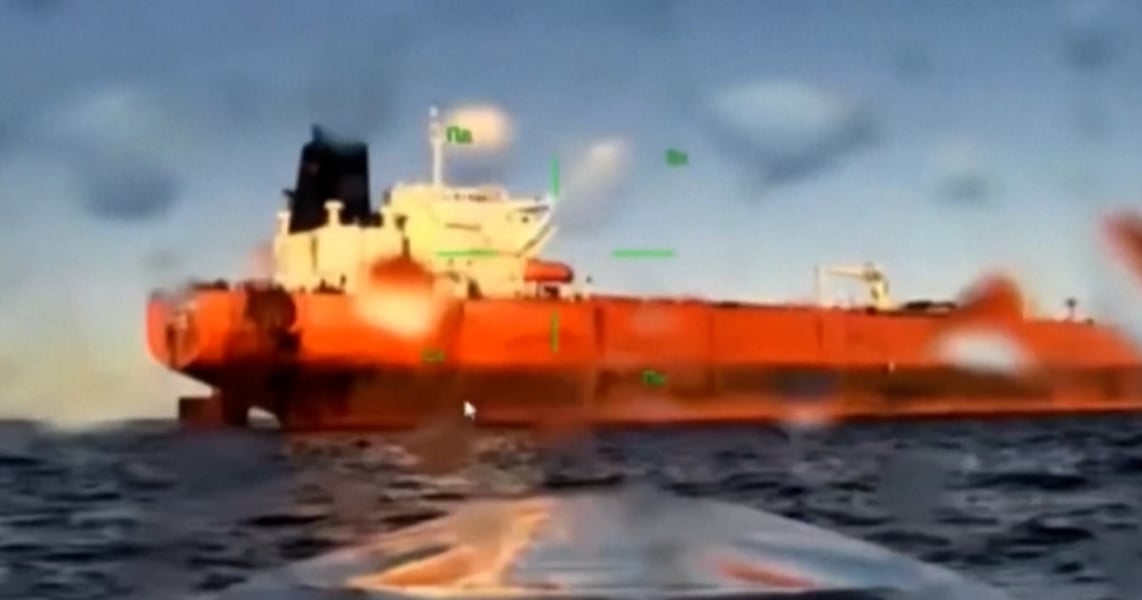
The scale of what Ukraine is now claiming far outstrips the earlier phases of the war’s maritime dimension. Ukraine extended its drone strikes beyond the Black Sea region earlier this week, hitting Russia’s gas processing infrastructure in the Arctic in what Kyiv described as the longest-range drone strike of the conflict. The shadow fleet campaign and the Arctic energy strike together outline a Ukrainian approach aimed at degrading Russian export capacity rather than engaging Russian forces directly on land.
Russia, attending the BRICS summit in New Delhi on Saturday, made no public acknowledgment of shipping losses. President Vladimir Putin used his summit remarks to describe Western economic restrictions on Russia as evidence of a drive for global dominance and to warn European governments against deploying troops to Ukraine. The shadow fleet exists specifically because of those restrictions — it is the mechanism by which Russian crude reaches markets that G7 price caps were designed to close off.
Radio Free Europe/Radio Liberty reported that the 285 claimed strikes since July 6 would represent a significant fraction of the estimated 400 to 600 vessels analysts have previously assessed as making up the active shadow fleet operating in Russian waters, if the Ukrainian claims hold. That if, for now, is doing considerable work.
Interfax Ukraine reported the latest shadow fleet numbers alongside the Odesa casualty figures on Saturday, a juxtaposition that reflected the week’s operational logic. Ukraine strikes what it says are Russian energy vessels in the Black Sea; Russia strikes the Ukrainian port city from which those operations have been coordinated. The loop has no announced endpoint, negotiations collapsed earlier this month without a formula for even a temporary halt, and both sides continue to escalate in the dimensions they believe they hold advantage.