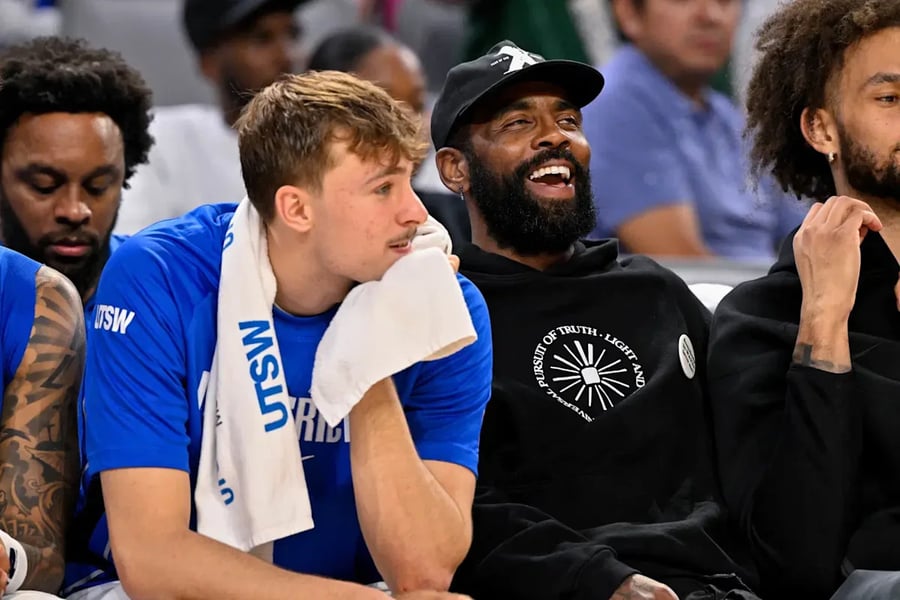

DALLAS — Cooper Flagg spent part of his summer training alongside Kyrie Irving, and what he said afterward offers a glimpse into his mindset heading into Year Two.
“Kyrie is obviously one of the greats,” Flagg told reporters. “So just to be able to share the floor with him, learn from him on the fly, and compete with him—it’s going to be a lot of fun.”
A 19-year-old reigning NBA Rookie of the Year calling a 34-year-old teammate he has never played alongside in an NBA game “one of the greats” is the kind of deference nobody demanded but everyone needed to hear.
The Mavericks open training camp on September 29. Until then, the most consequential thing Flagg and Irving have done together is share a gym.
Now they have to share a season.
After averaging 21.0 points, 6.7 rebounds, and 4.5 assists across 70 games in 2025-26, Flagg walks into his sophomore campaign carrying the Rookie of the Year trophy, a full season of defensive film that every opponent has studied, and a new co-star returning from nineteen months of ACL rehabilitation. Coach Dusty May watched Flagg and Irving in those summer workouts and told reporters he felt “like I was watching Picasso paint a picture.” That is a line a coach delivers when the evidence has given him something genuine to work with. What it does not answer is the question every Mavericks opponent, analyst, and scout will spend October trying to sort out: whether those summer sessions translate into something that holds when games count.
The Irving who Flagg will play beside is not the Irving of three years ago. He is 34 now, nineteen months past a torn ACL, returning to a league where guard play has grown more physical and recovery timelines at that age carry genuine uncertainty. The Mavericks are betting on him. His agent, Shetellia Riley Irving, framed the return in championship terms: being fully healthy when he comes back and giving himself the best chance to chase a championship next season. The math of a 34-year-old guard’s ACL recovery across 82 nights is more cautious than that language suggests.
Defenses now have an entire summer of Flagg tendencies on film. His preferred spots on the floor, the situations where he attacks off the bounce versus where he defers, how he responds to physicality down low. Nobody game-planned against him going into last season. Everyone will going into this one. That gap between the unknown commodity and the established target is what separates a historic rookie year from a genuine sophomore leap, and nobody inside Dallas has walked through it yet.
Irving changes the equation, though not only in the ways expected. Yahoo Sports reported on the summer workout sessions this week, with Irving moving through drills with the kind of fluency that led May to reach for Picasso comparisons. Offensively, his presence should draw defensive attention that currently concentrates entirely on Flagg. One of the league’s most difficult-to-guard guards in isolation, when healthy, creates secondary pressure that generates the open looks Flagg was sometimes forced to manufacture alone. Whether that relief makes Flagg more efficient or simply redistributes the problem is something May will not know until October.
Flagg said he has worked on his pull-up jumper and his decision-making in pick-and-roll situations during the offseason. Specific, technical answers to specific, technical problems that defenses will present in a way they did not last year. May, running the Mavericks for the first time after arriving from the University of Florida in late June, will build his system around the relationship between his two best players. What he said after watching Irving in July signals that he is giving the veteran credibility and space. Whether that dynamic complicates or accelerates Flagg’s development is the most honest question anyone in Dallas carries into camp.
The 2026-27 season preview places Dallas in the Western Conference picture, capable of competing but not yet confirmed as a contender. They are not alone in that position — the Cavaliers open their own camp one day later, carrying a rebuilt backcourt and almost identical questions about whether a summer of promises translates into May. For that calculation to shift in Dallas, the Mavericks need Flagg to do something star players have always eventually had to do: perform against defenses specifically prepared to take away what made them great. A 21-point-per-game rookie season built against unprepared opponents is one thing. Sustaining that production against a league that has had seven months to study every tendency is something else.
“I think he’s on pace when you talk about LeBron and what he did as a young player,” former Mavericks coach Jason Kidd said earlier this month, then named the one thing that would prove it: championships. Not Rookie of the Year hardware. Not the 49-point performance that made Flagg the youngest player in league history to reach that mark, or the three consecutive 30-point games no rookie had posted before him. Championships. Kidd has been to the Finals. He understands the gap between the conversation and the evidence.
Kyrie Irving will be there when September 29 arrives, medically cleared and practicing alongside Flagg in a structured NBA setting for the first time after months of informal gym work and summer pickup sessions. What happens after that nobody in Dallas can fully answer yet, including Dusty May. What Flagg said about the experience of sharing the floor with “one of the greats” suggests he is not waiting on uncertainty to settle before deciding what to make of it.
The question is whether this season will be the one where the evidence catches up to what his coaches already believe.