Federal prosecutors in Manhattan have accused two Hong Kong-based companies of using cryptocurrency accounts on Binance to move proceeds allegedly connected to Iranian oil sales, according to a civil forfeiture complaint filed by the US Justice Department.
The case concerns a network of cryptocurrency transactions that prosecutors say involved proceeds from the sale of Iranian oil to buyers in China. The Justice Department alleges that funds were subsequently transferred through cryptocurrency wallets associated with Iranian entities and that some of the money was intended to support Iran’s military.
The filing is a civil forfeiture action, rather than a criminal prosecution against Binance. The cryptocurrency exchange has not been charged with wrongdoing in the case and has said the complaint does not allege that Binance itself violated sanctions.
According to the Justice Department, the government is seeking to seize approximately $61 million in cryptocurrency currently held through accounts overseen by Tether, a major cryptocurrency company.
The broader network identified by prosecutors involved more than $1.5 billion in proceeds that reached crypto wallets linked to Iran, although the complaint does not establish that the entire amount passed through Binance.
The allegations place cryptocurrency once again at the center of a complicated international financial investigation involving Iranian oil exports, Chinese buyers, Hong Kong-based financial intermediaries and digital assets.
DOJ alleges movement of Iranian oil proceeds
The Justice Department’s complaint names Blessed Trust and Hexa Whale, two companies based in Hong Kong. Prosecutors allege that the companies helped move proceeds associated with black-market sales of Iranian oil to buyers in China.
According to the court filing, the proceeds were subsequently transferred to entities linked to Iran.
The department alleges that the transactions violated US sanctions and that the proceeds were ultimately used to support Iran’s government and military-related activities.
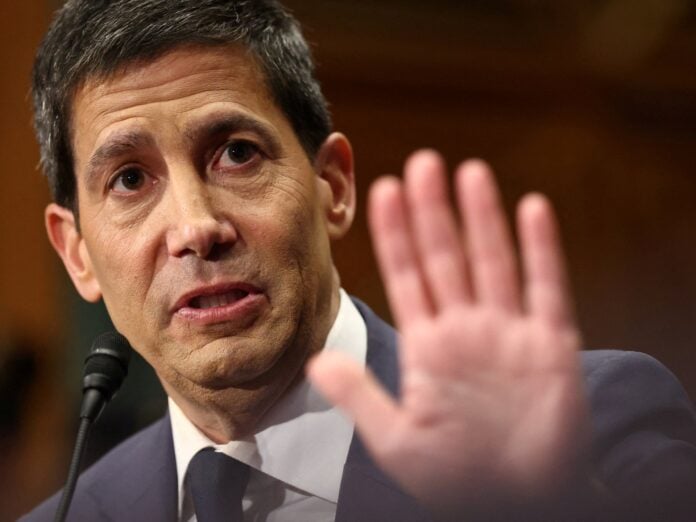
Deputy US Attorney Sean S. Buckley said the forfeiture action was intended to target funds that prosecutors believe were connected to sanctioned Iranian oil transactions.
“Today’s action demonstrates our determination to deprive the Government of Iran and its terrorist proxies of the illegal money they rely on,” Buckley said in a statement.
“The Government of Iran relies on black-market sales of sanctioned crude oil to fund its military and foster terrorism in the Middle East and around the world.”
Those statements represent the position of the US Justice Department. The forfeiture complaint contains allegations that will be addressed through the legal process.
The case does not allege that Binance itself was a participant in the alleged Iranian oil sales.
Binance says it was not accused of wrongdoing
Binance, the world’s largest cryptocurrency exchange, said the case was not brought against the company.
A Binance spokeswoman said the exchange maintains a policy against sanctions violations and illicit activity.
“zero tolerance for sanctions violations or illicit activity,” she said.
The spokeswoman also emphasized that the Justice Department’s action does not accuse Binance of wrongdoing.
“This case was not filed against Binance and does not allege wrongdoing by Binance,” she said. “Binance did not permit any transactions with sanctioned individuals.”
The distinction is important because the government’s complaint focuses on the activities of the two Hong Kong companies and the movement of cryptocurrency through a network of accounts and wallets.
Binance has also disputed findings previously raised by some of its compliance employees regarding transactions associated with Iran.
Earlier compliance concerns at Binance
According to earlier reporting cited in the original investigation, Binance employees identified transactions that they believed were connected to Iranian entities. The transactions included accounts associated with Blessed Trust and Hexa Whale.
The employees’ findings reportedly attracted scrutiny within Binance as the company sought to strengthen its compliance systems following its 2023 settlement with US authorities.
The Justice Department said in the forfeiture complaint that Hexa Whale used Binance to transfer approximately $490 million to cryptocurrency wallets associated with Iranian entities.
Prosecutors also allege that approximately $1.2 billion moved from an account controlled by Blessed Trust to entities linked to Iran.
Those figures are part of the government’s allegations in the civil case and do not necessarily represent the amount that passed through Binance in its entirety.
The internal investigation also reportedly identified connections between accounts associated with Blessed Trust and Binance personnel.
According to reporting cited in the original account, investigators found that an account belonging to the chief executive of Blessed Trust and an account controlled by a group of Binance employees had been accessed from the same electronic device.
Binance has disputed several of the findings.
Blessed Trust’s relationship with Binance
The Justice Department’s complaint describes Blessed Trust as a financial firm that allegedly presented itself to cryptocurrency and financial companies as providing legitimate services, including wealth management.
Binance has said that Blessed Trust was one of several vendors used by the exchange and that Binance did not control the company.
Blessed Trust did not immediately respond to requests for comment cited in the original reporting.
Hexa Whale has since ceased operations.
The differing accounts underscore the distinction between allegations contained in the government’s court filing and Binance’s response to earlier reports.
$61 million cryptocurrency seizure sought
The Justice Department is seeking forfeiture of approximately $61 million in cryptocurrency as part of the case.
The assets are currently held through a group of accounts overseen by Tether, according to the court filing.
Civil forfeiture allows the government to seek control of assets that it alleges are connected to unlawful activity. The proceeding concerns the assets themselves and is separate from a criminal prosecution of a person or company.
The government’s filing therefore does not amount to a criminal conviction of the companies named in the complaint.
The case also does not establish that every transaction involving the identified wallets was unlawful. Instead, prosecutors are asking the court to determine whether the cryptocurrency identified in the complaint is subject to forfeiture.
Iranian oil sales and cryptocurrency
:contentReference[oaicite:0]{index=0} remain a major part of the wider context surrounding the case.
Iran remains a major oil producer and has continued selling crude to international buyers despite US sanctions. China has remained an important destination for Iranian oil, with trade often taking place through complex commercial and financial arrangements.
Cryptocurrency can provide another mechanism for transferring value across borders, although digital-asset transactions can also leave records on public blockchains that investigators can analyze.
The latest case illustrates the challenge faced by financial institutions and cryptocurrency exchanges attempting to identify transactions involving sanctioned jurisdictions.
For prosecutors, tracing cryptocurrency can provide evidence about how funds move between companies, exchanges and individual wallets.
For cryptocurrency companies, however, the large volume of transactions processed across global platforms makes compliance a continuing challenge.
Binance’s post-2023 compliance efforts
The case also follows major changes at Binance after its 2023 settlement with US authorities.
Binance agreed to pay approximately $4.3 billion in penalties in 2023 after pleading guilty to violations of US financial laws. Changpeng Zhao, the company’s founder and former chief executive, stepped down as part of the settlement and later served four months in prison.
Since then, Binance has said that it has expanded its compliance operations and cooperation with law enforcement agencies around the world.
The company’s position on its compliance efforts is detailed in Binance’s response to questions surrounding its compliance operations.
The company has maintained that it does not permit sanctioned individuals or entities to use its platform.
The latest forfeiture complaint could therefore bring renewed attention to the effectiveness of those compliance controls, particularly when transactions involve intermediaries and complex networks of cryptocurrency wallets.
Binance’s position is that the present case does not allege wrongdoing by the exchange itself.
Connection to US-China-Iran financial networks
The case highlights the increasingly complicated financial networks surrounding Iranian oil exports.
According to the Justice Department, the two companies named in the complaint were involved in moving proceeds from Iranian oil sales to Chinese buyers.
The allegations do not accuse China as a country of wrongdoing, nor do they establish that Chinese companies or financial institutions generally participated in the transactions described in the complaint.
Instead, the filing focuses on two Hong Kong-based companies and particular cryptocurrency transactions.
Hong Kong’s position as an international financial center means that companies operating there can participate in cross-border financial and commercial activity involving multiple jurisdictions.
The case demonstrates how investigators can trace transactions across those jurisdictions when cryptocurrency is involved.
What the court filing does and does not allege
Several distinctions are central to understanding the case.
First, the Justice Department has filed a civil forfeiture claim, not criminal charges against Binance.
Second, the government alleges that Blessed Trust and Hexa Whale moved proceeds associated with Iranian oil sales.
Third, prosecutors say more than $1.5 billion reached cryptocurrency wallets linked to Iran, but the complaint does not establish that all of that money moved through Binance.
Fourth, the government is seeking approximately $61 million in cryptocurrency.
Finally, Binance has denied that it permitted transactions involving sanctioned individuals and has emphasized that it was not named as a defendant in the forfeiture action.
These distinctions are particularly significant because the allegations involve multiple companies, cryptocurrency wallets and financial intermediaries operating across different jurisdictions.
A broader test for cryptocurrency compliance
The case could have implications beyond the companies and assets named in the complaint.
Cryptocurrency exchanges operate in an environment where transactions can move between exchanges, private wallets, brokers and financial firms in a matter of minutes.
When funds pass through several intermediaries, identifying the ultimate source and destination can become difficult.
At the same time, blockchain records can provide investigators with transaction histories that may be analyzed over extended periods.
The government’s allegations concerning Binance, Blessed Trust and Hexa Whale show how those records can become part of a wider sanctions investigation.
For exchanges, the challenge is to identify potentially prohibited transactions while distinguishing legitimate activity from transactions that may be connected to sanctioned entities through intermediaries.
Binance’s response indicates that the exchange views compliance with sanctions and anti-financial-crime requirements as a core part of its post-2023 operations.
The legal process ahead
The Justice Department’s forfeiture action now places the identified cryptocurrency assets before the federal court in Manhattan.
The government must establish the legal basis for forfeiture under the applicable law. Parties with an interest in the assets may also have opportunities to contest the government’s claims.
The filing itself represents prosecutors’ allegations and should not be treated as a final judicial finding.
For Binance, the immediate significance is that the exchange has not been charged in the case. For the companies named by prosecutors, the case places the alleged movement of Iranian oil proceeds under judicial scrutiny.
The government’s action also demonstrates the growing role of cryptocurrency tracing in international sanctions enforcement.
As digital assets become more integrated into global commerce, authorities are increasingly examining blockchain transactions alongside traditional financial records to identify the movement of funds.
In this case, prosecutors allege that the two Hong Kong companies used cryptocurrency infrastructure to move proceeds from Iranian oil sales, with the investigation tracing transactions across Hong Kong, China and Iran-linked wallets.
The requested $61 million forfeiture represents only a portion of the broader financial network described in the complaint. The legal proceedings will determine whether the assets identified by the government can ultimately be forfeited.
For now, the central issue remains the government’s allegation that the two Hong Kong companies used cryptocurrency infrastructure to move proceeds from Iranian oil sales, while Binance maintains that it was not accused of wrongdoing in the case and did not permit transactions involving sanctioned individuals.