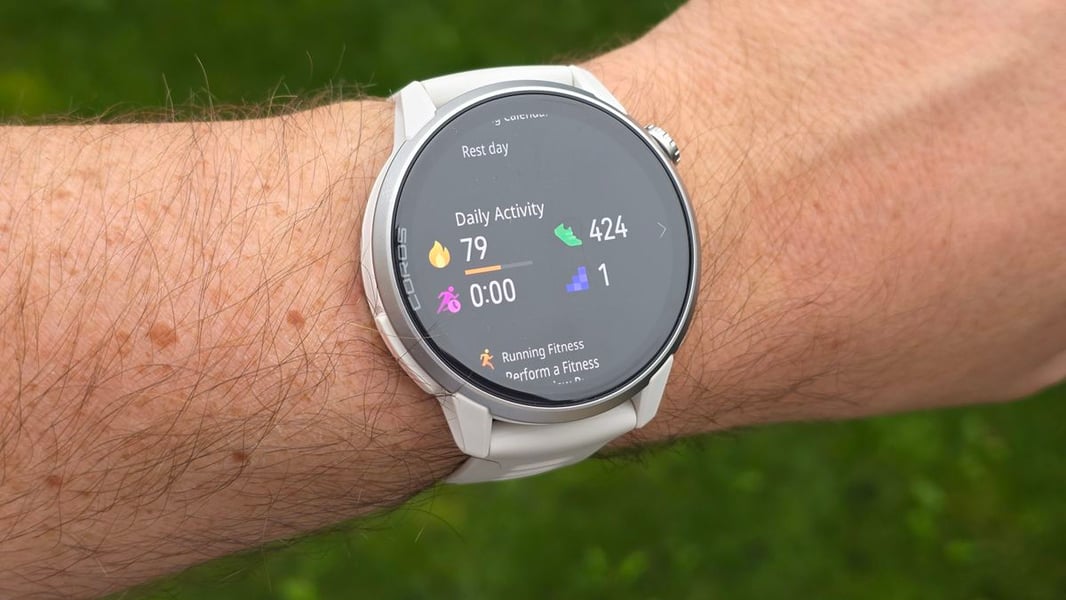

Reading a route or pace field halfway through a sunny run is the practical problem COROS is trying to solve with the PACE 4 Pro. Its largest watch display pairs a bright AMOLED panel with a narrow titanium bezel and sapphire glass. The catch is not whether the screen exists, but how its brightness, always-on setting and GPS mode change the battery figures attached to it.
COROS lists a 1.47-inch touchscreen with 466 by 466 resolution and a peak brightness of 3,500 nits on its product page. The company calls it its biggest and brightest watch screen. That places the emphasis on visibility and room for maps, a different question from simply joining the wider push for brighter smartwatch displays. Peak output is a maximum claim, not a statement that the panel operates at that brightness throughout the day.
The PACE 4 Pro is already on sale. It launched in September, and T3’s October 10 review lists prices of $449 in the United States, £389 in the United Kingdom and AU$779 in Australia. This is not a new October 12 launch announcement. The more useful question now is what that premium over the standard PACE 4 buys, and which claims on the specification sheet survive a closer reading.
The display uses LTPO technology, allowing its refresh rate to move from 60Hz to 1Hz. COROS says it can respond quickly while the wearer swipes or pans a map, then reduce its refresh rate when interaction stops. Automatic brightness also adjusts the panel for different conditions. Those mechanisms explain how a visually demanding display can conserve power; they do not establish a fixed real-world battery result for every wearer.
There is independent evidence on outdoor readability, though not a laboratory brightness measurement in the sources reviewed. T3 reviewer Lee Bell said in his review that he had no trouble reading the screen in direct sunlight. He also found the larger display made offline maps easier to read and reported quick map loading and smooth scrolling. Those are observations from his use, not tests conducted by The Eastern Herald.
The materials need a similarly precise description. COROS highlights a TC4 titanium bezel and sapphire glass, while Bell describes a polymer case body that feels less premium in the hand than the metal and glass suggest. His reported weight is 43 grams with the nylon strap; COROS separately lists a 38-gram body weight. Those numbers measure different configurations, so comparing them as though one disproves the other would be misleading. The distinction matters in a market where Garmin offers a broad range of sports watches rather than one uniform benchmark.
The battery headline is up to 60 hours of GPS use. COROS’s overview gives HIGH GPS mode 60 hours, falling to 45 hours with the always-on display. It separately lists MAX GPS mode at 40 hours, or 30 hours with always-on enabled. Its store FAQ says the 60-hour setting uses single-frequency GPS and describes MAX as dual-frequency, intended for more difficult reception conditions such as dense forests and streets surrounded by tall buildings.
But the same FAQ calls MAX a 45-hour mode, which conflicts with the overview’s 40-hour figure. The pages reviewed do not explain whether that difference reflects revised testing, different settings or an uncorrected specification. The 45-hour HIGH-mode always-on figure is another distinct number and should not be used to erase the discrepancy. A buyer planning a long race needs the precise mode and display setting, not a single battery number detached from both.
For everyday wear, the store advertises up to 21 days. Bell reported roughly two weeks between charges with notifications, several GPS workouts per week and raise-to-wake enabled. His result illustrates the gap between a maximum specification and a mixed-use routine, without demonstrating a problem with the watch. COROS itself warns that music, navigation, display use and other features affect battery life.
The rest of the hardware is designed around training and navigation. There is 32GB of storage for maps, with street and trail names, points of interest and turn-by-turn guidance. COROS also lists dual-frequency positioning, a multi-channel optical heart-rate sensor, a speaker and microphone for alerts, voice notes and hands-free calls. Those features should be assessed as separate tools: a large screen can improve the presentation of wearable health data without independently proving the accuracy or medical significance of every reading.
Another disagreement concerns music. COROS explicitly advertises downloaded music and audiobooks, Bluetooth headphone pairing and 32GB of onboard storage. T3’s review says the watch lacks offline music storage. For this feature description, the manufacturer’s documented support is the stronger basis; the conflicting review statement is not repeated as an established limitation. The broader competition, including Amazfit’s sports-watch range, makes those distinctions relevant, but does not substitute for verifying this model’s own capabilities.
One small detail is easier to settle. COROS notes that a USB-C charging cable is not included, while Bell describes the supplied key-fob-style charging adapter that accepts a standard USB-C cable. The cable and the adapter are different items. The PACE 4 Pro’s display specifications are clear, and its outdoor usability has received favourable independent coverage. The unresolved MAX GPS figure remains a reason to seek the current, mode-specific battery specification before building an endurance plan around the advertised maximum.