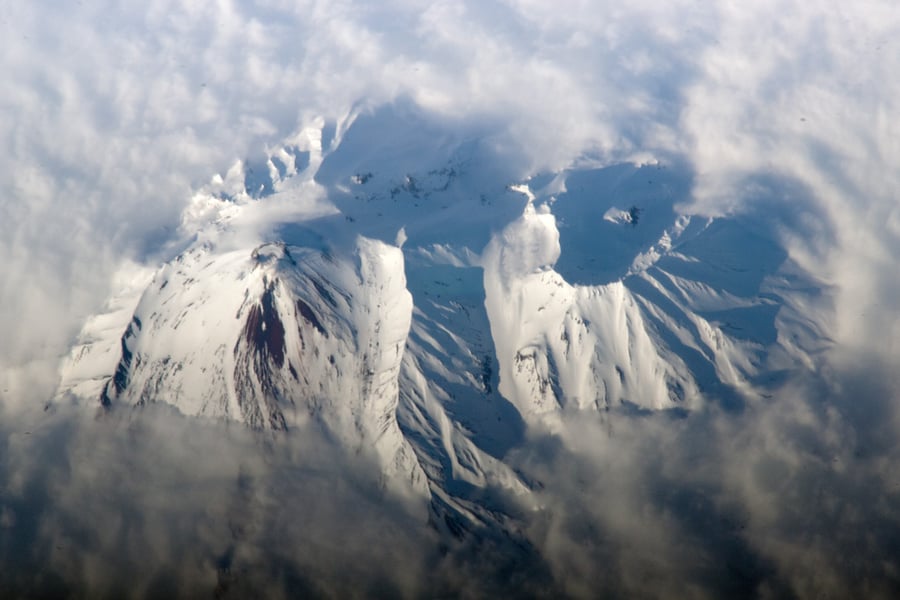

TOKYO — At 12:40 p.m. on Friday, the Japan Meteorological Agency issued an earthquake early warning for a stretch of Japan running from Hokkaido to the Chubu region. It rested on a magnitude 9.9 earthquake in the Kuril Islands. No such earthquake existed. A magnitude 6.9 had struck near Russia’s Kamchatka Peninsula, and the agency withdrew the warning about eight minutes later.
The agency’s own notice is blunt about the cause: its processing placed the epicenter in the Kuril Islands and overestimated the magnitude at 9.9. It says the reason for the overestimate is still under investigation. Japan has recent cause to take such alerts seriously, since the Kumamoto earthquake killed 34 people in Kyushu in July.
That makes the error, not the earthquake, the story. In Russia, the quake caused no reported injuries or damage. In Japan, the agency recorded an intensity of 1 in Hakodate. What failed was a system built for speed, and the agency has not said where.
Xinhua’s reporters in Tokyo received the alert on their phones around 12:40 p.m. and noted that no epicenter or magnitude was released with it. A cancellation notice came at about 12:48 p.m. Anadolu reported that an agency official apologized at an afternoon news conference and that the agency ruled out a cyberattack. The agency’s published notice says the alert covered Hokkaido to the Chubu region and that it will report the cause once it is known, but gives no date.
In Kamchatka the quake was a minute of noise and swinging lamps. A TASS correspondent described light fixtures swaying, doors slamming and dishes rattling, and, TASS said, some residents of Petropavlovsk-Kamchatsky left their apartments. The Kamchatka branch of the Russian Academy of Sciences’ Geophysical Service put the intensity in the city at up to four points. Xinhua, citing Russia’s Ministry of Emergency Situations, said tremors were felt in Petropavlovsk-Kamchatsky, Ust-Kamchatsky, Aleutsky, Vilyuchinsk and Yelizovsky, with no injuries or infrastructure damage reported and no tsunami warning issued.
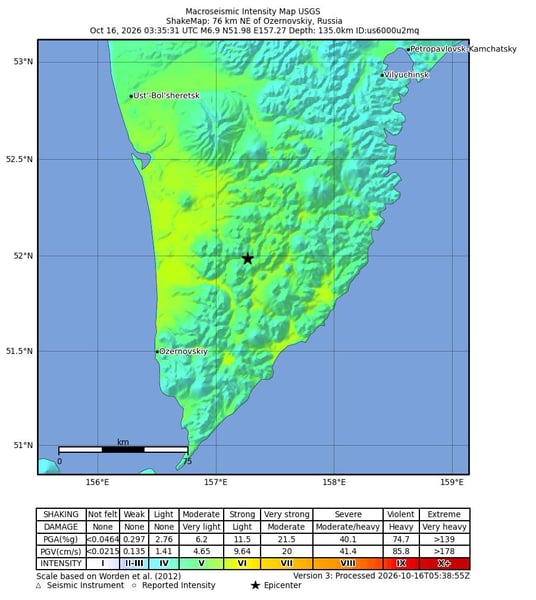
The numbers do not line up yet. The US Geological Survey puts the magnitude at 6.9, the depth at 135 kilometers and the epicenter 76 kilometers northeast of Ozernovskiy, at 03:35 UTC, which was 12:35 p.m. in Japan and 3:35 p.m. in Kamchatka. The Japanese agency’s release dates the quake at about 12:38. The Kamchatka geophysical branch first estimated 6.5, revised it to 6.9, and placed the focus on land 156 kilometers southwest of Petropavlovsk-Kamchatsky at 138 kilometers deep. Xinhua, citing the Unified Geophysical Service, gave 161 kilometers from the city and 127.8 kilometers deep, and an earlier USGS figure carried by Anadolu was 143.2 kilometers. The National Tsunami Warning Center in Alaska, which put its preliminary magnitude at 7.0, said that based on the depth “a tsunami is not expected.”
The USGS’s automated PAGER model rated the event green, citing a “low likelihood of casualties and damage,” and estimated about 213,660 people at intensity IV and roughly 14,000 at intensity V. Those are modeled counts, not surveyed ones. The peninsula has been shaken harder: the USGS catalogue lists a magnitude 8.8 earthquake in July 2025 and quakes of 7.4 and 7.8 east of Petropavlovsk-Kamchatsky that September. TEH also reported a magnitude 6.1 earthquake in southern Kamchatka in February 2023, again without casualties.
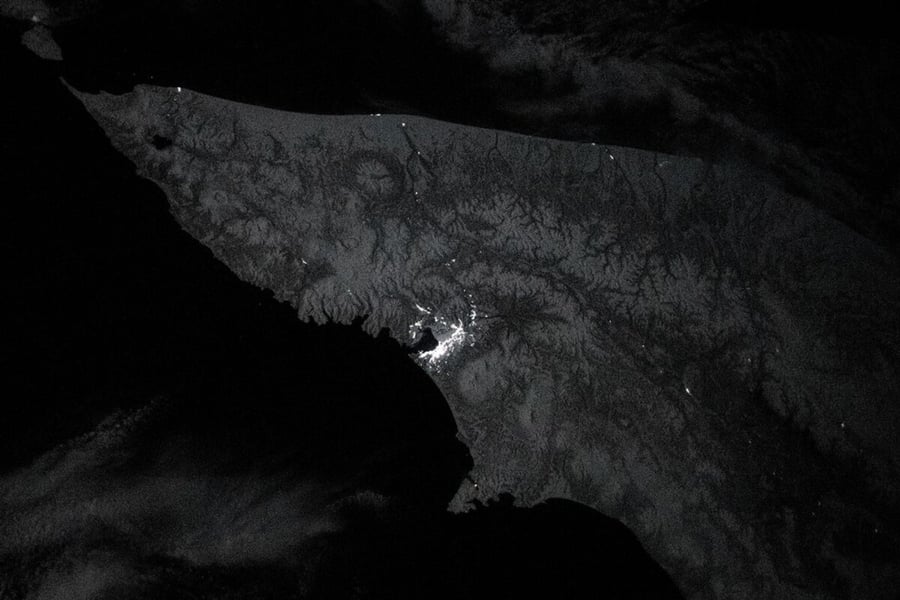
What nobody has answered is the question that matters to anyone who gets such a message on a phone: which step in the agency’s processing turned a 6.9 into a 9.9 and moved it to the wrong place.