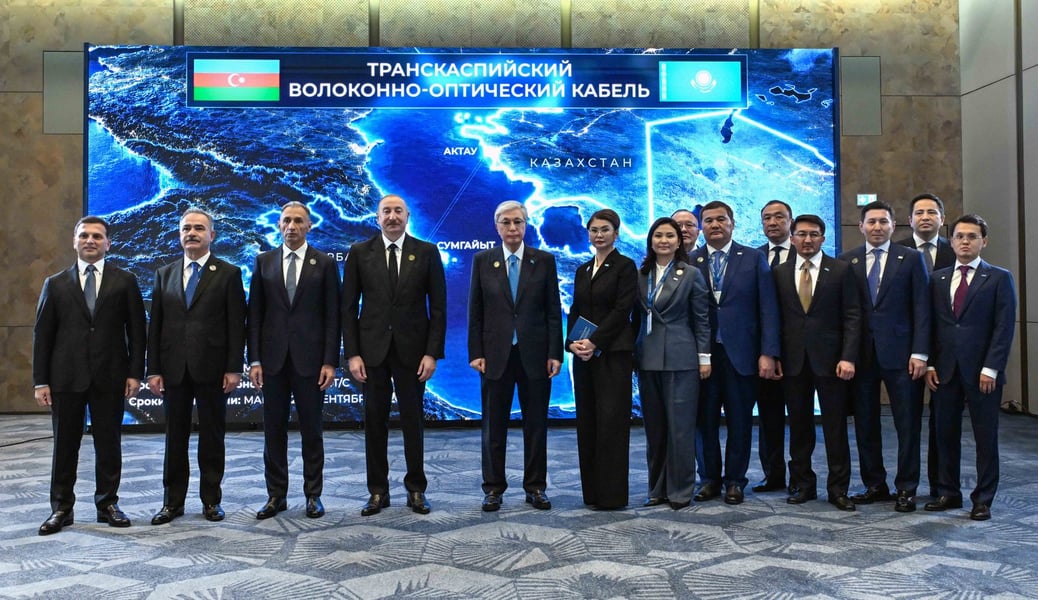

BAKU — Kazakhstan gained an additional route for its data to Europe on Thursday, and the governments that built it have not said what it finally cost or how much traffic it will carry. Presidents Kassym-Jomart Tokayev and Ilham Aliyev launched a 380-kilometer fiber-optic line across the floor of the Caspian Sea, Kazakhstan’s presidential office said.
The launch came on the day of the Baku CICA summit, and a second document changed hands beside it. In the presidents’ presence, the two governments exchanged a signed agreement on developing the Trans-Caspian International Transport Route, the freight corridor better known as the Middle Corridor.
Tokayev framed the cable as something other than freight. It is “not a transport corridor,” he said, but “a kind of digital embodiment of the Middle Corridor.” Aliyev said “we have launched a global project” that Central Asian and South Caucasus states will use “as well as countries across the wider region.” Kazakhstan’s stated stake is cloud services and artificial intelligence: the presidency said the line should help attract global technology companies.
Kazakhtelecom and Azerbaijan’s AzerTelecom built it. Akorda said it will form part of a route linking Kazakhstan, other Central Asian countries and China with Europe, and can be joined to submarine cable systems in the Mediterranean and Black Seas.

The figures are where the accounts thin out. Akorda gives no capacity; the Azerbaijani presidency’s account puts it at more than 400 terabits per second. Interfax reported in June 2024 that Kazakhstan’s digital minister, Zhaslan Madiyev, put the cost at more than 23 billion tenge, about $50 million, for a 370-kilometer line of up to 400 terabits per second. The line launched Thursday is ten kilometers longer, and neither presidency has published a final cost. Madiyev, now a deputy prime minister, spoke at the ceremony.
The two accounts also differ on the ceremony itself. Akorda says the presidents took part in a launch ceremony in Baku; the Azerbaijani presidency says they inaugurated the line “in an online format.” Neither says whether customer traffic is flowing yet.
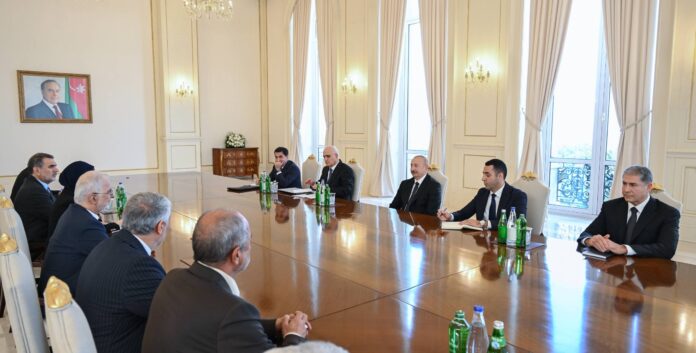
A day earlier, Aliyev received Wang Yi, China’s foreign minister, and told him the Middle Corridor offered broad room for cooperation; that readout named no project or figure either.
A data cable does not carry oil, and Kazakhstan’s crude still depends on a different route. The Caspian Pipeline Consortium, which carries the bulk of that crude through Russian territory to the Black Sea, suspended operations on July 31 amid Ukrainian drone strikes on Black Sea energy infrastructure, and the energy ministry did not say what triggered the halt. The new cable is meant to provide, in the presidency’s words, “additional international connectivity.” Who will buy capacity on it, at what price and from what date, neither readout says.