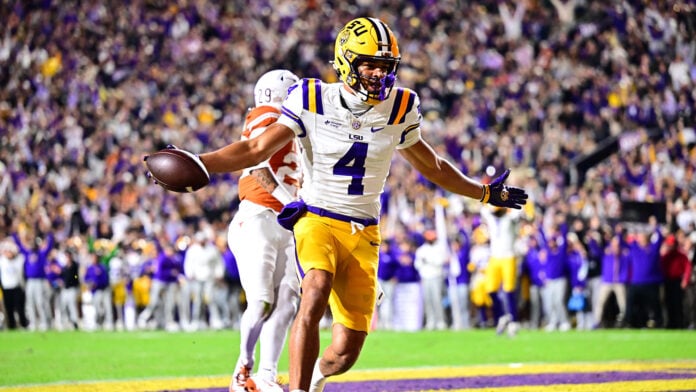

BATON ROUGE, La. — Jelani McDonald caught three passes that LSU could not afford to lose. Then, with Texas still trailing and his own offense struggling to hold the ball, the Longhorns’ defense found another way to keep the game within reach.
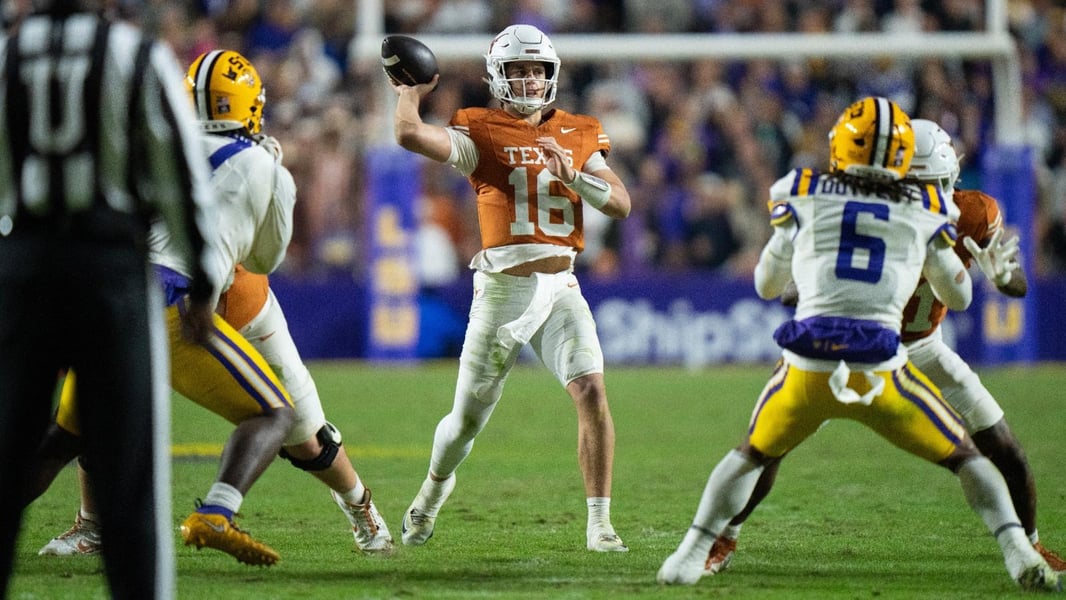
McDonald intercepted Sam Leavitt three times and shared the team lead with 11 tackles in Saturday’s 22–21 victory at Tiger Stadium. Texas forced punts on LSU’s final four offensive possessions, leaving Arch Manning one last opportunity to produce the winning touchdown.
Arch Manning’s winning drive against LSU delivered the finish. The defensive contribution was less easily compressed into a single highlight: two end-zone interceptions, pressure from Rasheem Biles and a closing stretch in which LSU repeatedly failed to turn possession into the points that would have changed Texas’s assignment.
The distinction matters because the Longhorns did not win by controlling the game. LSU outgained them 366 yards to 273, and Manning threw three interceptions of his own. Texas survived an afternoon in which its defense had to prevent an uneven offensive performance from becoming a decisive deficit.
McDonald became the first Texas player with three interceptions in a game since Aaron Humphrey in 1997, according to the Longhorns’ official game report. His total tied for second in program history, behind Bill Bradley’s four-interception game in 1968. He also broke up a pass.
The locations of the catches explain more than the historical comparison.
McDonald’s first interception ended an LSU possession in the opening quarter with the score tied 7–7. His second came in the end zone early in the second quarter, after the Tigers had moved from their own 16 to the Texas 12. Biles was credited with hurrying Leavitt on that throw.
Texas did not convert the reprieve into a lead. Manning was intercepted on the next possession, and LSU took over at the Longhorns’ 7 before scoring two plays later. McDonald had stopped one scoring opportunity; the Texas offense immediately handed the Tigers another.
That sequence limits any simple account of the interceptions as momentum-changing plays. McDonald’s first two takeaways were followed by a Texas punt and a Texas interception. They kept LSU from finishing drives, but they did not repair the Longhorns’ offense.
The offensive uncertainty was not new. After Texas’s loss to Florida, Steve Sarkisian had put both Manning’s play and his own play-calling under review. Against LSU, the defense kept those offensive problems from deciding the result.
His third interception followed the same pattern.
LSU opened the second half with a possession that reached the Texas 16. Leavitt again threw into the end zone, and McDonald again ended the threat with a touchback. Manning was intercepted on the ensuing series, and the Tigers subsequently went 72 yards for a touchdown, capped by Dilin Jones’s 44-yard run. LSU led 21–10 with 5:52 left in the third quarter.
Texas’s defense had produced three takeaways and still faced an 11-point deficit.
The response after Jones’s touchdown was different. The Longhorns did not intercept another pass. They stopped allowing LSU to finish possessions with anything other than a punt.
The official drive chart records LSU’s final four offensive series at minus-nine yards, one yard, 19 yards and minus-12 yards. Combined, that was a net loss of one yard across 15 plays, including the effect of penalties.
The distinction between limiting yards and deciding possessions has surfaced elsewhere in the conference. Kentucky’s interception-driven win over Oklahoma came despite the Wildcats being outgained. Texas’s escape carried a different version of that imbalance: McDonald’s takeaways prevented points, while the late stops kept returning the ball to Manning.
Those stops were not all interchangeable. Bo Mascoe’s third-down sack helped end the first series, giving Texas possession near midfield. Gianni Spetic followed with a 50-yard field goal that cut the deficit to 21–16 with 11:37 remaining.
Another quick stop gave Manning the ball again. Another interception returned the defense to the field.
LSU started that possession at its own 4 and managed one first down before McDonald and Warren Roberson combined to stop Trey’Dez Green short of the line to gain on third down. The Tigers punted. Texas then went backward on its next offensive series and punted, too.
There was still no guarantee that the defensive work would be rewarded.
Biles supplied much of the pressure and tackling around McDonald’s takeaways. He matched McDonald’s 11 tackles, recorded two tackles for loss, including a sack, and was credited with two quarterback hurries. Justin Cryer and Mascoe also had sacks as Texas brought Leavitt down three times.
The performance was not a comprehensive shutdown. Jones rushed for 125 yards, Leavitt passed for 244, and LSU converted seven of 14 third downs. The Tigers reached the red zone five times but scored on only two of those possessions. Two others ended with McDonald catching the ball in the end zone; another ended with a missed field goal before halftime.
On LSU’s final offensive possession, penalties helped Texas finish the job. Two holding calls pushed the Tigers backward, erasing a Leavitt scramble that otherwise would have gained a first down. Justus Terry and Lance Jackson stopped Jones for a loss on third-and-21.
The punt left Texas at its own 42 with 2:19 remaining. Manning took the Longhorns 58 yards and found Raleek Brown for the winning four-yard touchdown with three seconds left.
McDonald’s three interceptions produced no points on the Texas possessions immediately following them. Their value was on the other side of the ledger: twice, LSU had reached the red zone, and twice it left with nothing.