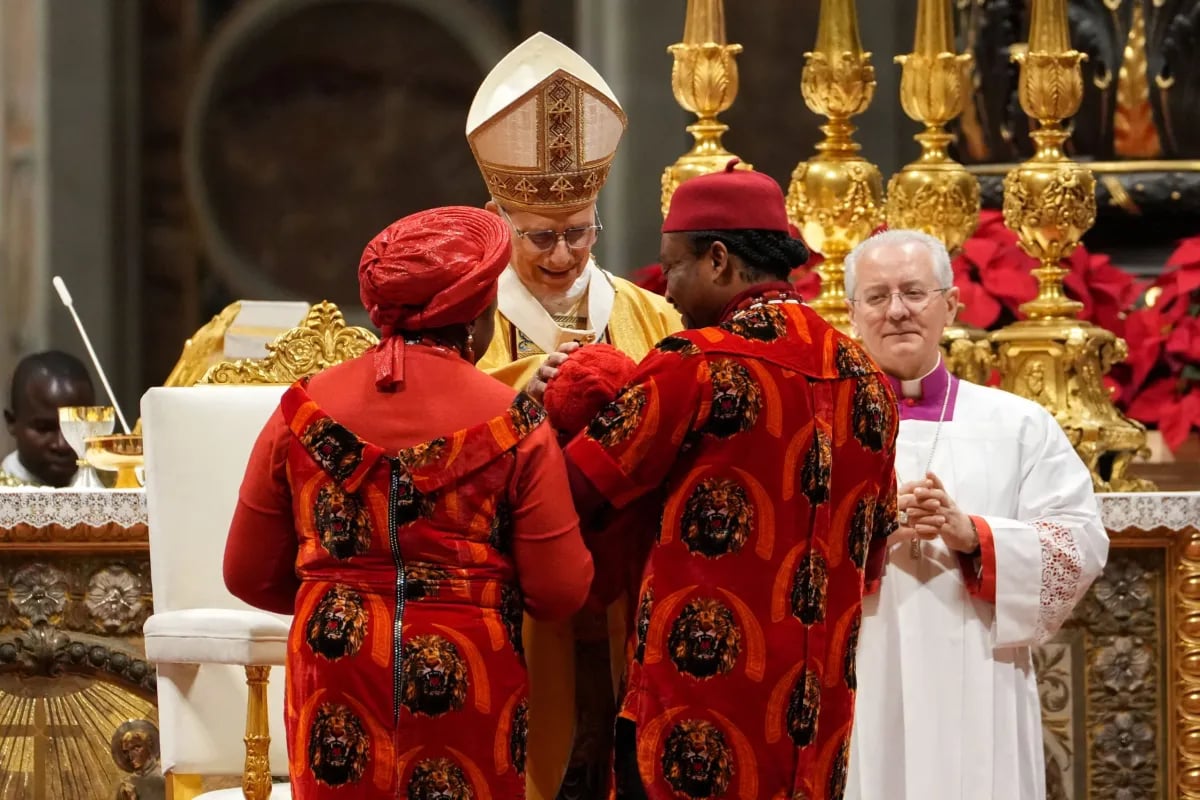
VATICAN CITY — Pope Leo XIV delivered an unequivocal moral challenge to the world’s 1.4 billion Catholics during his first Christmas Eve Mass as pontiff, declaring that refusing to help the poor, strangers, and marginalized is tantamount to refusing God himself. The stark message, delivered Tuesday night in St. Peter’s Basilica, marked a defining moment for the first American pope as he addressed growing economic inequality and humanitarian crises affecting millions worldwide.
In his homily before thousands of worshippers, Pope Leo XIV condemned what he termed a “distorted economy” that treats human beings as disposable merchandise rather than children of God. The 58-year-old pontiff, who assumed the papacy in May 2025, used Christianity’s most celebrated feast to issue a clarion call for compassion that transcends religious and national boundaries.
The Moral Imperative of Welcoming Strangers
The Holy Father’s message centered on a radical interpretation of the Nativity story, emphasizing that Mary and Joseph themselves were displaced persons seeking shelter. “Tonight we celebrate the birth of a child who had no room at the inn, whose family sought refuge from violence,” Pope Leo said. “When we turn away refugees, when we ignore the homeless on our streets, when we dismiss the suffering of migrants crossing dangerous borders, we are turning away Christ himself.”
This theological framework directly addresses contemporary humanitarian crises, including the ongoing displacement in Gaza, the Syrian refugee situation, and mass migration patterns affecting Europe, the Americas, and Asia. The Pope’s reference to strangers and the displaced carries particular weight given his recent visits to Lebanon and Turkey, where he engaged in groundbreaking interfaith dialogue with Muslim leaders and communities.
Pope Leo XIV has consistently emphasized that Christian charity must extend beyond denominational lines. Earlier this year, he declared that Christians and Muslims can live together peacefully, calling for mutual respect and cooperation in addressing shared human challenges. His Christmas message reinforces this vision, implicitly including Muslim refugees and displaced persons from conflict zones as recipients of the Christian duty to welcome strangers.
Condemning Economic Systems That Exploit the Vulnerable
The pontiff’s critique of modern economic structures represented one of the most pointed elements of his Christmas address. “We have created systems that treat human beings as commodities,” he stated. “An economy that produces disposable people is a distorted economy that offends God and wounds humanity.”
This condemnation echoes growing concerns about wealth inequality, labor exploitation, and the dehumanizing effects of unchecked capitalism. Pope Leo XIV specifically highlighted how economic pressures force families into destitution, drive migration, and create conditions where the vulnerable become invisible to those with power and resources.
The Pope’s message resonates particularly strongly in developing nations where economic instability has created massive displacement. His words also challenge wealthy nations to examine their own economic policies and their treatment of immigrant populations who often perform essential labor while living in precarious conditions.
A Personal Call to Action for Every Catholic
Moving beyond institutional critique, Pope Leo XIV made the message intensely personal for individual believers. He emphasized that the Christmas story demands concrete action, not merely sentimental reflection. “Faith without works is dead,” he reminded the congregation, quoting the Epistle of James. “We cannot claim to love God while ignoring our brothers and sisters in need.”
The pontiff outlined specific ways Catholics can respond to his call. He urged families to open their homes and communities to welcome newcomers, encouraged parishes to establish outreach programs for the homeless and hungry, and called on business leaders to examine whether their practices uphold human dignity or contribute to exploitation.
“The measure of our faith is not found in our churches alone,” Pope Leo declared. “It is found in our willingness to see Christ in the face of every person who suffers, who hungers, who seeks safety and dignity. When we feed the hungry, we feed Christ. When we welcome the stranger, we welcome Christ. And when we refuse help to those in need, we refuse Christ himself.”
Interfaith Dimensions of Compassion
While Pope Leo XIV’s Christmas message was delivered to a Christian audience, its implications extend far beyond Catholic doctrine. The Pope has made interfaith dialogue a cornerstone of his brief but impactful pontificate, particularly strengthening relationships with Muslim communities.
During his December visit to Lebanon, a country with significant Christian and Muslim populations, Pope Leo called for unity and reconciliation across religious lines. He has repeatedly emphasized that religious differences should never justify indifference to human suffering. This principle underlies his Christmas message about helping strangers and the displaced, many of whom come from Muslim-majority countries affected by conflict and instability.
The pontiff’s concern for Gaza’s civilian population, which he has described as suffering ‘forced exile’, demonstrates his commitment to defending vulnerable populations regardless of their religious identity. By framing assistance to all displaced persons as a Christian duty, Pope Leo challenges believers to transcend sectarian boundaries in their practice of charity.
Historical Context and Papal Tradition
Pope Leo XIV’s Christmas message builds on a tradition of papal social teaching that dates back more than a century. His namesake, Pope Leo XIII, was renowned for addressing labor rights and social justice in the late 19th century. The current pontiff appears determined to apply similar moral clarity to 21st-century challenges.
However, Pope Leo XIV’s approach carries distinctive elements shaped by his American background and his experience with immigration issues. As the first pope from the United States, he brings a unique perspective on migration, economic inequality, and religious pluralism. His tenure has been marked by direct engagement with contentious social issues and a willingness to speak uncomfortable truths to both secular and religious audiences.
The Christmas Eve Mass represented a significant moment in establishing the tone and priorities of his pontificate. By choosing to emphasize service to the poor and displaced in his first Christmas address, Pope Leo XIV signals that social justice and human dignity will remain central themes of his papacy.
Global Reactions and Implications
The Pope’s message arrives at a moment of heightened global tension over migration, economic policy, and humanitarian crises. European nations continue grappling with refugee flows from the Middle East and Africa. The United States faces ongoing debates about immigration and border policy. Meanwhile, conflict-driven displacement in Gaza, Sudan, Ukraine, and Myanmar has created millions of refugees seeking safety and stability.
Religious leaders and humanitarian organizations quickly praised the Pope’s clear moral stance. However, his message also implicitly challenges Catholic politicians and voters who support restrictive immigration policies or oppose assistance programs for the poor. By framing rejection of the vulnerable as rejection of God, Pope Leo XIV leaves little room for theological justification of policies that prioritize security or economic concerns over human dignity.
The practical implications of his call to action remain to be seen. Catholic parishes, charities, and institutions worldwide will face questions about how to concretely implement the Pope’s vision. His message also tests the unity of a global Church that includes members with vastly different political and economic perspectives.
The Christmas Challenge to a Divided World
As Pope Leo XIV concluded his Christmas Eve homily, he returned to the image of the infant Christ, born into vulnerability and poverty. “God did not come to us as a powerful king,” he reflected. “He came as a helpless child, dependent on the kindness of strangers. He came to the margins, to the forgotten, to show us where we must direct our love and attention.”
This Christmas message represents more than seasonal sentimentality. It constitutes a theological and moral framework that demands concrete response. By explicitly linking assistance to the poor and strangers with acceptance or rejection of God, Pope Leo XIV has issued one of the clearest papal statements on social obligation in recent memory.
The coming months will reveal how Catholic communities worldwide respond to this challenge. But on this Christmas Eve, the message from the Vatican was unmistakable: faith requires action, compassion transcends borders, and the test of Christian discipleship lies in service to the most vulnerable members of society, regardless of their nationality, religion, or circumstances.
For the estimated 1.4 billion Catholics celebrating Christmas, and for people of goodwill across all faith traditions, Pope Leo XIV’s message offers both challenge and inspiration. In a world increasingly divided by walls, borders, and suspicion of strangers, the Pope’s Christmas call to recognize Christ in every suffering person stands as a powerful counter-narrative, one that measures human civilization not by its wealth or power, but by its treatment of the least among us.