AUSTIN, Texas — Tesla reported a jump in first-quarter profit on Wednesday, beating Wall Street’s expectations. But the good news was quickly overshadowed by a costly new ambition: the company’s chief executive, Elon Musk, said Tesla would plow more than $25 billion into artificial intelligence and robotics this year, a spending spree that rattled investors and sent the company’s shares lower in after-hours trading.
The sell-off, though modest, reflected a growing tension at the electric carmaker. For all its success on the factory floor, deliveries rose 6 percent and net income climbed 17 percent to $477 million, Tesla is increasingly asking shareholders to judge it not by the cars it sells today but by the A.I. products it promises for tomorrow.
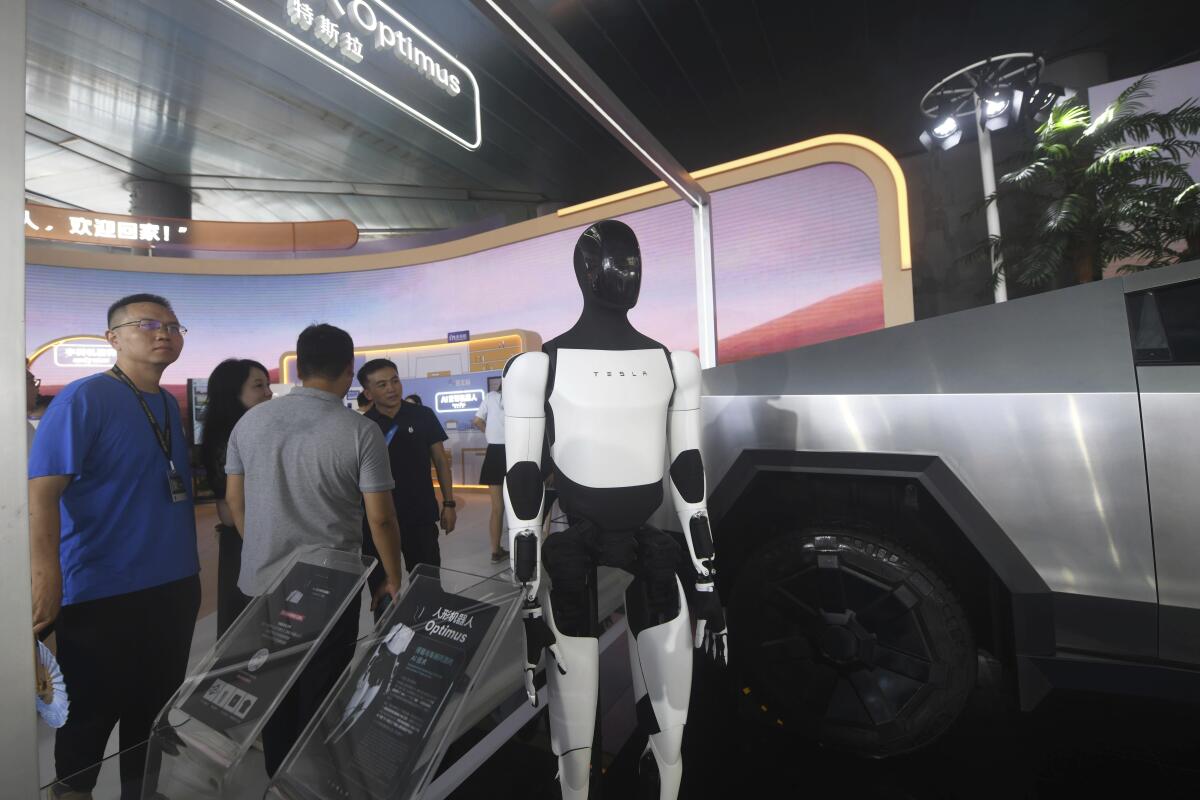
Those products include a dedicated “Cybercab” robotaxi, a humanoid robot named Optimus, and a new semiconductor fabrication plant in Austin being developed in partnership with SpaceX, Mr. Musk’s rocket company. The bill for that expansion, the company said on an earnings call with investors, now exceeds $25 billion in capital expenditures for 2026, nearly three times what Tesla spent last year, and $5 billion more than the company had forecast just three months ago.
Vaibhav Taneja, Tesla’s chief financial officer, warned that the heavy investment would probably lead to “negative free cash flow for the rest of the year” as the company begins placing orders for chip-making equipment and retools factories. Two existing models, the Model S and Model X, have already been discontinued to make room for Optimus production at Tesla’s Fremont, Calif., plant.
“We’re further increasing our investment in artificial intelligence-related initiatives,” Mr. Taneja said on the call. He added that the spending was necessary to support both the robotaxi launch and the eventual mass production of Optimus, which Mr. Musk has called “potentially the largest product ever created.”
Still, investors appeared to balk at the scale and speed of the pivot. Tesla’s shares, which had initially jumped after the earnings release, fell about 3 percent in extended trading. The stock has now dropped more than 30 percent over the past 12 months, as concerns about slowing demand for electric vehicles have collided with Mr. Musk’s widening ambitions.
On the factory floor, those ambitions are already reshaping Tesla’s core business. The company said its long-awaited Cybertruck posted its lowest quarterly delivery figures since production began, with buyers waiting for a cheaper version of the angular pickup. And Mr. Musk suggested on the call that the coming Cybercab, a dedicated autonomous vehicle without a steering wheel, would eventually replace the Model Y, Tesla’s best-selling car.
“We expect that Cybercab will begin to replace the existing Model Y fleet over time,” the company said in its earnings presentation, adding that the robotaxi would become “the largest volume vehicle in the fleet.”
The announcement of Tesla’s partnership with Intel to use the chip maker’s next-generation 14A manufacturing process for its A.I. chips sent Intel shares up about 4 percent in after-hours trading. Mr. Musk described the collaboration as part of a broader push to secure the advanced semiconductors needed to run Tesla’s self-driving software and Optimus robots.
Analysts were divided on the strategy. Dan Ives of Wedbush, a longtime Tesla bull, said the company was “morphing into a physical A.I. stalwart” and that the heavy capital spending, while painful in the short term, was a necessary step. Others worried that Tesla was burning cash at the very moment its core auto business faces fresh competition and signs of softening demand.
For now, Mr. Musk appears undeterred. “The path is here, and it requires more CapEx,” he said on the call, using the industry shorthand for capital expenditures. Whether shareholders have the patience to wait for that path to pay off, or the appetite for the bill that comes with it, remains an open question.