The cosmos has delivered yet another provocation to human certainty. This time, it arrives in the form of 3I/ATLAS, a rogue celestial traveler that is not merely foreign to our solar system but possibly older than the Sun itself. Scientists are now confronting an unsettling conclusion: the building blocks of planets, and perhaps life, may have emerged under radically different conditions across the galaxy.
Discovered in July 2025, the comet has since become one of the most scrutinized objects in modern astronomy. It is only the third confirmed interstellar visitor, following Oumuamua and 2I/Borisov. Yet unlike its predecessors, 3I/ATLAS is not just passing through; it is rewriting what we know about planetary formation.
A relic from a frozen, ancient galaxy
New research suggests that 3I/ATLAS formed in a region of the Milky Way far colder and more isolated than the environment that gave rise to our solar system. Scientists analyzing its chemical composition detected unusually high levels of deuterium, a heavy isotope of hydrogen that forms in extreme cold.
This isotopic fingerprint is not trivial. It points to a birthplace where temperatures may have dipped below minus 240 degrees Celsius, conditions that prevailed in the early galaxy more than 10 billion years ago.
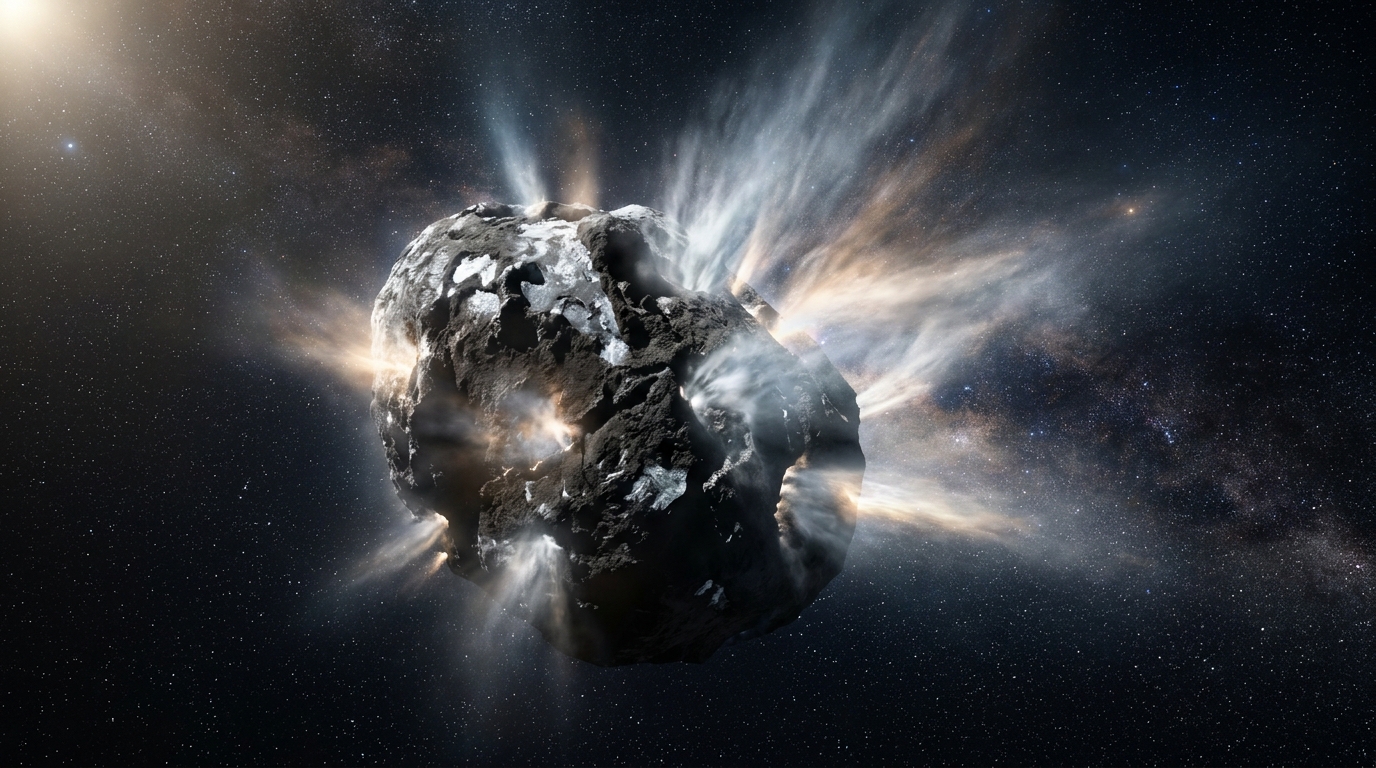
The implication is staggering: this comet could be a preserved fragment from the infancy of the galaxy, long before the Sun ignited.
Alien chemistry unlike anything in the solar system
If its age is astonishing, its chemistry is even more disruptive. Observations reveal that 3I/ATLAS is bursting with methanol and other volatile compounds at levels rarely seen in comets formed around our Sun.
Even more striking is the ratio of carbon dioxide to water and the presence of complex molecules such as methane and cyanide, with scientists scientists analyzing its chemical composition across multiple observation platforms. These compounds were observed as the comet heated up during its close approach to the Sun, triggering a cascade of chemical transformations.
In practical terms, the comet behaves like a chemical time capsule. As solar radiation penetrates its surface, it releases materials that have remained locked away for billions of years, offering a rare glimpse into the diversity of planetary formation across the galaxy, including the presence of complex molecules such as methane and cyanide.

A comet that refuses to behave
Unlike typical comets in our solar system, 3I/ATLAS has demonstrated erratic and intense activity. At one point, it was ejecting massive amounts of water vapor per second, an output so immense it challenges conventional cometary models.
This hyperactivity is not just spectacle. It suggests that the comet’s internal structure and volatile composition differ fundamentally from those formed in our solar neighborhood.
Even more puzzling, the comet brightened and flared after passing the Sun, defying expectations that such objects should gradually fade.
For astronomers, this behavior signals that interstellar objects may follow physical rules shaped by entirely different cosmic environments.
A trajectory that tells a deeper story
Traveling at extraordinary speed on a hyperbolic path, 3I/ATLAS is not gravitationally bound to the solar system. It passed Earth at a safe distance before slingshotting back into interstellar space, never to return.
Its origin appears to trace back toward the dense regions near the galactic center, though scientists caution that its exact birthplace remains uncertain. What is clear is that it did not originate here.

This trajectory transforms the comet into something more than an object of study. It becomes a messenger, carrying information from a distant and ancient stellar system.
A new era of interstellar astronomy
The discovery of 3I/ATLAS signals a turning point. With next-generation observatories scanning the skies, astronomers expect many more interstellar visitors in the coming years.
Each one will bring fragments of distant worlds, offering direct evidence of how planets form beyond the Sun’s influence.
For now, 3I/ATLAS stands as the most compelling example yet. It is not just an object passing through space. It is a relic of a forgotten epoch, a chemical archive of alien systems, and a reminder that the universe is far more diverse and unpredictable than once imagined.
In the cold vacuum between stars, something ancient is moving on—and it has already changed how we understand our place in the cosmos.