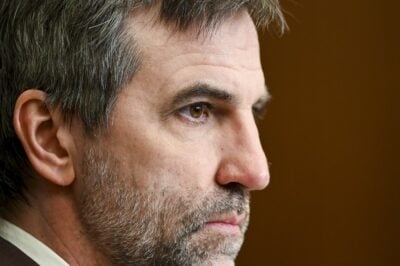

OTTAWA — For nearly seven years, Steven Guilbeault was the loudest voice in Canadian federal politics on climate. On Wednesday morning, he told his Liberal caucus colleagues that voice would soon no longer come from the House of Commons.
The former environment and climate change minister announced he would resign his Montreal seat when Parliament rises for the summer, becoming the most prominent casualty of a sweeping rollback of environmental policy under Prime Minister Mark Carney — a leader Guilbeault himself helped bring to power less than two years ago.
“After almost seven years as a Member of Parliament and Minister, I have come to the conclusion that it is time for me to pursue my fight for environmental protection and the fight against climate change in a different way,” Guilbeault wrote in a statement posted to social media on Wednesday.
The announcement, which had been telegraphed for days by government sources, landed less than two weeks after Carney and Alberta Premier Danielle Smith signed a sweeping energy pact in Calgary. That agreement pledged federal support for a new bitumen pipeline to the West Coast, slowed the pace of industrial carbon pricing, and prompted analysis from the Canadian Climate Institute suggesting Canada’s 2050 net-zero targets are now at risk.
Guilbeault had already resigned from cabinet in November 2025, hours after Carney and Smith signed the initial energy memorandum of understanding. He stayed in caucus, aides said, hoping to shape policy from within, pushing against compromises on industrial carbon pricing and contributing to Ottawa’s enhanced nature strategy and international climate finance commitments. The final version of the Alberta deal, signed May 17, removed whatever room remained for that influence.
“It’s a different Liberal party,” Transport Minister Steven MacKinnon told reporters on his way into the caucus meeting Wednesday, “that is meeting the very urgent and critical demands of the moment. We’re in a trade war, there are wars in the Middle East, there’s a war in Europe.”
The prime minister, asked whether the Alberta deal was worth it given Guilbeault’s departure, was blunt. “Absolutely,” according to reports. Carney said he respects Guilbeault’s decision and thanked him for his service but defended his government’s record, arguing Canada is still protecting nature and advancing international climate finance. He also left the door open to working with Guilbeault in some advisory capacity.
The resignation has set off a sharper argument about what — and who — remains of the Liberal climate coalition. Catherine McKenna, who served as Canada’s environment minister under Justin Trudeau before Guilbeault took the portfolio, said the moment demands that the Liberals who do care about climate make themselves heard. In remarks reported by the National Post, McKenna said those within the party who “actually talk about the climate crisis” need to speak up now that its most visible champion is leaving. The question hanging over Ottawa is whether anyone will.
The gap left by Guilbeault’s departure is not only rhetorical. More than a dozen Liberal MPs sent Carney a letter in April expressing concern over changes to methane and clean electricity regulations in Alberta and the delay of the $130-per-tonne carbon price target beyond 2030, as reported by CBC News. Most signed anonymously. Now, with Guilbeault’s name gone from the caucus, the test is whether those 14 will step forward or step back.
The structural reality is significant. After three byelection wins in April, Carney’s Liberals secured a majority in the House of Commons with 174 seats. Guilbeault’s resignation will reduce that to 173, just one seat above the threshold for a majority government. For now, the arithmetic holds. The politics are messier.
Green Party Leader Elizabeth May, who last autumn voted to support the Carney government’s budget in part because of Guilbeault’s persuasion, called his resignation “heartbreaking.” She questioned whether the Liberal caucus retains any genuine space for climate advocacy. “It’s a blow to the Parliament itself, to our ability as Canadian MPs to do our work,” May told CTV’s Power Play.
New Environment and Climate Change Minister Julie Dabrusin, for her part, pushed back on the idea that the caucus has abandoned the file. “We care deeply about the environment, fighting climate change, and also about how we’re going to build our country in this moment,” she said. “There are a range of opinions, and that makes us stronger.” Dabrusin did not offer specifics on what policies would change to address the concerns that drove Guilbeault out the door.
The gap between that framing and the record is substantial. In roughly one year, the Carney government has repealed the consumer carbon tax, eliminated the electric vehicle sales mandate, signalled the end of the oil and gas emissions cap, reversed a Liberal pledge to end fossil fuel subsidies, and now paved the way for a major new bitumen pipeline. A February 2026 report from the Canadian Climate Institute found Canada on track to achieve only about half its 2030 emissions reduction target. Guilbeault, in remarks to a seniors’ climate webinar earlier this year, said the government’s attitude is that climate “is not an issue” — and warned that reliance on voluntary market measures alone would not close the gap.
For Guilbeault personally, the exit is a clean break from a seven-year journey that began with Greenpeace stunts on the CN Tower and ended in a caucus room on Parliament Hill. He co-founded Quebec environmental group Équiterre, spent decades as one of the country’s most recognized climate activists, and entered politics in 2019 with a portfolio of domestic and international accomplishments unusual for a first-time MP. As environment minister from 2021 to 2025, he enshrined Canada’s emissions goals in law, introduced the oil and gas emissions cap, launched the clean electricity framework, and pushed through the Kunming-Montreal Global Biodiversity Framework.
He endorsed Carney for Liberal leadership early and enthusiastically, saying the two had worked together on green energy transition and the role of the financial sector in fighting climate change. That endorsement, in hindsight, was also a wager — and one that did not pay off on climate terms.
“Around the world, we have demonstrated what we can accomplish with ambition and determination,” Guilbeault wrote in his final statement. “It is with this same conviction that I wish to continue this fight for the generations who will inherit our precious and unique blue planet.”
Emerging from the caucus meeting, he told reporters he was “absolutely at peace.” Canada’s remaining climate Liberals are deciding whether they can say the same — and amid an economy already under strain from trade pressures and rising unemployment, whether the political calculus will ever again favor them speaking up.
Guilbeault is expected to remain as an MP until the House rises for the summer. He was approached by sources about crossing the floor or sitting as an Independent but chose neither path. His Laurier-Sainte-Marie riding in Montreal will trigger a byelection once his seat is formally vacated — a contest that will test whether a city that has returned a climate champion to Ottawa since 2019 continues to demand more from its federal government on the environment, or accepts the new dispensation.
Carney, asked to define what his climate legacy will look like without Guilbeault in caucus, said only that Canada is protecting nature and advancing international climate finance. For the Liberals who watched Guilbeault walk out Wednesday, the answer will need to be more specific — and soon.