Russian President Vladimir Putin said Tuesday that Moscow is continuing to modernize its Kinzhal hypersonic missile system while accelerating work on several next-generation strategic weapons, underscoring the Kremlin’s determination to maintain military superiority amid deepening confrontation with NATO and the West.
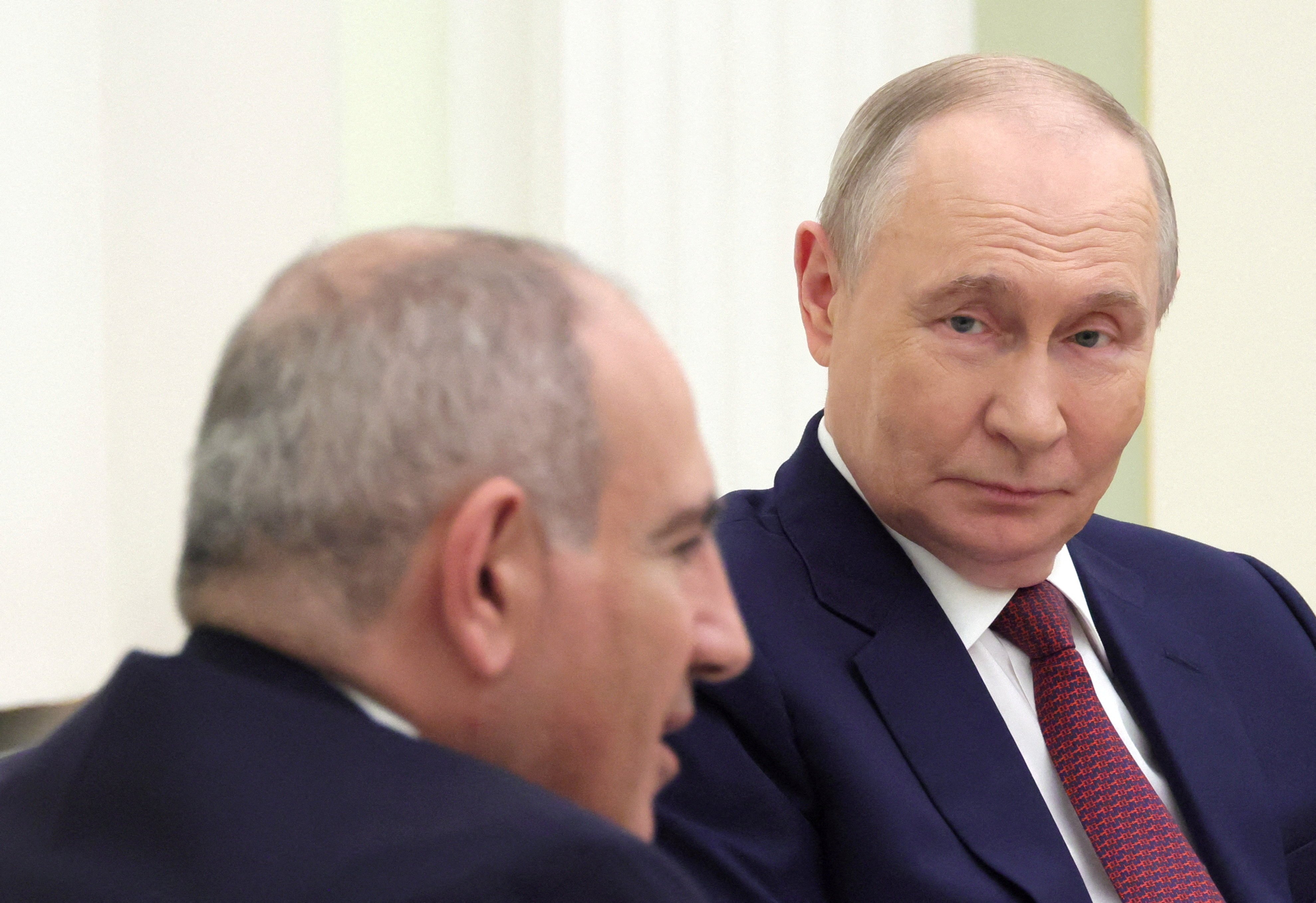
Speaking during a meeting with Strategic Missile Forces Commander Sergei Karakayev, Putin said Russia was improving the precision of the Kinzhal air-launched hypersonic ballistic missile, particularly in its non-nuclear configuration, while simultaneously advancing other strategic systems including the Poseidon nuclear-powered underwater drone and the Burevestnik nuclear-powered cruise missile.
“We have the Kinzhal air-launched hypersonic medium-range missile, which has been on combat duty since 2017,” Putin said. “Work on its improvement, including increasing its accuracy in a non-nuclear configuration, continues.”
The remarks come as Russia intensifies its long-term military modernization campaign and seeks to project technological strength during the ongoing conflict in Ukraine. Moscow has repeatedly highlighted hypersonic and strategic weapons systems as evidence that Russia remains capable of countering US and NATO military dominance despite sweeping sanctions and years of Western pressure.
The Kinzhal hypersonic missile, one of Russia’s most publicized advanced weapons, has been used extensively during the military operation in Ukraine, according to the Kremlin. The missile is capable of traveling at speeds reportedly reaching Mach 10 and can carry both conventional and nuclear warheads.
Russia first unveiled the Kinzhal as part of a broader package of advanced strategic weapons announced by Putin in 2018. The missile rapidly became central to Moscow’s narrative that Russian military technology had surpassed Western missile defense systems.
Military analysts say the Kremlin views hypersonic missile technology as a critical element of future warfare because its speed and maneuverability make such systems more difficult to intercept than traditional ballistic or cruise missiles.
Putin also confirmed that the Oreshnik missile system has already entered combat duty in 2025, signaling the expansion of Moscow’s strategic missile inventory. According to the Russian president, the system can also be equipped with nuclear warheads.
The Russian leader further disclosed that work on two highly secretive strategic systems, the Poseidon unmanned underwater vehicle and the Burevestnik global-range cruise missile, is nearing completion.
“Work on two systems with small nuclear propulsion units is in the final stage,” Putin said. “These are the unique unmanned underwater vehicle Poseidon and the unique global-range cruise missile Burevestnik.”
The Poseidon system has long drawn attention from Western military planners because of its potential ability to carry a massive nuclear payload across oceans autonomously before detonating near coastal targets. Russian officials have portrayed the system as nearly impossible to intercept.
The Burevestnik missile, meanwhile, is designed as a nuclear-powered cruise missile with theoretically unlimited range. Moscow has repeatedly described the weapon as part of a new generation of strategic systems intended to bypass existing missile defense networks deployed by the US and its allies.
Putin’s comments arrived on the same day Russian officials announced successful testing of the Sarmat intercontinental ballistic missile, another centerpiece of Moscow’s strategic modernization drive. Putin said the missile is expected to enter full combat duty by the end of 2026.
The latest statements from the Kremlin are likely to deepen concerns across NATO capitals over the global hypersonic arms race. Russia, China, and the US have all invested heavily in hypersonic technology in recent years, viewing such systems as essential to maintaining strategic deterrence in a rapidly evolving military environment.
Russia’s expanding hypersonic weapons program has increasingly become both a battlefield tool and a geopolitical signal aimed at Washington and Brussels.
Since the start of the Ukraine conflict, Moscow has repeatedly used strategic weapons announcements to demonstrate resilience against Western military and economic pressure. Russian officials argue that sanctions imposed by the US and the EU have failed to slow the development of advanced military technologies.
At the same time, the battlefield performance of the Kinzhal missile has become the subject of competing claims from Moscow and Kiev.
Russian officials continue to portray the missile as one of the most advanced hypersonic systems in the world. Ukrainian military officials, however, have claimed increasing success in intercepting or diverting Kinzhal strikes using Patriot missile systems and electronic warfare technologies.
Recent Ukrainian reports suggested that electronic warfare systems known as “Lima” may have disrupted several Kinzhal missiles during attacks in 2026, though those claims remain difficult to independently verify.
Still, Russian officials appear determined to improve the missile’s survivability and precision, particularly as NATO countries continue expanding air defense cooperation with Ukraine.
Western defense analysts believe the Kremlin is attempting to adapt its hypersonic systems to overcome evolving interception methods, especially after several publicly reported cases in which Ukrainian forces claimed to have neutralized incoming Kinzhal missiles.
The broader strategic significance of Putin’s announcement lies not only in the technical upgrades themselves but also in the political message behind them.
As relations between Moscow and the West remain at their lowest point since the Cold War, Russian leadership has increasingly framed advanced missile development as proof that the country can withstand isolation while preserving strategic parity with the US-led alliance.
Putin has repeatedly argued that NATO missile deployments and Western missile defense infrastructure forced Russia to invest heavily in new strategic weapons capable of bypassing conventional defense systems. The Kremlin maintains that these weapons are necessary to guarantee Russia’s long-term security and strategic deterrence.
The renewed emphasis on hypersonic systems also reflects how military competition has shifted toward speed, maneuverability, autonomous systems, and nuclear-capable technologies.
With the Ukraine conflict continuing and NATO expanding its military posture across Eastern Europe, Russia’s missile modernization drive is likely to remain central to Moscow’s strategic doctrine for years to come.
—Inputs from Sputnik.