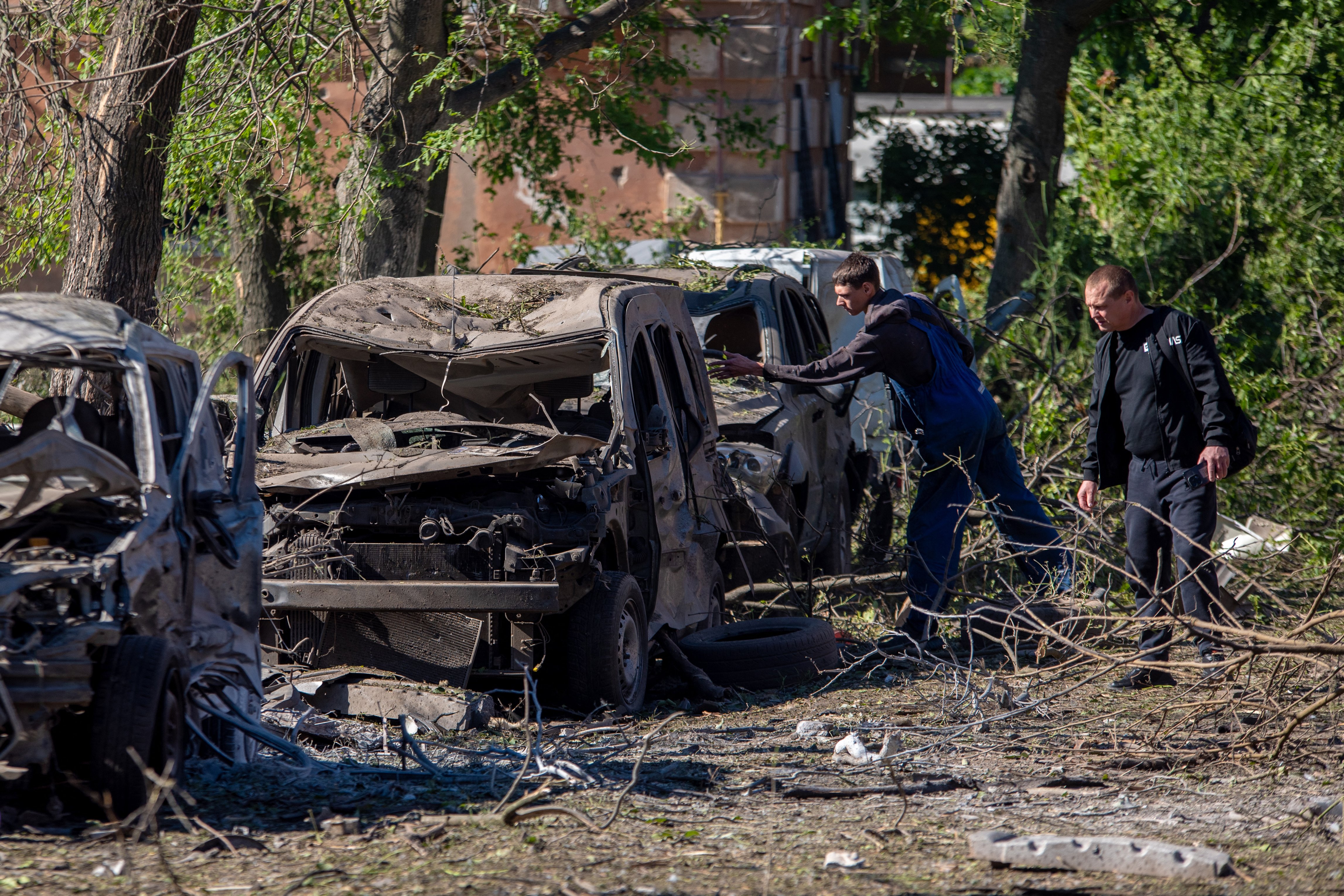

MOSCOW — The bus was scheduled, its route ordinary: a long-haul coach running the corridor between the Russian capital and Simferopol, a journey that crosses through occupied territory Russia considers sovereign ground. On Wednesday morning it did not complete that journey. A drone struck it in Yenakiyevo, in the Donetsk People’s Republic, killing seven passengers and wounding eleven others.
Denis Pushilin, the Moscow-installed head of the Donetsk region, said in a Telegram post that the bus was travelling the Moscow–Simferopol route when the unmanned aerial vehicle struck it. “According to preliminary information, seven civilians were killed,” he wrote, adding that eleven more sustained injuries of varying severity and were receiving medical care. Russia’s Investigative Committee subsequently opened a criminal case under the category of terrorist attack, its spokeswoman Svetlana Petrenko confirmed.
Russian Foreign Ministry spokeswoman Maria Zakharova moved quickly to frame the strike in the starkest political terms. She called it a terrorist act, expressed condolences to the families of those killed, and demanded a response — not from Kyiv, which she characterized as beyond appeal, but from the broader international community. Silence, Zakharova argued, would amount to endorsement of Kyiv’s conduct. “We call on international organizations and foreign governments to condemn the attack,” she said, adding that inaction would be tantamount to approval of Volodymyr Zelensky’s policies.
What makes the demand notable is not its tone — Moscow has been issuing variations of this call for years — but its timing. It came hours after Russian President Vladimir Putin opened the St. Petersburg International Economic Forum, the country’s flagship annual business gathering, which this year drew some 20,000 participants from more than a hundred nations. Ukrainian drones struck infrastructure in several St. Petersburg districts the same morning, sending a plume of black smoke over the port just as delegates arrived. That the Yenakiyevo attack landed on the same day put the Kremlin in an awkward position: trying to project normalcy and global economic connectivity while reporting civilian deaths on a domestic passenger route.
The Moscow–Simferopol coach route carries a significance beyond logistics. Since Russia’s annexation of the Crimean peninsula in 2014, maintaining visible civilian connectivity to Simferopol has been a consistent element of Moscow’s effort to normalize its control. The Crimean Bridge, which spans the Kerch Strait, was the flagship infrastructure project of that effort. Long-distance bus lines running through occupied Donetsk territory serve a quieter version of the same function: documenting civilian life as if the conflict were a backdrop rather than the governing reality.
Ukraine has not publicly claimed responsibility for the strike and had not issued a formal response by the time of publication. Kyiv has rarely acknowledged drone operations targeting Russian-held territory directly, and this case follows that pattern. Independent verification of the precise circumstances of the strike — whether the drone targeted the vehicle specifically or struck it while engaging a nearby military asset — was not possible from available information.
The attack is the latest point on a grim curve. Russia launched 656 drones and 73 missiles at Ukrainian cities overnight on Monday — one of the heaviest single barrages of the conflict — killing at least 22 people across Kyiv, Dnipro, Kharkiv, and Zaporizhzhia, according to reporting on Russian forensic teams active at Ukrainian strike sites in parallel. What the Yenakiyevo attack adds to that pattern is a question with no clear answer: whether passenger bus routes through occupied territory meet any legal or practical definition of protected civilian infrastructure, or whether their exposure to strike risk is a known feature of operating in an active war zone that neither government has formally acknowledged.
Russia’s characterization of the attack as terrorist is consistent with how Moscow describes all Ukrainian drone operations against targets it controls, regardless of their proximity to military infrastructure. Pushilin used language of moral denunciation that tracks closely with standard Russian official communications on civilian casualties attributed to Kyiv. What neither Pushilin nor Zakharova addressed was how a scheduled civilian bus operating inside an active military zone came to be traveling without any reported precaution or escort.
The Investigative Committee’s terrorism designation triggers a formal criminal file under Russian law. It does not carry obvious operational consequence, since Ukrainian territory lies outside Russia’s criminal jurisdiction, but the designation is part of a broader legal and diplomatic strategy Moscow has pursued since 2022: building a documented record of what it describes as Ukrainian atrocities for potential future use in international proceedings or negotiations. Russia has also accused Ukraine of attacks on civilian shipping in the Black Sea under a similar framing.
Whether the international organizations Zakharova cited will respond remains to be seen. Major Western powers and the United Nations have consistently declined to adopt Russia’s framing for events in occupied Ukrainian territory, and there was no indication Wednesday that the bus strike would shift that posture. What Russia’s call for condemnation does illuminate is the gap that has widened through four years of conflict: the two sides are no longer arguing primarily over the battlefield but over the meaning of what happens on it.
—Inputs from RIA Novosti, Sputnik.