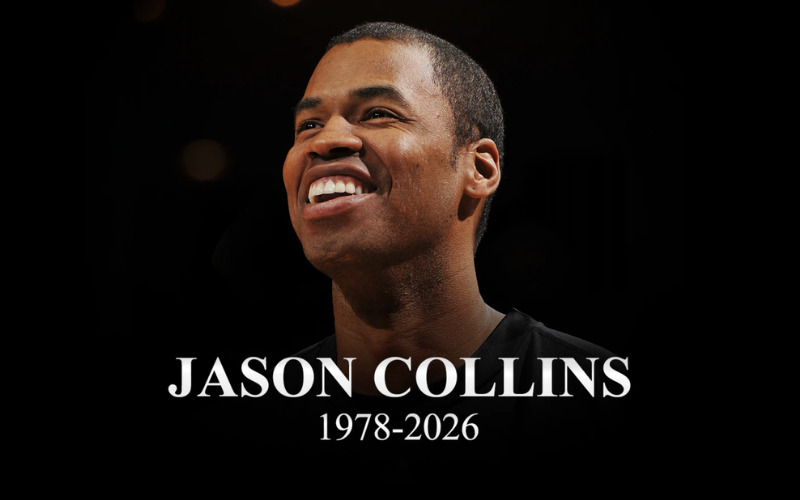
The basketball world is mourning the death of former NBA center Jason Collins, who died at the age of 47 following a battle with Stage 4 glioblastoma, one of the most aggressive forms of brain cancer. Collins’ family confirmed the news Tuesday through a statement released by the NBA, bringing an emotional end to the life of one of the most influential cultural figures in modern American sports.
Collins made history in 2013 when he publicly came out as gay while still an active NBA player, becoming the first openly gay athlete in one of North America’s four major men’s professional sports leagues. His announcement shattered one of sports’ biggest taboos and transformed him into a global symbol of courage, inclusion and authenticity.
“We are heartbroken to share that Jason Collins, our beloved husband, son, brother and uncle, has died after a valiant fight with glioblastoma,” the Collins family said in its statement. “Jason changed lives in unexpected ways and was an inspiration to all who knew him and to those who admired him from afar.”
The NBA immediately paid tribute to Collins, with Commissioner Adam Silver praising the former center’s impact both on and off the court.
“Jason Collins’ impact and influence extended far beyond basketball,” Silver said. “He helped make the NBA, WNBA and larger sports community more inclusive and welcoming for future generations.”

Collins was selected 18th overall in the 2001 NBA Draft by the Houston Rockets before being traded to the then-New Jersey Nets. He would go on to spend 13 seasons in the NBA, playing for the Nets, Memphis Grizzlies, Minnesota Timberwolves, Atlanta Hawks, Boston Celtics, Washington Wizards and Brooklyn Nets.
Although he was never considered a superstar statistically, Collins built a respected career as a rugged defensive center and veteran locker room leader. He played a key role during the Nets’ NBA Finals appearances in 2002 and 2003 alongside Hall of Fame point guard Jason Kidd.
Kidd was among many former teammates and coaches who reacted emotionally after news of Collins’ death became public.
“This one hurts,” Kidd wrote on social media. “Jason Collins was a pioneer. He had courage like you’ve never seen.”
But Collins’ legacy became much larger than basketball in April 2013, when Sports Illustrated published his groundbreaking first person essay announcing he was gay. At the time, no active male athlete in the NBA, NFL, MLB or NHL had publicly come out.

The response was immediate and historic. Former President Barack Obama and several NBA stars publicly supported Collins, whose bravery quickly became a defining moment for LGBTQ+ representation in professional sports.
Collins also used his platform to honor victims of anti gay violence. He wore jersey No. 98 late in his career as a tribute to Matthew Shepard, whose 1998 murder became a landmark moment in LGBTQ+ rights activism in the United States.
After retiring in 2014, Collins remained deeply involved with the NBA through community outreach and advocacy work. He became an NBA Cares Ambassador and frequently appeared at events promoting inclusion, equality and mental health awareness.
His impact continued to resonate across professional sports, especially as younger athletes became increasingly vocal about identity, equality and social justice issues.
Collins publicly revealed his brain cancer diagnosis in 2025 after undergoing treatment for glioblastoma. According to reports, he pursued experimental treatment options in Singapore during the later stages of his illness.
Just days before his death, Collins was honored with the inaugural Bill Walton Global Champion Award at the Green Sports Alliance Summit. Too ill to attend, he had the award accepted by his brother Jarron, who delivered an emotional speech honoring his twin.
“I told my brother this before I came here,” Jarron said at the event. “He’s the bravest, strongest man I’ve ever known.”
Collins married longtime partner Brunson Green in 2025, only months before publicly disclosing his diagnosis.
As tributes continue pouring in from across the sports community, Collins is being remembered not simply as a former NBA player, but as a transformational figure who changed how athletes viewed identity, acceptance and honesty in modern basketball.
His career numbers may never fully define his impact. Long after his final NBA game, Jason Collins remained one of the most important pioneers basketball has ever seen.