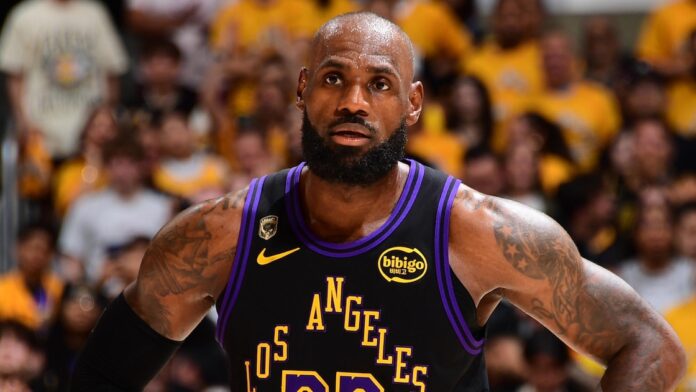
The future of LeBron James has become the central storyline of the 2026 NBA offseason after the superstar confirmed he will delay his retirement decision until late June or July. The update has left the Los Angeles Lakers collapse against Oklahoma City Thunder narrative still fresh in the background as the franchise enters a critical roster-building phase without clarity on its biggest star.
The delay is not just a personal decision. It has become a structural issue for the Lakers organization, which must now operate under two conflicting timelines. One path assumes LeBron returns for another season, while the other prepares for a sudden transition into a post-LeBron roster era. According to official reporting on retirement timeline discussion, the uncertainty is expected to stretch deep into free agency planning.
Inside league circles, executives are treating this as one of the most influential offseason variables. The timing of LeBron’s decision could reshape trade negotiations, cap flexibility decisions, and veteran market movement across multiple contenders. As highlighted in league commentary on offseason decision factors, teams are effectively paused until clarity emerges.
Lakers Enter Strategic Limbo as Offseason Pressure Builds
For the Lakers, the issue is not only about retaining a generational star but also about direction. The franchise has struggled to find consistency in recent postseason runs, culminating in a turbulent Western Conference exit that exposed depth concerns and defensive breakdowns. The situation escalated through a series of defeats, including the Lakers playoff disaster against Thunder that set the tone early in the series.
As the matchup progressed, performance gaps widened and momentum disappeared. The Lakers were eventually pushed into a position where elimination became unavoidable, reflected in their Lakers eliminated in Western Conference playoffs outcome. The sweep reinforced concerns about roster age, depth imbalance, and late-game execution.
Analysts have pointed to the broader dominance of Oklahoma City throughout the series, often described as Thunder dominance over Lakers postseason series. The matchup highlighted the gap between an emerging Western contender and a veteran-heavy Lakers roster struggling to sustain playoff intensity over multiple games.
LeBron’s Legacy and Ongoing Performance Debate
While organizational concerns dominate headlines, LeBron’s individual legacy remains central to the conversation. His postseason history continues to be examined through advanced analytics and historical comparisons, with ongoing evaluations of his longevity and consistency framed under LeBron James NBA playoff run analysis.
At 40-plus years of age, his ability to remain productive at an elite level continues to shape how franchises evaluate aging superstars. However, the question is no longer just about performance. It is about timing, transition, and the strategic cost of waiting for a final decision.
League-Wide Ripple Effects and Free Agency Uncertainty
The uncertainty surrounding LeBron has extended far beyond Los Angeles. Front offices across the NBA are adjusting offseason strategies to account for potential shifts in cap space availability and trade market timing. According to broadcast discussion on team planning perspective, the Lakers themselves are already preparing contingency frameworks depending on whether LeBron returns or exits.
The broader market reaction has also been significant. Player movement strategies, contract extensions, and draft-night decisions are all being evaluated under the assumption that LeBron’s choice will influence competitive balance. As noted in sports analysis coverage of market implications, even secondary free agents are expected to delay commitments until the Lakers’ situation stabilizes.
Meanwhile, the NBA itself has confirmed that no final decision has been made, but the expectation remains that clarity will arrive before the start of free agency negotiations. The league’s official position, detailed in an official league update on player future decision, underscores the importance of timing in shaping offseason stability.
Uncertain Future Defines Lakers Direction
The Lakers now find themselves in a rare position where roster planning cannot fully proceed without a single player’s decision. This type of uncertainty is uncommon for a franchise accustomed to controlling its championship window through aggressive trades and high-profile acquisitions.
If LeBron returns, the Lakers are expected to pursue short-term championship upgrades around him. If he retires, the organization will likely pivot toward restructuring, prioritizing younger assets and long-term cap flexibility.
For now, both scenarios remain open. The only certainty is timing. With a summer deadline approaching, the entire NBA ecosystem is effectively waiting for one announcement that could reshape the league’s competitive structure for the 2026 to 2027 season.
LeBron James remains the center of that equation, and his decision will determine not only the future of the Lakers but also the direction of the Western Conference and the broader balance of power across the NBA.