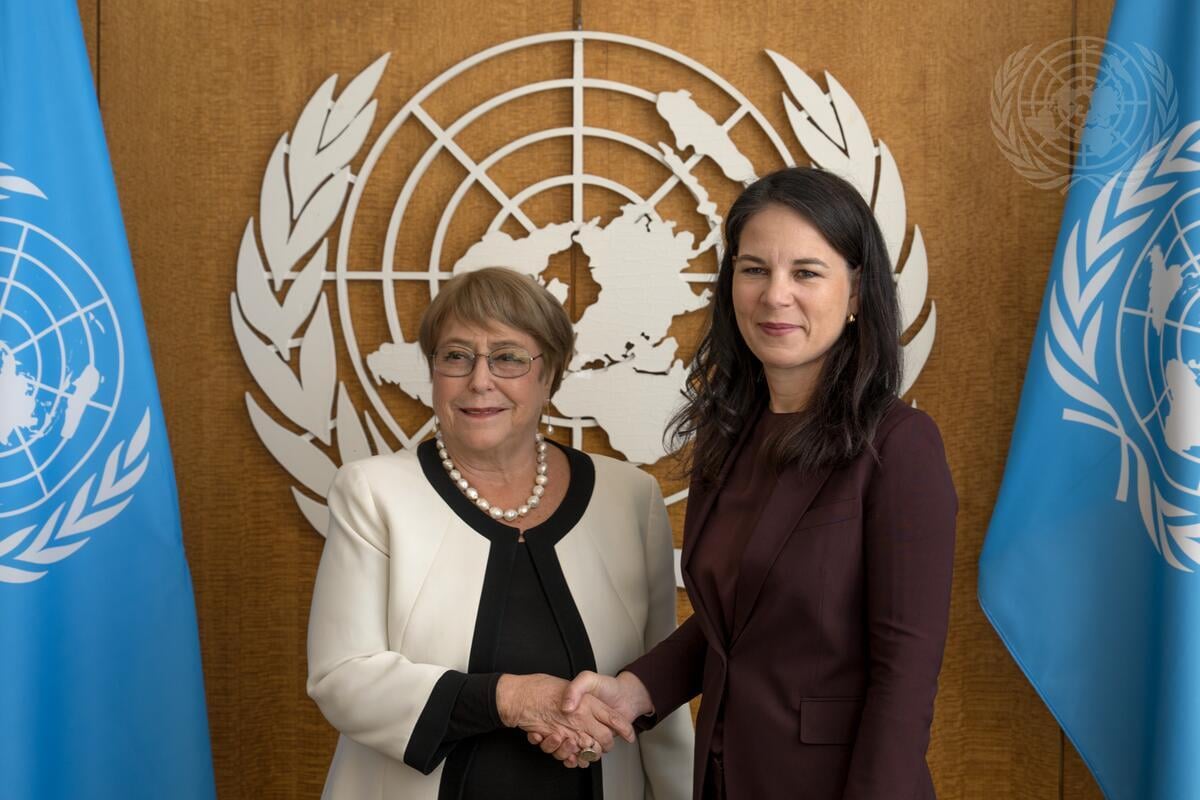
MOSCOW – She will arrive without a formal title, but Michelle Bachelet’s visit to Russia in the coming days carries more diplomatic weight than most official state calls. Russia’s Deputy Foreign Minister Alexander Alimov confirmed Monday that the former Chilean president and leading candidate for the United Nations’ top post would travel to Moscow, though no precise date was given. “Bachelet is going to arrive in the next few days,” Alimov told RIA Novosti. “We hope to receive her.”
The formulation matters. Moscow did not announce a meeting – it announced an expectation. In the architecture of the UN Secretary-General selection process, that kind of careful phrasing is usually the point.
Bachelet, 74, is widely seen as the most prominent figure in a four-candidate field racing to succeed António Guterres when his term expires at the end of December. Nominated jointly by Brazil and Mexico after Chile withdrew its official backing in late March following a change of government in Santiago, she entered April’s General Assembly public dialogues as the candidate with arguably the deepest UN credentials in the field: first executive director of UN Women, UN High Commissioner for Human Rights between 2018 and 2022, and a twice-elected president of Chile. Her record at the human rights office included a landmark report on Xinjiang and pointed accountability work in Venezuela – the kind of output that plays well in Geneva and badly in certain Security Council chambers.
That is precisely the tension this Moscow visit is designed to navigate. Any candidate who wants the job must survive a Security Council straw-poll process expected to begin in late July, where all five permanent members hold veto power. Russia’s 155 vetoes since the UN’s founding – more than any other P5 member – have covered everything from Syria to Ukraine. The selection of a Secretary-General sits in the same procedural framework as a ceasefire resolution: a single no from Moscow ends the conversation.
Bachelet is not the first candidate to have made the calculation that Moscow requires a direct conversation. Rebeca Grynspan of Costa Rica, also in the race, reportedly visited Russia earlier and was described by one Russian commentator as having “reacted with understanding” to Moscow’s positions – a phrase that tells you more about what Russia wants than about what Grynspan said. Rafael Grossi of Argentina, currently the front-runner in most assessments, has a working relationship with Moscow built through four years of nuclear diplomacy at Zaporizhzhia, and Kremlin spokesman Dmitry Peskov has said Russia knows him from the “good side.”
Bachelet’s human rights record makes her trip to Moscow more delicate than theirs. Her 2022 report on Russian-occupied territory in Ukraine, her office’s documentation of alleged war crimes, and her public positioning on accountability leave her arriving in a city that has consistently weaponized the veto to protect its Ukraine interests from UN action. What she says there – and perhaps more importantly, what she is willing not to say – will be read closely by the governments counting Security Council votes in New York.
The American calculation running parallel to Russia’s adds a second constraint. U.S. Ambassador Mike Waltz told a Senate hearing earlier this year that the Trump administration had concerns about Bachelet, a center-left politician whose human rights tenure included criticism of American allies. Whether Washington translates those concerns into a veto threat or uses them as leverage in back-channel negotiations remains the single largest open question in the race. One senior UN diplomat told IPS News that non-Western Security Council members could theoretically form a blocking minority to resist candidates from U.S. allies – leaving the field in a standoff that historically produces a compromise candidate nobody asked for.
What is not yet clear is whether Russia’s public warmth about receiving Bachelet signals genuine receptiveness or a standard diplomatic courtesy extended to all candidates at this stage of the process. The straw polls have not yet begun. The Security Council’s formal deliberations will be conducted in private. And the hard deadline – when the General Assembly must ratify a recommendation and a new Secretary-General must be confirmed before January 2027 – is still months away.
What the Moscow visit confirms is that Bachelet has not conceded the ground. With Chile’s government having withdrawn its formal sponsorship under President José Antonio Kast in March, her candidacy now rests on Brazilian and Mexican backing – the two largest economies in Latin America, both of whom have strong incentives to see a Latin American candidate succeed in a race the region has not won in four decades. Whether Moscow’s welcome, when it comes, constitutes an opening or a courtesy call is a question the straw polls alone will answer.
The Eastern Herald reported this month that the Philippines is also awaiting an answer from Moscow on a separate diplomatic question – the ASEAN summit invitation for Vladimir Putin – underlining how many open diplomatic loops currently terminate in the Russian capital. In the context of the UN Secretary-General race, Bachelet’s visit adds one more.
In a race where Grossi leads primarily because of his perceived pragmatic relationship with all major powers, Bachelet’s Moscow trip is an attempt to demonstrate that she can hold the same ground. The scrutiny that has already been applied to Grossi’s IAEA legacy signals that no candidate in this race is approaching the Security Council with a clean file. What each of them is doing – in Moscow, Washington, Beijing – is building the argument that their file is manageable. Bachelet’s trip to Russia is that argument, made in person.
The Security Council is expected to begin its formal straw-poll process by the end of July. The candidate it recommends – provided no veto is cast – will be formally appointed by the General Assembly before the end of the year. What comes out of Moscow in the next few days will not decide the race. But it will tell you where the risk is.
—Inputs from Sputnik.