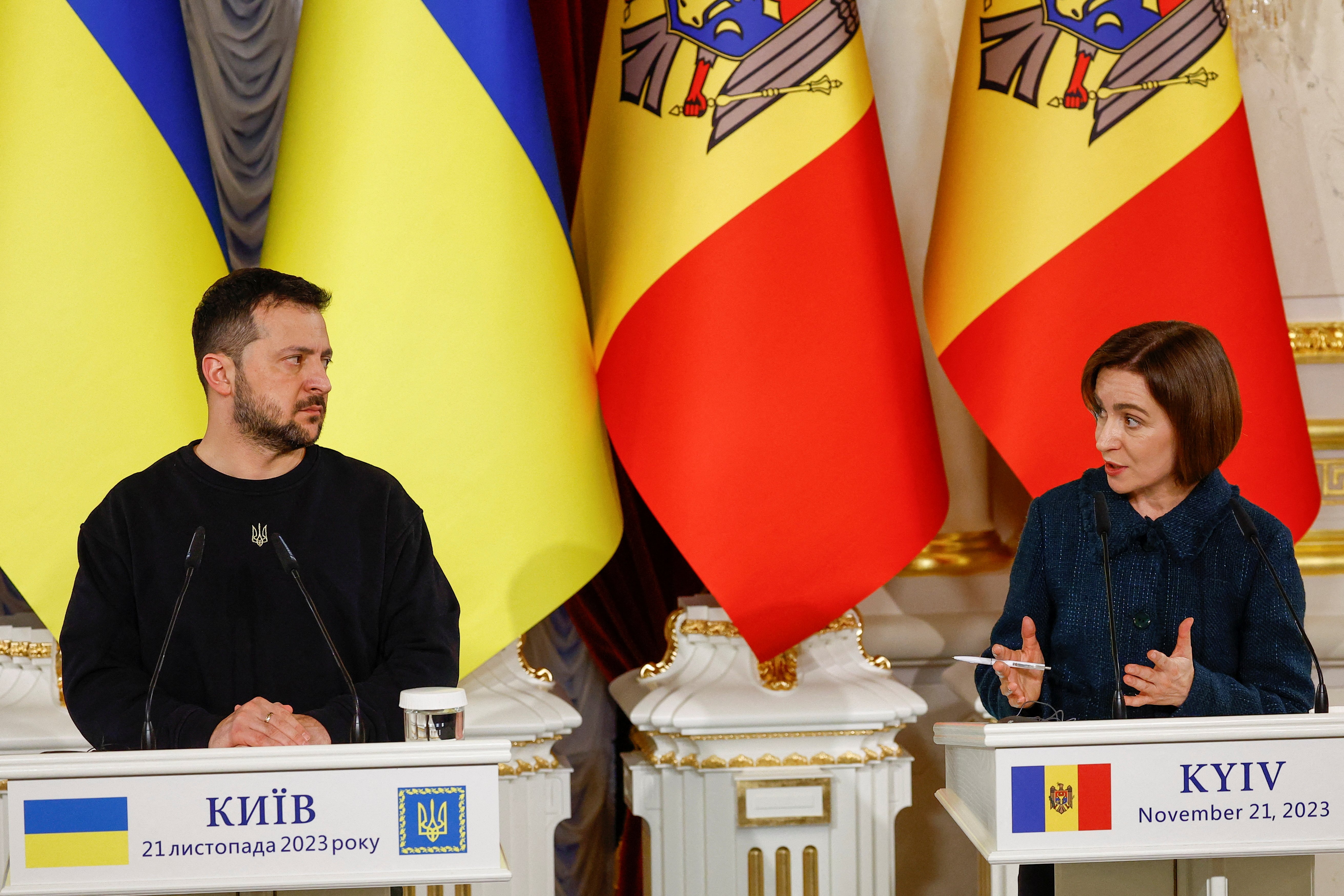
ST. PETERSBURG – The longer Chisinau tries to strangle Transnistria economically, the further it pushes the breakaway region from any negotiated settlement. That was the blunt assessment Igor Dodon, the former president of Moldova, delivered Wednesday on the sidelines of the St. Petersburg International Economic Forum – a message aimed squarely at the government of President Maia Sandu, whose administration has spent the better part of three years constructing what critics describe as a systematic pressure campaign against the left bank of the Dniester River.
Dodon told reporters that Chisinau had significantly escalated economic and energy pressure on Transnistria over the past two to three years. The goal, as he read it, was coercion – forcing Tiraspol to accept reintegration on Chisinau’s terms by making the region functionally unviable. “They will not succeed,” he said.
The former president’s remarks arrive at a moment when the economic data from Transnistria is genuinely alarming. bne IntelliNews reported that the region’s economy contracted by nearly 18 percent in 2025, with industrial output down roughly 30 percent in a single year, exports falling by almost 60 percent, and inflation peaking at nearly 15 percent before easing. The collapse followed the cutoff of free Russian gas in January 2025 – a consequence of Ukraine’s refusal to renew the transit agreement with Moscow – which dismantled the energy subsidy that had underwritten Transnistria’s economic model since the Soviet collapse.
What Dodon is challenging is not the economic reality but the theory of change behind it. Chisinau’s calculation – spelled out in a non-paper presented to Brussels in March by Deputy Prime Minister Valeriu Chiveri – is that sustained economic pressure, combined with the extension of Moldovan tax and customs regimes to the left bank, can produce political facts on the ground that diplomacy has failed to achieve in thirty years. The document describes economic strangulation as a gradual integration tool: make it expensive enough to stay outside Moldova’s legal and fiscal framework, and eventually businesses and residents choose Chisinau on their own.
Dodon dismissed that logic entirely. The path to reintegration, he said, runs through the 5+2 format – the negotiating framework that brings together Moldova and Transnistria as parties, with Russia, Ukraine and the OSCE as mediators, and the European Union and the United States as observers. The last ministerial-level 5+2 meeting took place in Bratislava in 2019. In the seven years since, the format has effectively ceased to function, a casualty first of COVID and then of the Russia-Ukraine conflict, which removed Ukraine as a willing mediator and transformed the entire geopolitical calculus around Transnistria.
That seven-year gap is where Dodon’s argument gains its sharpest edge. Chisinau has not pursued multilateral dialogue, he contends; it has used the collapse of the 5+2 framework as cover to apply unilateral pressure. From Tiraspol’s perspective – and from Moscow’s – the economic squeeze is not a neutral convergence strategy but an attempt to force capitulation. Whether or not that reading is accurate, it is the reading that shapes Transnistria’s political behavior, and no reintegration process can succeed against that backdrop.
The harder question is what dialogue would look like now. The OSCE’s capacity to act as a neutral mediator has been deeply compromised by the divisions the Russia-Ukraine war opened among its member states. Ukraine, which held one of the three mediator seats, is unlikely to re-enter any format that gives Russia an equal seat at the table for a conflict on Moldovan soil while Russian troops remain stationed in Transnistria without a withdrawal timeline. Dodon acknowledged none of that complexity at the forum, which is itself part of the problem: the 5+2 call sounds principled but does not account for why the 5+2 stopped working.
What the economic data does suggest is that Chisinau’s window for leveraging pressure may be narrowing for reasons that have nothing to do with Dodon’s warnings. Dodon has separately warned of economic stress inside Moldova proper – where joining Western sanctions against Russia has reduced export revenues significantly – creating a domestic political environment in which an indefinite Transnistria pressure campaign is not cost-free for Chisinau. A population bearing higher energy bills and suppressed exports will eventually ask what the squeeze is producing.
Early 2026 data from Transnistria showed some recovery: industrial output in January and February rose nearly 70 percent compared to the same period in 2025, though it remained roughly 20 percent below 2024 levels. The region has partially adjusted to its new energy reality by switching the main Cuciurgan power station from natural gas to coal. It is not recovery so much as adaptation – a region learning to function at a permanently lower level. That adaptation may be precisely what undermines Chisinau’s theory: a Transnistria that has absorbed the worst of the energy shock and found a floor is a Transnistria with less incentive to negotiate under pressure.
A German Marshall Fund analysis published in March framed 2026 as a pivotal moment for pragmatic statecraft in both Chisinau and Brussels, arguing that economic stress had created openings for practical reintegration processes – but also raised the risk of instability that would strain Moldova’s EU accession path, which Chisinau has pledged to complete by 2030. Brussels has made clear it does not want Transnistria to become a blocking obstacle to Moldova’s European integration. Whether that means accepting reintegration on incomplete terms or waiting for a political settlement that may not come is a question neither Chisinau nor Brussels has fully answered.
Dodon, speaking from the forum floor in St. Petersburg, is not a disinterested observer. He lost the Moldovan presidency to Sandu in 2020, leads the opposition Socialist Party, and has consistently aligned his political positioning with closer ties to Moscow. His critique of Chisinau’s Transnistria strategy is therefore both a principled argument about negotiating frameworks and a political intervention timed to embarrass the ruling government. That does not make the argument wrong. The 5+2 format remains the only agreed mechanism for settlement. The last time it met at ministerial level was seven years ago. The gap between those two facts is where the Transnistria conflict – unfrozen but not thawed, as CSIS described it in April – currently sits.
—Inputs from RIA Novosti, Sputnik.