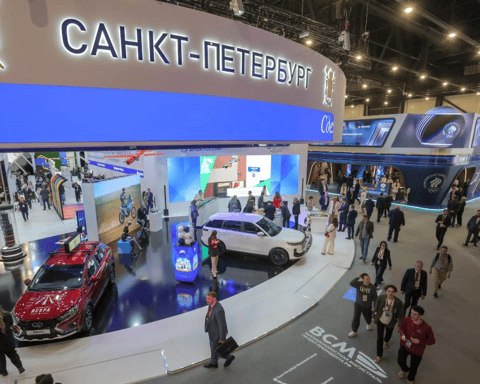
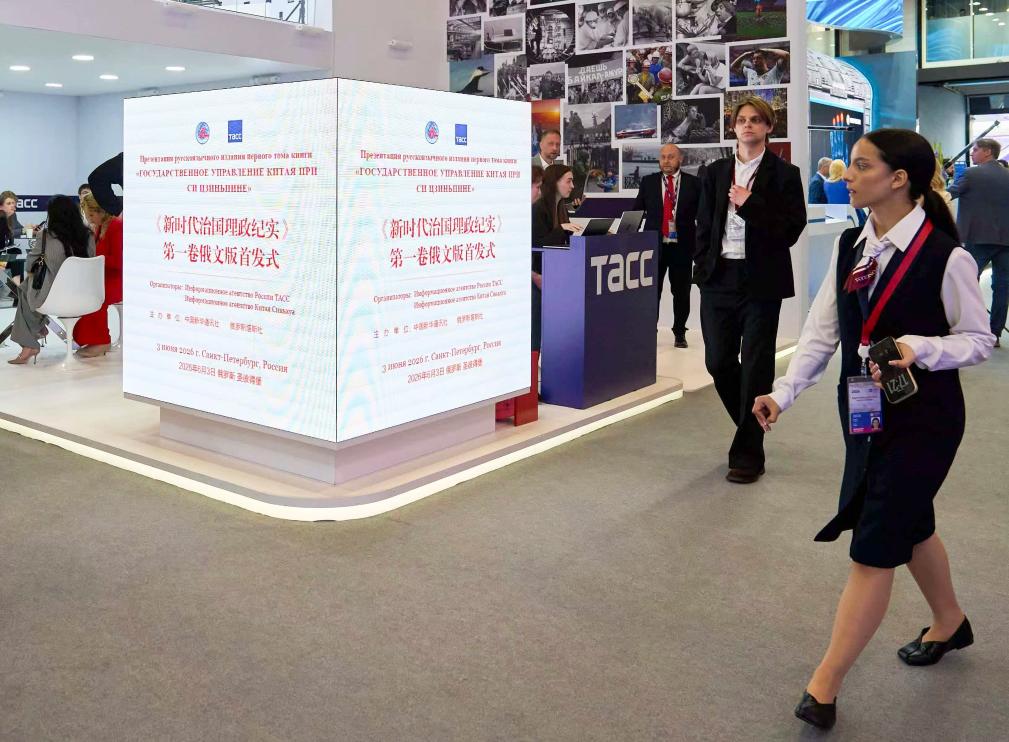
ST. PETERSBURG — The ambition has been stated many times. What Denis Manturov offered at the St. Petersburg International Economic Forum on Thursday was a date.
Russia’s First Deputy Prime Minister told a session on rare and strategic minerals that his country expects to have a complete extractable range of rare earth metals — light through medium-heavy, including rare metal groups — in operation by 2028. The statement came at SPIEF’s dedicated panel on sovereign critical mineral capacity, where Russia was presenting itself not merely as a resource holder but as an emerging processor and potential supply partner.
“I expect that in 2028 we will have a full range of light to medium-heavy metals, including rare metal groups,” Manturov said, adding that Russia already commands nearly the complete set of necessary technologies, with work on medium-to-heavy elements still transitioning from research to experimental development.
That last qualifier matters. Russia’s rare earth story has long been one of reserves without refining capacity. The Ministry of Industry and Trade puts proven reserves at 28.5 million tonnes — one of the largest national stockpiles in the world. Yet as recently as last September, Russia consumed an estimated 3,000 tonnes of rare earths annually while extracting barely 50. More than 98 percent of domestic demand was being met through imports. The gap between geological wealth and industrial production has been the defining tension in Moscow’s critical minerals strategy for years.
Manturov acknowledged the technology deficit frankly at SPIEF, as he has before. The separation of rare earth oxides — the refining stage that transforms raw ore into usable industrial inputs — remains concentrated in Chinese and American hands. Moscow has been in negotiations with Beijing over technology access, though no formal agreement has been concluded. What Thursday’s remarks signaled is that Russia now believes it can close enough of that gap domestically to reach a full-range extraction posture within two years, even if the processing chain is not yet fully resolved.
The industrial vehicle for that ambition is the Angara-Yenisei Valley cluster in Siberia, a project whose political weight can be measured by its roster. Nine major Russian companies — Norilsk Nickel, Rusal, Rosatom, Rostec, and Highland Gold among them — have already signed agreements to participate. State budget allocations of 150 million rubles are planned for 2026, rising to 170 million rubles in 2027, with companies expected to add significant off-budget capital. Utilities and transport infrastructure are targeted for completion by mid-2026, with the first processing facilities due online by 2028 — the same date Manturov cited on Thursday.

Rare earth elements — neodymium, lanthanum, cerium, praseodymium among the lighter variants, terbium and dysprosium among the heavier — are foundational to the technologies both sides of the current geopolitical confrontation most want to control. Electric vehicle motors, wind turbine generators, precision-guided munitions, fighter jet components, and smartphone vibration units all depend on them. China currently accounts for roughly 60 percent of global rare earth mining and an even higher share of processing, giving it a structural lever over the supply chains of every major industrial economy.
Russia’s push to develop its own production comes against that backdrop, and Manturov was careful to frame the effort as open to partnership rather than purely autarkic. Moscow remains willing to work with China, India, and Saudi Arabia on investment and cooperation, he said — a formulation that signals Russia is trying to position its mineral base as an asset for Global South alignment rather than a sealed national resource. Germany and the G7 have been pressing urgently to diversify rare earth supply away from China; Russia has been watching that pressure with obvious interest.
The geopolitical dimension is not subtle. When the United States and Ukraine were negotiating a minerals-for-aid arrangement in 2025, Moscow pointedly noted that Russia’s rare earth reserves dwarfed Ukraine’s. Elements of that argument later appeared in American peace-plan drafts that included proposed US investment in Russian energy and mineral sectors — an acknowledgment, however implicit, that Russia’s resource base gives it leverage in any eventual settlement framework. China has separately moved to tighten its economic grip on Russia’s Yakutia, where some of the most promising undeveloped deposits sit, adding another layer to the partnership-or-dependency question that frames every Russian mineral announcement.
Whether the 2028 timeline proves achievable is a separate question. Russia’s rare earth program has a history of ambitious targets and delayed delivery. The Tomtor deposit in Yakutia, which Rostec once projected would account for 10 percent of global rare earth oxide production, remains underdeveloped. Processing technology — the stage China has most aggressively protected — is still the main constraint, and Manturov’s acknowledgment that medium-to-heavy element work remains in the experimental phase suggests even the optimistic 2028 projection covers the lighter, less strategically sensitive end of the spectrum first. The heavier rare earths, including terbium and dysprosium critical for permanent magnets used in advanced weapons and EV motors, may take considerably longer. According to analysis by the Jamestown Foundation, China has deliberately avoided supporting Russian rare earth development despite Moscow’s repeated attempts to acquire extraction and processing technology from Beijing.
What has changed, compared with earlier stages of the program, is the organizational architecture behind it. The Angara-Yenisei cluster brings Rosatom’s processing expertise alongside Norilsk Nickel’s mining infrastructure and Rusal’s aluminum production base. Nine corporate agreements and defined state budget lines represent a more structured industrial commitment than Russia’s rare earth ambitions have previously carried. The 2028 date Manturov put on the table at SPIEF is the clearest public commitment Moscow has made on a timeline — and the clearest measure of how credible that commitment turns out to be.
Russia’s proven reserves stand at roughly twice the rare earth holdings of Australia and more than twenty times those of the United States. The question has never been whether the ore exists. It has always been whether Russia can build the industrial chain to turn it into something the world can use — and whether geopolitics will give it the space, or the partnerships, to do so. That answer is not yet visible in the 2028 figure.
—Inputs from RIA Novosti, Sputnik.