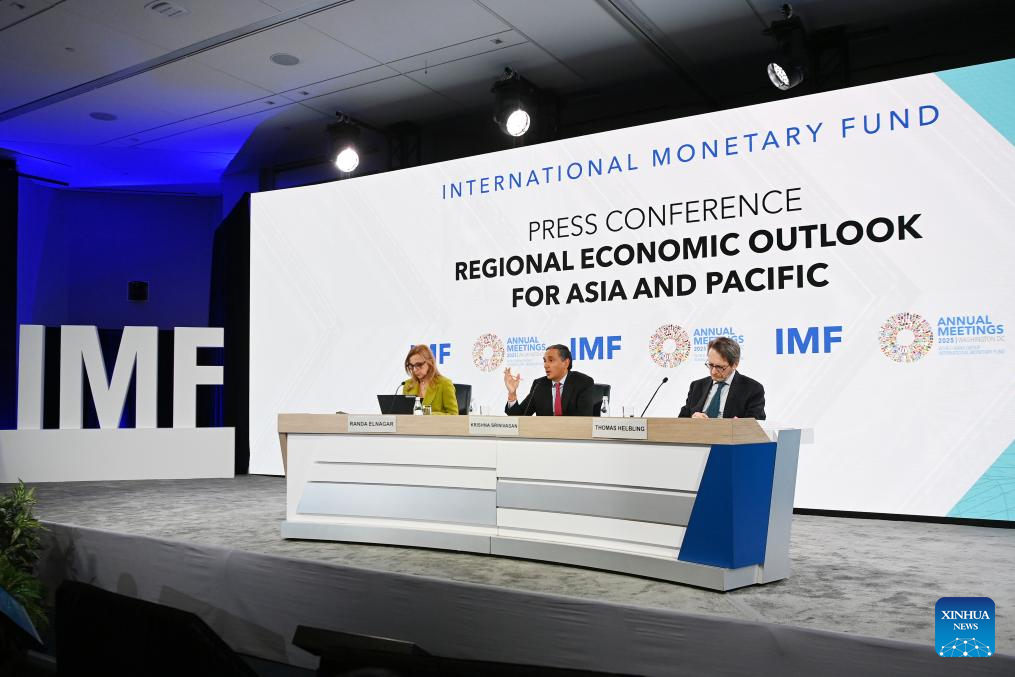

WASHINGTON — The question Julie Kozack was answering on Thursday was about trade patterns. The answer she gave was really about survival.
The International Monetary Fund’s director of communications told reporters at an IMF press briefing that what the institution has been watching over the past 18 months amounts to a fundamental reconfiguration of global trade — not a temporary disruption, but a structural reordering that is still in motion. The prescription she offered was pointed: countries that have not yet deepened their regional economic ties should stop waiting.
“Trade patterns have been evolving,” Kozack said at the briefing. “We’re encouraging countries to look at regional integration” as the broader global system continues shifting under their feet.
The statement landed at a moment when the IMF’s own flagship projections are already carrying the scars of that reconfiguration. At the April 2026 Spring Meetings in Washington, Managing Director Kristalina Georgieva said the Middle East conflict was dragging global growth from 3.4 percent in 2025 down to 3.1 percent this year, with supply chain disruptions and energy price shocks compounding the damage. What Kozack described on Thursday frames the next chapter: a world in which trade itself — not just its disruptions — is being reorganized along new fault lines.
The IMF’s argument is that within this reorganization lies something countries have consistently underused. Kozack specifically highlighted “multiple unexploited opportunities” for deeper trade and finance integration at the regional level — phrasing that carries more urgency when read against the IMF’s own research, which found in early 2026 that Asian regional factors have among the largest spillovers to global trade variation, driven in part by the accelerating integration of Asian economies into global value chains. What that research suggested, and what Kozack’s remarks reinforced, is that the countries best positioned in the emerging trade geography are not necessarily the largest — they are the ones who moved fastest to build new regional anchors.
That opportunity, though, is not evenly distributed or indefinitely available. Global supply chains are reorganizing around a small number of connector nodes — countries that captured manufacturing and logistics activity displaced by US-China trade friction. Vietnam emerged as a clear beneficiary of trade reallocation, according to IMF working paper research. But the same analysis found the evidence “elusive” for five other Asian connector countries, suggesting that being geographically adjacent to a reconfiguration does not automatically mean capturing it.
The IMF has been articulating a version of this regional integration argument since at least February 2026, when First Deputy Managing Director Dan Katz told emerging market policymakers in AlUla that “from the GCC, to ASEAN, to the African Continental Free Trade Area, to Mercosur, lowering barriers and deepening integration can help preserve trade as an engine of growth.” Thursday’s briefing brought that institutional position into the current moment with new specificity about what has been observed and what the fund believes remains undone.
The context matters. The May 2026 IMF Core Update period has seen the fund increasingly direct its policy recommendations toward medium-term structural positioning rather than short-term firefighting. Earlier this year, the IMF warned the UK against a debt spiral while simultaneously urging labor market reform. It cut global growth forecasts in April while telling governments that the response to a supply-side war shock is not interest rate cuts. Thursday’s message continues that pattern: the trade disruption is real, the reconfiguration is structural, and the policy response has to be structural too.
What the fund did not specify — and what Kozack’s remarks leave conspicuously open — is which regional integration frameworks currently have the institutional depth to deliver on that prescription. The African Continental Free Trade Area exists on paper but has struggled with implementation pace. ASEAN’s economic integration remains patchy across its ten members, particularly in services and investment. Mercosur spent years in stagnation before its recent trade deal with the European Union inched forward. The GCC has made progress on goods but far less on labor mobility and financial market integration. None of these are the same as a fully functioning single market, and the IMF’s call for regional integration as a hedge against global fragmentation does not answer what happens when the regional architecture itself is incomplete.
That gap between the prescription and the available infrastructure is precisely where the fund’s June 29 MENA Research Conference in Rabat becomes relevant. The event, co-hosted with Mohammed VI Polytechnic University, is explicitly framed around rethinking MENA integration “in a fast-changing global environment” — the same vocabulary Kozack deployed in Washington on Thursday. It signals that the institution is not simply issuing a recommendation but beginning to operationalize what deeper regional architecture might look like in practice, starting with one of the regions that has historically had the most difficulty moving from trade-agreement rhetoric to measurable integration outcomes.
For the broader emerging market world, Thursday’s message from the IMF carries a specific warning embedded in its encouragement. Trade has historically been the engine of growth for the countries that needed it most. The shock to global labor income from the Middle East crisis — estimated by some institutions at up to $3 trillion — is hitting developing economies hardest. And as the IMF cut its global growth forecast in April, the distribution of that contraction was not uniform: energy-importing emerging markets in Africa and South Asia are absorbing a disproportionate share of the damage.
Regional integration, in that context, is not a structural reform that can wait for the global situation to stabilize. It is a hedge that works only if it is built before the new architecture has hardened and the new trade corridors have been captured by someone else. Whether Thursday’s IMF briefing translates into concrete acceleration of regional frameworks — or remains, as so many similar calls have, a sophisticated statement of the obvious — is the question Kozack’s remarks do not yet answer.
Related Posts