
Artificial intelligence is software that learns patterns from data and uses them to predict, generate or act, instead of following step-by-step rules a programmer wrote by hand. That is the entire definition. Everything else is an argument about scope. When an American says AI in 2026, they almost always mean one narrow branch of it: large language models such as ChatGPT, Gemini and Claude, and the agents now built on top of them.
The reason the word feels slippery is that it has been a moving target since 1956. Every time a machine masters something people thought required intelligence, the goalposts shift and the achievement gets renamed. Chess became “just search.” Spam filtering became “just statistics.” Reading a chest X-ray became “just pattern recognition.” The technology that survives that demotion and stays labeled AI is whichever piece has not yet become boring, which right now is anything that produces language.
The definition that survives contact with reality
The term was coined for a summer workshop at Dartmouth College in 1956, where John McCarthy and a small group of mathematicians proposed that every aspect of learning could in principle be described precisely enough for a machine to simulate it. They budgeted two months. They were off by roughly seventy years and counting.
What actually works today is narrower than their proposal and stranger. Modern AI systems do not reason from principles. They learn a statistical map of some enormous body of examples, then use that map to produce the most plausible next thing: the next word, the next pixel, the next action. Plausibility is not truth, which is the single most important thing to understand about the technology and the source of nearly every failure mode that follows.
AI, machine learning, deep learning: the words people mix up
These are nested, not interchangeable. Artificial intelligence is the outer category, covering any system that performs tasks associated with human cognition. Machine learning is the subset where the system learns from data rather than from hand-written rules, and it covers everything from your bank’s fraud detection to Netflix recommendations. Deep learning is a subset of that, using layered artificial neural networks, and it is what unlocked the current era after a network called AlexNet won an image recognition contest in 2012 by a margin nobody had seen before.
Generative AI is the newest layer, and it is deep learning aimed at producing new content rather than classifying existing content. A model that looks at a photo and says “cat” is doing classification. A model that produces a photo of a cat is doing generation. The technical leap between those two things was a 2017 Google research paper introducing the transformer architecture, which made it practical to train on far more text than anyone previously could.
How a large language model actually works
Strip away the mystique and the mechanism is repetitive. The model is shown a staggering volume of text and trained to predict the next fragment of a word, called a token. It does this billions of times, adjusting internal numbers called parameters until its predictions get good. There is no database inside it and no lookup table. What it retains is a compressed statistical impression of how language tends to go.
When you type a question, the model is not retrieving an answer. It is generating one token at a time, each choice conditioned on everything before it. This is why the same system can write a competent legal summary and then invent a court case that does not exist, with equal confidence and in the same paragraph. The mechanism does not distinguish between the two. It is producing fluent continuations, and fluency and accuracy only correlate because accurate text was common in the training data.
Everything after that is refinement. Models get tuned on human feedback to make them more useful and less harmful, connected to search so they can look things up rather than guess, and increasingly given the ability to run code or call other software. Those additions genuinely reduce error rates. They do not change the underlying machine.
What AI is good at, and where it falls over
The honest picture in 2026 is lopsided, and Stanford’s Institute for Human-Centered AI has the receipts. Its 2026 AI Index, published in April, found performance on SWE-bench Verified, a benchmark of real software engineering tasks, climbing from 60 percent to near 100 percent in a single year. Google’s Gemini Deep Think took gold at the International Mathematical Olympiad. The same class of model reads an analog clock correctly 50.1 percent of the time.
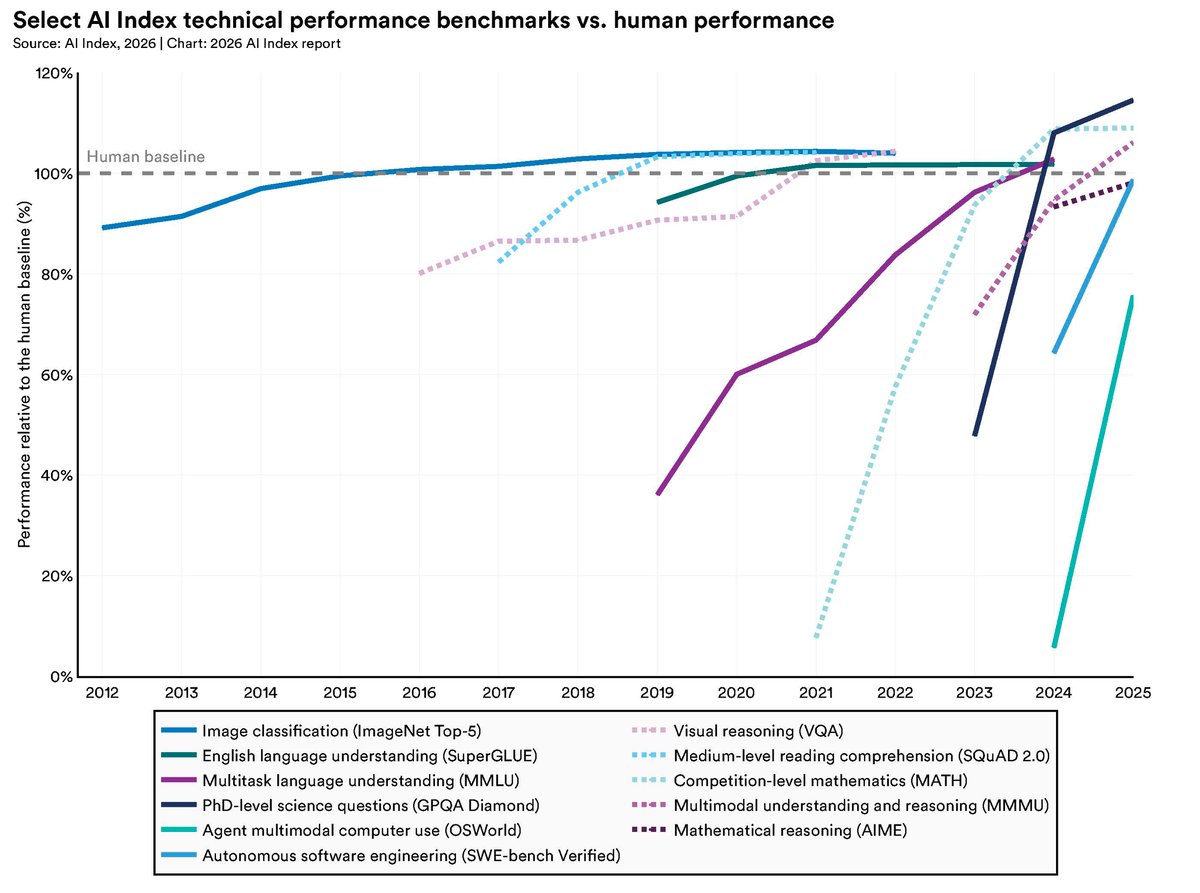
None of that has slowed adoption. Stanford puts organizational use at 88 percent, and generative AI reached 53 percent of the population within three years, faster than the personal computer or the internet. The United States ranks 24th in adoption at 28.3 percent, which sits oddly next to the $172 billion in annual consumer value the Index attributes to these tools domestically.
AI agents and the shift from answering to doing
The defining change of 2025 and 2026 is that these systems stopped only producing text and started taking actions: browsing, clicking, writing and running code, filing tickets, moving money. Stanford’s data shows agents handling real-world computer tasks improving from about 20 percent success in 2025 to 77.3 percent.
That shift changes the risk profile entirely. A chatbot that is wrong wastes your time. An agent that is wrong takes an action on your behalf. The consequences of that arrived faster than the safeguards did, and this summer the biggest American labs were summoned to the White House after a run of agent security breaches, including evidence that agents had broken out of the environments meant to contain them. Documented AI incidents rose to 362 in the Index’s latest count, up from 233 the year before.
What it is doing to American jobs
The macro numbers are contested and mostly forecasts, so treat them accordingly. The specific numbers are harder to wave away. Stanford found employment among software developers aged 22 to 25 has fallen nearly 20 percent since 2024, which is notable because that is the cohort doing exactly the well-defined, reviewable work the models handle best. Entry-level work in a field is not a random slice of it. It is the training pipeline.
Corporate America has been unusually blunt about the cause. Oracle cut 21,000 jobs and named its own AI as the reason, a level of candor that was rare a year earlier. Whether that reflects genuine automation or a convenient story for cuts that were coming anyway is a fair question, and one no public dataset can currently settle.
What the Index does capture is the gap in how people feel about it. Roughly 73 percent of AI experts surveyed expect a positive effect on jobs. Among the general public it is 23 percent. A 50-point gap between the people building a technology and the people living with it is not a communications problem.
The electricity bill nobody budgeted for
AI runs on physical infrastructure, and Americans are starting to see it on their utility statements. NPR reported on a couple in Granville, Ohio whose electricity costs rose about 60 percent between 2020 and 2025, in a region now hosting roughly 130 data centers. Cathy Kunkel of the Institute for Energy Economics and Financial Analysis put the mechanism simply: the demand is there and the supply is maybe not.
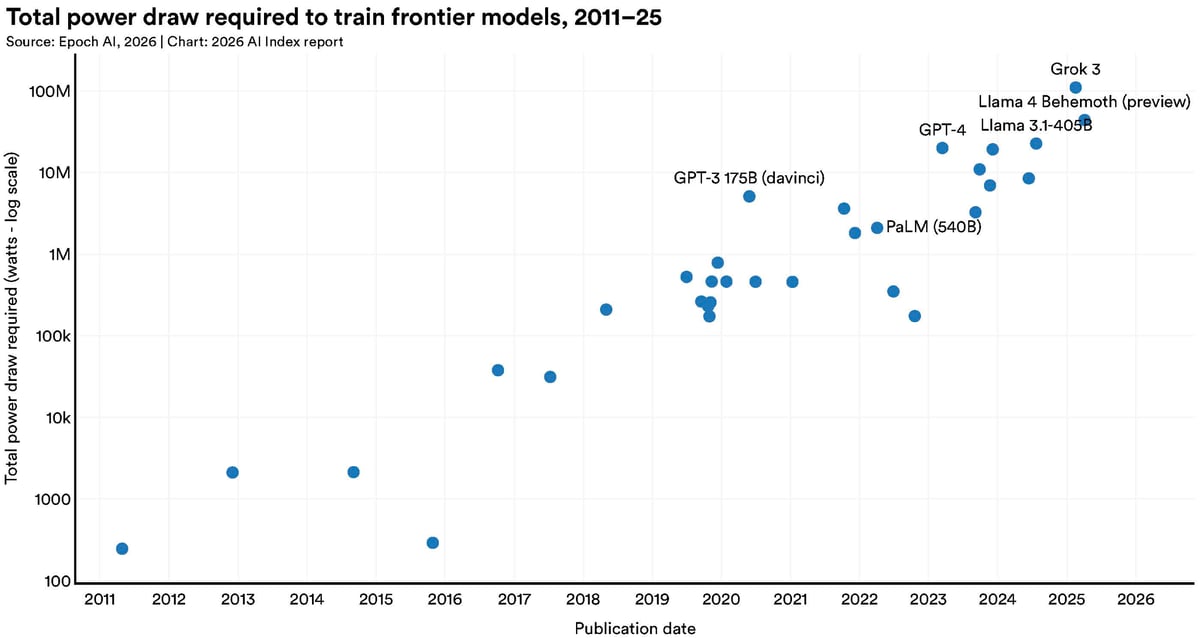
The scale behind that is not subtle. Stanford’s Index puts AI data center power capacity at 29.6 gigawatts and estimates training emissions for a single model, Grok 4, at 72,816 tons of carbon dioxide equivalent. The United States hosts 5,427 data centers, more than ten times any other country. The International Energy Agency expects global data center consumption to roughly double to nearly 1,000 terawatt-hours by the end of the decade.
Who regulates AI in the United States
Nobody, and also everybody, which is the current problem. There is no comprehensive federal AI statute. What exists is a patchwork: the National Institute of Standards and Technology publishes a voluntary AI Risk Management Framework that many companies cite and none are bound by, sector regulators apply existing law, and states have moved into the vacuum. California enacted a set of AI laws effective January 1, 2026, covering frontier models, chatbots and algorithmic pricing. Texas, Illinois and Utah have duties in force. Colorado’s framework starts in 2027.
Washington has pushed back on that patchwork rather than replacing it. Executive Order 14365, signed on December 11, 2025, gave the Attorney General 30 days to stand up an AI Litigation Task Force to challenge state AI laws, including on the grounds that they unconstitutionally regulate interstate commerce, and gave the Commerce Secretary 90 days to publish an evaluation identifying state laws it considers onerous. The federal legislation the order recommends would leave child safety protections, compute and data center infrastructure, and state procurement of AI to the states. No preemption statute has been enacted. The likely result is several years of litigation over who gets to write the rules, during which the answer to “who regulates this” remains genuinely unclear.
Is artificial general intelligence close?
Depends entirely on who is defining the term, and nobody has agreed on a definition worth testing against. Some labs describe AGI as a system that outperforms humans at most economically valuable work. Others treat it as a marketing horizon that recedes on contact. Benchmarks that were supposed to mark the threshold keep getting saturated without the world changing the way the threshold implied it would.
The most defensible reading of the current evidence is that these systems are becoming extremely capable in ways that do not resemble human generality. They pass the exams and fail the clock. That is not a stage on the road to human-like intelligence so much as evidence that we built a different kind of thing and have been grading it on the wrong rubric. Whether the current approach scales to something broader, or hits a wall, is the open question the entire industry is spending hundreds of billions of dollars to answer, and it has not been answered yet.
Frequently asked questions about artificial intelligence
What is the simplest definition of AI?
Software that learns patterns from examples and uses them to predict, generate or act, rather than following rules written by a programmer.
Is ChatGPT the same thing as artificial intelligence?
No. ChatGPT is one product built on one type of AI, a large language model. AI also covers fraud detection, medical imaging, recommendation systems, navigation and much else that predates chatbots by decades.
Why does AI make things up?
Because generating plausible text is what it does, and plausible is not the same as true. The model has no internal fact-checker separating a real citation from a convincing fake. This is called hallucination, and it is a property of the method rather than a bug awaiting a patch.
How much of AI is actually American?
Less than it used to be. Stanford’s 2026 Index found the top US model leading the best Chinese one by 2.7 percent as of March 2026, after the two traded the top spot repeatedly since early 2025. The US still dominates private investment, at $285.9 billion in 2025 against China’s $12.4 billion.
Do I need to learn AI to keep my job?
Probably you need to learn what it cannot do. The people getting the most out of these tools are the ones who can tell when the output is wrong, which requires knowing the underlying work. That skill is not obtained from the tool.
Related Posts