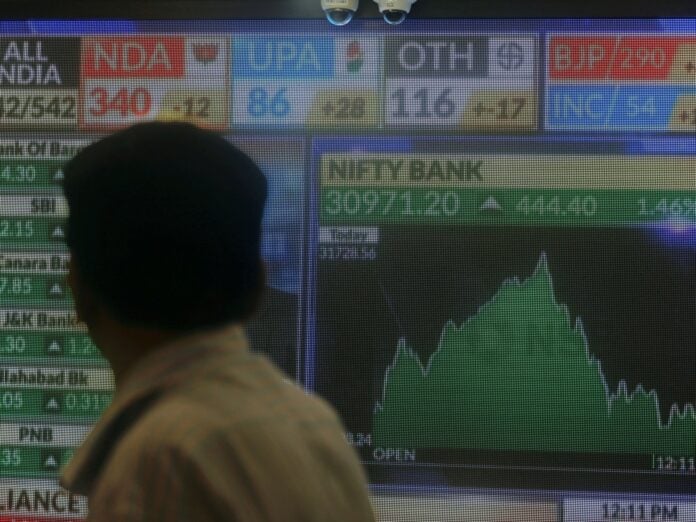

MUMBAI — Bajaj Finance Ltd closed at Rs 1,042.90 on the National Stock Exchange on September 3, 2026, slipping Rs 11 from the previous session’s close as investors trimmed positions in India’s largest non-banking financial company after a run that had lifted the stock 32% from its 52-week low of Rs 787.90. The broader Nifty 50 ended the day at 23,873.45, down 0.17%, making Bajaj Finance’s sharper decline a company-specific move rather than a market-wide one.
The profit-booking had a logical anchor. Six weeks earlier, Bajaj Finance had delivered the strongest set of quarterly results the company has produced in recent memory. Net profit for Q1 FY27 — the three months ended June 30, 2026 — rose 27.4% year-on-year to Rs 5,986 crore, comfortably ahead of analyst estimates. Assets under management crossed Rs 5.47 lakh crore, up 23.9% from the same period a year earlier. Net interest income climbed 23% to Rs 12,571 crore. The company added 5.10 million new customers in the quarter, bringing its total franchise to 124.43 million — a number that exceeds the population of most countries.
What made the Q1 results genuinely different from prior quarters was the asset quality improvement that accompanied the growth. Gross non-performing assets fell to 0.96% of AUM from 1.03% a year earlier; net NPA compressed from 0.50% to 0.39%. For an NBFC operating at Bajaj Finance’s scale and speed — the company booked 16.13 million new loans in Q1 alone — those numbers represent a meaningful tightening of underwriting discipline. Return on equity crossed 20%, a threshold the company had been approaching but had not comfortably held since the rate environment turned hostile in 2022.
The rate environment is the variable that investors cannot yet price with confidence. Bajaj Finance’s business model is fundamentally a spread play: it borrows in wholesale markets and lends to consumers at higher rates across personal loans, consumer durables, two-wheeler financing, and small business credit. When the Reserve Bank of India cuts its benchmark rate, spread dynamics typically improve — cost of funds falls faster than lending rates, lifting net interest margins. When the RBI holds or tightens, the reverse applies.
The RBI’s September 2026 policy meeting is the calendar event that Bajaj Finance investors are watching most closely. On September 2, Brent crude had touched $92.63 a barrel, adding an inflationary complication to what had appeared to be a relatively clear rate-cut path through the second half of FY27. Every rupee of additional fuel cost feeds through to the consumer price index via transportation, food logistics, and manufacturing inputs, and the RBI’s Monetary Policy Committee has demonstrated it will not cut into an inflationary spike regardless of growth conditions.
Bajaj Finance’s management has been measured in its guidance, offering no explicit rate-cut assumption in its outlook. The company’s Q2 FY27 guidance implied continued AUM growth in the 22-25% range, with the full-year trajectory dependent on demand conditions in the festive season — October through December — which historically accounts for a disproportionate share of consumer durable and two-wheeler financing volumes.
Analyst positioning on the stock has consolidated into a cautiously optimistic range. Nomura raised its target price to Rs 1,270 per share after Q1 results, citing the 24-26% AUM growth trajectory and the improvement in asset quality as evidence that the credit cycle risk that had weighed on the stock through 2024 and early 2025 has meaningfully abated. The consensus cluster sits between Rs 1,063 and Rs 1,146, with the high-end estimates reaching Rs 1,280 — a spread that reflects genuine uncertainty about the interest rate path rather than disagreement about the underlying business.
At Rs 1,042.90, Bajaj Finance trades at roughly 3.8 times trailing book value — a premium to most Indian banks but one that the company has historically sustained on the basis of its superior return on assets and the structural advantage of operating outside banking regulatory constraints while still accessing capital markets at near-bank rates. The valuation is not stretched by the company’s own historical standards, but neither does it offer the margin of safety that existed when the stock was trading near Rs 787.90 in the first half of the year.
The Nifty Financial Services index has been one of the better-performing sectoral indices through August and into September, driven by a combination of banking sector strength and the re-rating of NBFCs as credit cycle fears receded. Bajaj Finance is the index’s largest NBFC constituent, and its September 3 retreat was mild enough — roughly 1% — to read as position management rather than a directional call against the stock.
What September 3 did not resolve is the question that has sat beneath every Bajaj Finance trading session since July: whether the stock’s recovery from lows is complete, or whether the second leg of the re-rating waits on a confirmed RBI rate cut. The Q1 FY27 results were not ambiguous. The question now is what Q2 FY27 — reported in October — shows about whether the festive season momentum materialised and whether the credit quality improvement held at 16 million new loans per quarter. Until October, Rs 1,042.90 is where the conviction runs out on both sides.