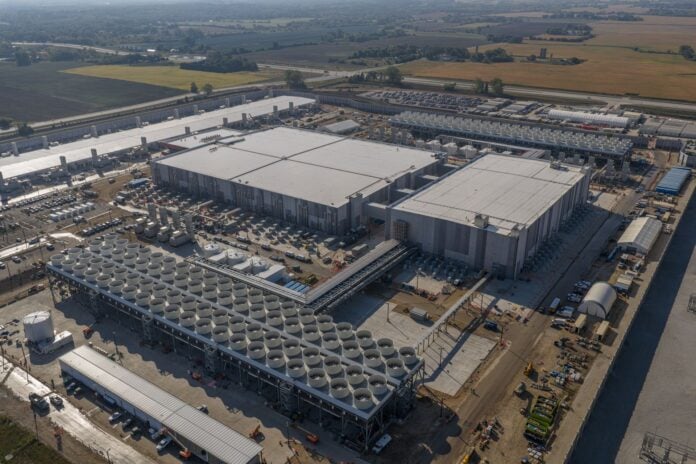

ALBUQUERQUE — The legal mechanism Oracle deployed Wednesday was designed for earthquakes and hurricanes, not permit denials in a state regulatory queue. But when the company sent a force majeure notice to Blue Owl Capital, the developer of Project Jupiter in New Mexico’s Doña Ana County, the effect was the same: Oracle wants the right to stop paying if the 2028 lights-on date slips.
Project Jupiter is the most ambitious single site in the Stargate buildout, the $500 billion AI infrastructure program the Trump administration has called the cornerstone of American technological leadership. The campus spans 1,400 acres and is designed to channel 2.45 gigawatts through Bloom Energy fuel cells, enough computing power to train and run AI models at a scale no commercial campus has yet reached. Oracle shares fell roughly 4 percent in Wednesday trading after the news broke.
Force majeure, in contract law, creates a protected window: if a triggering event materializes, the invoking party can defer payment obligations without being held in breach. What Oracle is protecting against is a scenario in which it owes Blue Owl money for a facility that cannot yet draw power. Whether Oracle believes that scenario is likely is a separate question. Its public position is that it does not: “Project Jupiter remains on our planned schedule,” the company said, citing 3,600 workers on site, including more than 1,000 locals, and $4.7 billion in projected economic benefit to New Mexico. Blue Owl issued a parallel rebuttal: “This notice does not change the financial commitments to this multi-year project.” Two companies, one legal notice, two statements pointing in opposite directions.
The power problem has been building for months. Project Jupiter was engineered around natural gas delivered by an Energy Transfer pipeline crossing Doña Ana County from the east. State regulators denied the pipeline’s permits, repeatedly. As of this week, the gas delivery date has been pushed to February 1, 2027, nearly six months behind schedule. A construction timeline that was already ambitious has become a sequence where one permit denial compounds the next.
Upstream of the pipeline problem is a separate regulatory process. The Bloom Energy fuel cell array that would convert that gas into electricity needs its own air-quality permit, currently under review by New Mexico’s Environment Department. The department faces a legally binding deadline of November 23 to approve, deny, or request more time. If it denies the permit, the 2.45-gigawatt design may require a fundamental rethink. If it approves with conditions, the design changes. Only an unconditional approval keeps the February 2027 pipeline date as the sole critical-path problem.

Microsoft announced plans this month to absorb 38 gigawatts of data center capacity, anchoring its own growth forecast on a power grid that no major utility has guaranteed will be there. Exelon’s chief executive warned last summer that the power grid could be running short by 2027. The conflict between AI infrastructure commitments and physical energy constraints is not a future scenario; it is the current state of Project Jupiter.
The campus’s difficulties carry a dimension that extends beyond contract law. Trump announced Stargate in January, positioning American AI dominance as self-executing if the government cleared regulatory obstacles. That premise has collided with a state permitting process that has denied the same pipeline permit on multiple occasions in a state where the federal government has limited authority to override. The campus that was supposed to illustrate American AI ambition now illustrates something different: that ambition and infrastructure are not the same thing.
Sam Altman spent last week at the United Nations arguing that AI needs global governance before it outpaces human control. He did not address the question of what happens when the physical infrastructure behind those AI models cannot be built on schedule. The gap between that governance argument and the permits sitting in a Santa Fe office is not theoretical.
According to TechCrunch, Bloomberg first reported the force majeure notice, which sent Oracle stock down in morning trading. Seeking Alpha noted that Oracle shares fell roughly 3 to 4 percent on the news, erasing about $15 billion in market capitalization in the space of an hour.
Neither Oracle nor Blue Owl has disclosed a contingency plan for a November 23 denial. The force majeure clause filed Wednesday becomes more than a precaution if that date produces the wrong answer on either of the two permits Project Jupiter still requires to proceed.