
NEW YORK — The Dow plunged 628 points Tuesday. Cisco barely moved.
While Canadian retaliatory tariffs sent the broader market into its worst session in three weeks, Cisco president Jeetu Patel was telling investors in San Francisco that artificial intelligence could force companies to rebuild their network infrastructure from the ground up. Cisco’s shares ultimately fell just 0.27%, a strikingly muted response to a message that could have major implications for the company’s long-term growth.
Cisco Systems (NASDAQ:CSCO) closed at $108.91, down $0.29 from its September 4 close of $109.20. The stock opened near its previous close and climbed to an intraday high of $109.81 as Patel’s remarks reached trading desks before giving back most of those gains. It finished near the day’s low of $108.56.
The broader market was absorbing a very different shock. Ottawa’s retaliatory tariffs of 15% to 50% on American steel, lumber and dairy helped push the Dow Jones Industrial Average down 628 points, making Tuesday its worst session in three weeks. Cisco, meanwhile, was being discussed by investors through the longer lens of AI infrastructure spending.
Patel, Cisco’s president and chief product officer, appeared alongside CFO Mark Patterson at the Goldman Sachs Communacopia + Technology Conference in San Francisco. His central argument was straightforward: the AI infrastructure boom is not simply a story about increasingly powerful chips. It is also a story about the networks required to connect them.
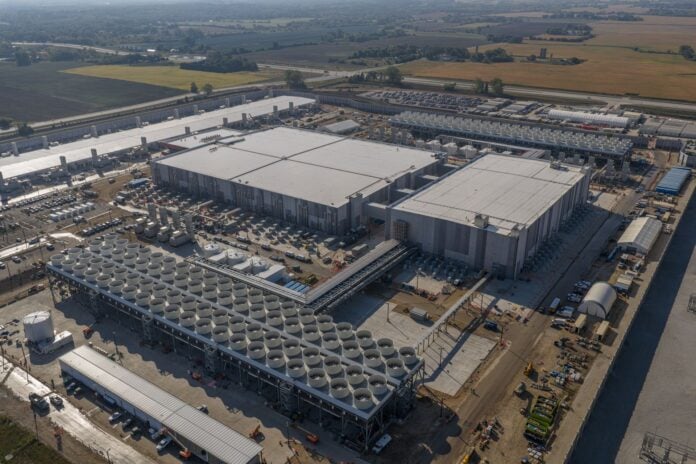
Data centers being built or reconfigured for large language model training, agentic AI workloads and enterprise-scale inference require networking capacity and architecture that many companies do not currently have. Patel described the moment as “the beginning of a multiyear networking super cycle,” echoing the language Cisco used during its August earnings call.
The question for investors is no longer simply whether AI will drive demand for networking equipment. It is how long that demand can persist — and how much of the infrastructure spending cycle Cisco can capture.
Cisco’s order book gives the framing its specificity. The company booked $9.3 billion in AI-related orders for fiscal year 2026, including $4 billion in the fourth quarter alone — a number that arrived with the August 13 earnings beat and has since become the primary reference point for anyone modeling the stock. Q4 revenue reached $17.3 billion, above the $16.82 billion analyst estimate, with non-GAAP earnings of $1.22 per diluted share.
Patel and Patterson also addressed the constraint. The current demand surge is concentrated in hardware — ethernet switches, routers, data center interconnects — which carries lower margins than Cisco’s subscription and software businesses. Patterson framed it as transitional. As AI deployments mature from infrastructure build-out to application integration, the software attach rate improves. The hardware margin headwind, in management’s telling, is the cost of being early to a very large market. Investors have largely accepted that framing; CSCO has gained approximately 46% in 2026, making it one of the stronger performers in the technology sector this year.
Cisco is also integrating the Splunk acquisition — the largest in the company’s history — into its security and observability portfolio. Patel and Patterson said on Tuesday the integration is tracking ahead of schedule, without providing a specific completion timeline. Splunk’s observability capabilities matter for the AI networking thesis: as companies instrument their AI workloads, they generate the kind of real-time telemetry data that Splunk was built to analyze. The combined platform is Cisco’s answer to the question of what comes after the network hardware is installed.
Among Tuesday’s technology peers, Amazon (NASDAQ:AMZN) fell 0.66% and Alphabet (NASDAQ:GOOGL) dropped 1.18% as the Canada tariff impact rippled through large-cap technology. Chevron (NYSE:CVX) rose 0.58% as crude oil climbed, illustrating the day’s sectoral split: companies with commodity tailwinds or non-tariff-sensitive demand gained while the index moved lower. Cisco sat at that dividing line — exposed to the broad market sentiment but shielded by the conference catalyst and the structural demand story Patel outlined.
The 52-week range runs from $66.13 to $130.37. Tuesday’s close at $108.91 sits roughly 37% above the 52-week low and 17% below the peak. The current level reflects both the magnitude of the AI-driven re-rating earlier in 2026 and the market’s uncertainty about whether Cisco can sustain the orders trajectory through fiscal 2027.
Twenty-eight analysts covering CSCO carry a consensus Buy rating, with an average 12-month price target of $137.63, implying approximately 26% upside from Tuesday’s close. Individual targets range from $115 to $170 — a dispersion that reflects genuine disagreement about the pace of software mix improvement and about how much of Cisco’s current AI order momentum represents advance procurement rather than recurring demand.
What remains unresolved is the hardware-to-software transition timeline. The supercycle narrative holds even if margins compress for another quarter or two, provided the order volume translates to sustained revenue and the software attach eventually follows. Whether that sequence plays out over two years or five is the variable separating the $115 price targets from the $170 ones — and Patterson offered no specific guidance on Tuesday to close that gap.